


Survival impact of centralization and clinical guidelines for soft tissue sarcoma (A prospective and exhaustive population-based cohort)
- PMID: 28158190
- PMCID: PMC5291382
- DOI: 10.1371/journal.pone.0158406
Survival impact of centralization and clinical guidelines for soft tissue sarcoma (A prospective and exhaustive population-based cohort)
Abstract
Purpose: The outcome of sarcoma has been suggested in retrospective and non-exhaustive studies to be better through management by a multidisciplinary team of experts and adherence to clinical practice guidelines (CPGs). The aim of this prospective and exhaustive population based study was to confirm the impact of adherence to CPGs on survival in patients with localized sarcoma.
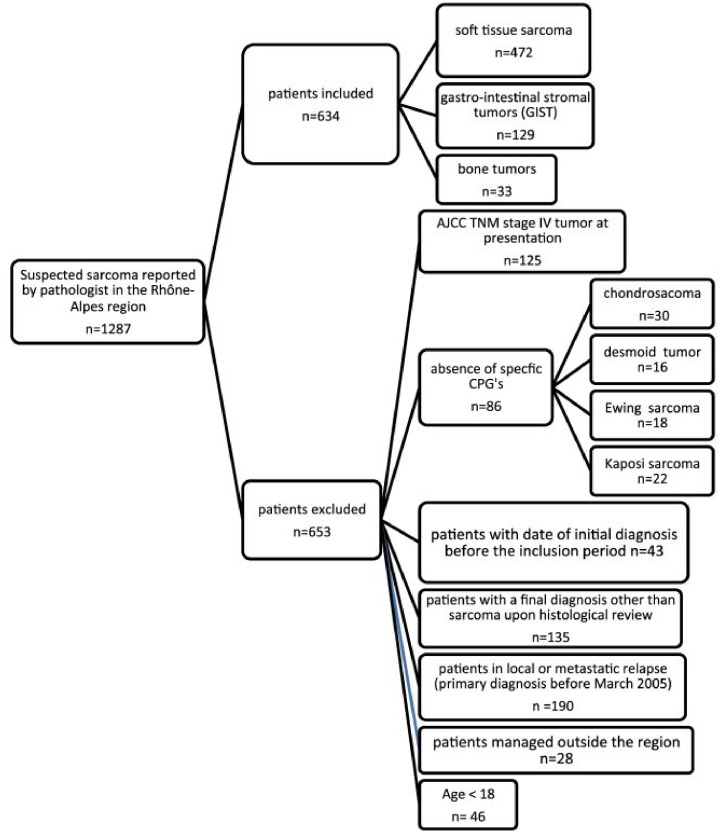
Experimental design: Between 2005 and 2007, all evaluable adult patients with a newly diagnosis of localized sarcoma located in Rhone Alpes region (n = 634), including 472 cases of soft-tissue sarcoma (STS), were enrolled. The prognostic impact of adherence to CPGs on progression-free survival (PFS) and overall survival (OS) was assessed by multivariate Cox model in this cohort.
Results: The median age was 61 years (range 16-92). The most common subtypes were liposarcoma (n = 133, 28%), unclassified sarcoma (n = 98, 20.7%) and leiomyosarcoma (n = 69, 14.6%). In the initial management phase, from diagnosis to adjuvant treatment, the adherence to CPGs for patients with localized STS was 36% overall, corresponding to 56%, 85%, 96% and 84% for initial surgery, radiation therapy, chemotherapy and follow-up, respectively. Adherence to CPGs for surgery was the strongest independent prognostic factor of PFS, along with age, gender, grade, and tumor size. For OS, multivariate analysis adherence to CPGs for surgery was a strong independent prognostic factor, with an important interaction with a management in the regional expert centers.
Conclusions: This study demonstrates impact of CPGs and treatment within an expert center on survival for STS patients in a whole population-based cohort.
Conflict of interest statement
The authors have declared that no competing interests exist.
Figures


References
-
- Grimshaw JM, Russell IT. Effect of clinical guidelines on medical practice: a systematic review of rigorous evaluations. Lancet 1993; 342: 1317–22. - PubMed
-
- Fletcher CDM, Unni KK, Mertens F. World Health Organization Classification of tumours: Pathology and Genetics of tumours of soft tissue and bone, IARC Press, Lyon: 2002.
-
- Ducimetière F, Lurkin A, Ranchère-Vince D, Decouvelaere AV, Cellier D, Gilly FN. Incidence of sarcoma histotypes and molecular subtypes in a prospective epidemiological study with central pathology review and molecular testing. PLoS One 2011; 6: e20294 10.1371/journal.pone.0020294 - DOI - PMC - PubMed
MeSH terms
LinkOut - more resources
Full Text Sources
Other Literature Sources
Medical
