Observational Study
. 2017 Apr 15;64(8):1066-1073.
doi: 10.1093/cid/cix042.

Evaluation of the Clinical and Microbiological Response to Salmonella Paratyphi A Infection in the First Paratyphoid Human Challenge Model

Affiliations
Observational Study

Evaluation of the Clinical and Microbiological Response to Salmonella Paratyphi A Infection in the First Paratyphoid Human Challenge Model

Hazel C Dobinson et al. Clin Infect Dis. .

Abstract

Background: To expedite the evaluation of vaccines against paratyphoid fever, we aimed to develop the first human challenge model of Salmonella enterica serovar Paratyphi A infection.

Methods: Two groups of 20 participants underwent oral challenge with S. Paratyphi A following sodium bicarbonate pretreatment at 1 of 2 dose levels (group 1: 1-5 × 10³ colony-forming units [CFU] and group 2: 0.5-1 × 10³ CFU). Participants were monitored in an outpatient setting with daily clinical review and collection of blood and stool cultures. Antibiotic treatment was started when prespecified diagnostic criteria were met (temperature ≥38°C for ≥12 hours and/or bacteremia) or at day 14 postchallenge.

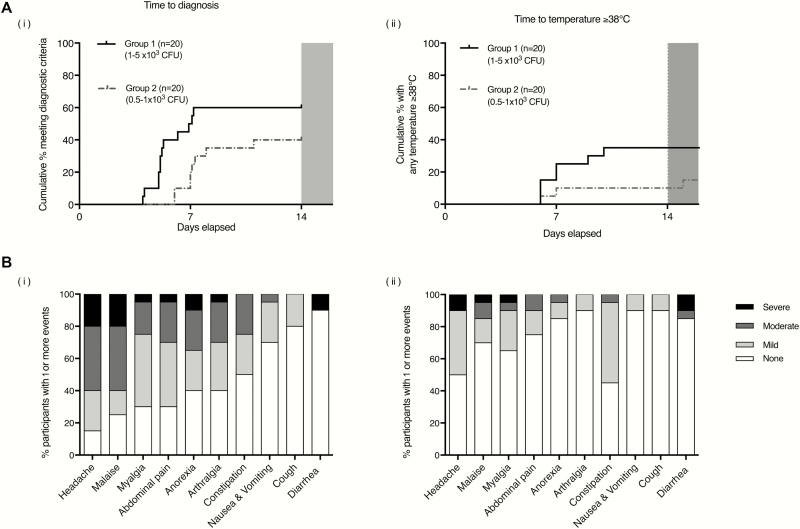
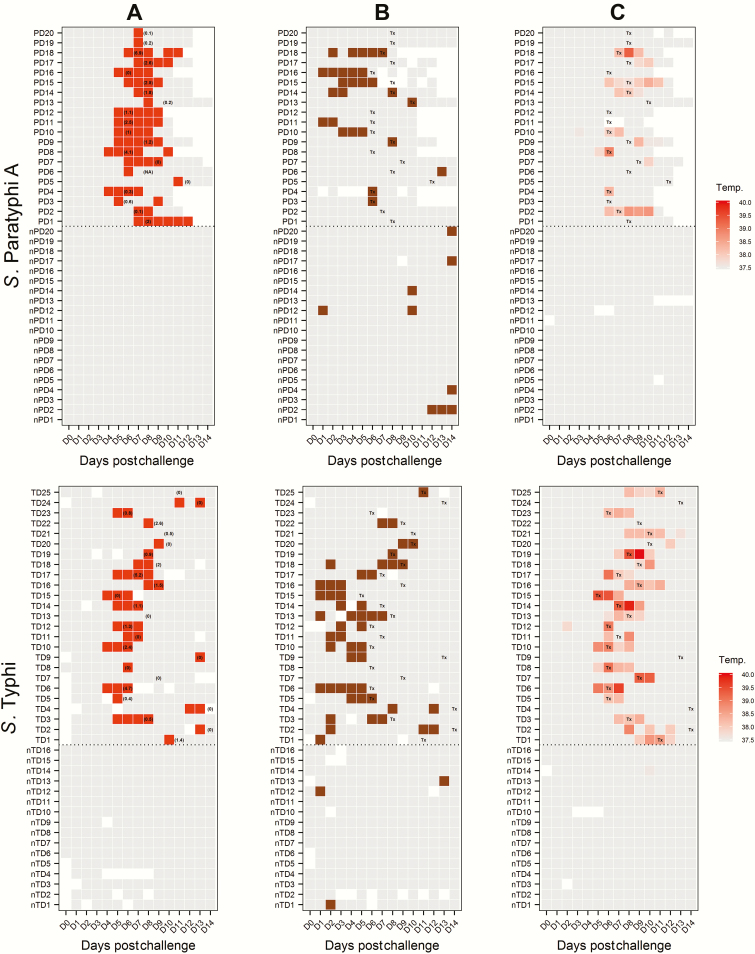
Results: The primary study objective was achieved following challenge with 1-5 × 10³ CFU (group 1), which resulted in an attack rate of 12 of 20 (60%). Compared with typhoid challenge, paratyphoid was notable for high rates of subclinical bacteremia (at this dose, 11/20 [55%]). Despite limited symptoms, bacteremia persisted for up to 96 hours after antibiotic treatment (median duration of bacteremia, 53 hours [interquartile range, 24-85 hours]). Shedding of S. Paratyphi A in stool typically preceded onset of bacteremia.

Conclusions: Challenge with S. Paratyphi A at a dose of 1-5 × 10³ CFU was well tolerated and associated with an acceptable safety profile. The frequency and persistence of bacteremia in the absence of clinical symptoms was notable, and markedly different from that seen in previous typhoid challenge studies. We conclude that the paratyphoid challenge model is suitable for the assessment of vaccine efficacy using endpoints that include bacteremia and/or symptomatology.

Clinical trials registration: NCT02100397.

Keywords: Salmonella enterica paratyphi A; enteric fever; human challenge study; immune responses; paratyphoid infection.


Figures

Figure 1.
Figure 1.
A, Kaplan-Meier plots indicating time to diagnostic endpoints: time to diagnosis (i) and time to first temperature ≥38°C (ii). B, Clinical symptom profiles following Salmonella Paratyphi A challenge. Percentage of participants reporting solicited systemic symptoms on 1 or more days following S. Paratyphi A challenge, recorded using an online diary for 21 days. Stacked columns display percentage of participants reporting maximum symptom severity as mild, moderate, or severe. (i) Individuals meeting prespecified criteria for paratyphoid disease in group 1 and group 2. (ii) Individuals who did not meet prespecified criteria for paratyphoid disease in group 1 and group 2. None, no reported symptoms; mild, present but no limitation of usual activity; moderate, some limitation of daily activity; severe, unable to perform normal daily activity. Abbreviation: CFU, colony-forming units.
Figure 2.
Figure 2.
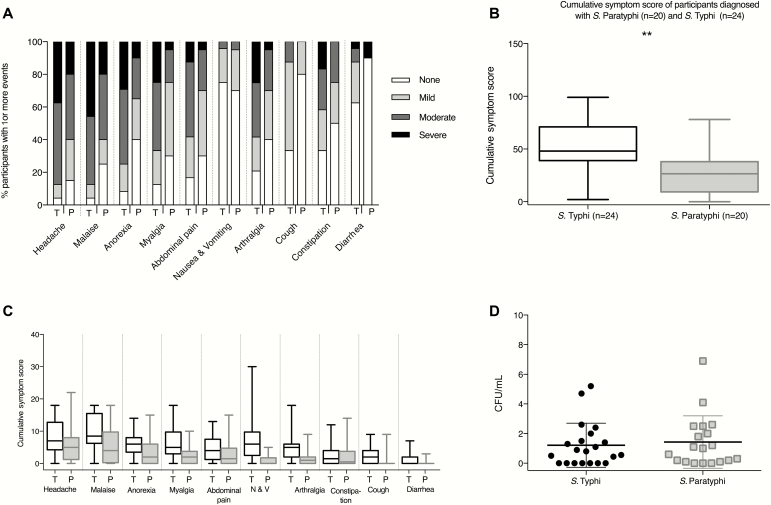
Comparison of the clinical and microbiological response to Salmonella Typhi and Salmonella Paratyphi A challenge. A, Solicited systemic symptoms in individuals with acute typhoid (n = 24) or paratyphoid (n = 20) disease recorded using an online diary (day 0, day of challenge; day 14, final day of treatment initiation). Percentage of participants reporting 1 or more events. Stacked columns display percentage of participants reporting maximum symptom severity as mild (present but no limitation of usual activity), moderate (some limitation of daily activity), or severe (unable to perform normal daily activity). B, Comparison of cumulative symptom severity scores between participants with acute typhoid (n = 24) or paratyphoid (n = 20) disease. Symptom scores were calculated by summing numerical values assigned to the severity of individual symptoms between day 0 and day 14 (0, not present; 1, mild; 2, moderate; 3, severe). Box-and-whisker plots display median, interquartile range, and range. C, Symptom severity scores for specific symptoms, day 0 to day 14. D, Results of quantitative blood cultures collected immediately prior to initiation of antibiotic treatment for participants with typhoid or paratyphoid disease (see Materials and Methods). Abbreviations: CFU, colony-forming units; N & V, nausea and vomiting; P, paratyphoid; T, typhoid.
Figure 3.
Figure 3.
Clinical and microbiological dynamics for participants challenged with Salmonella Typhi and Salmonella Paratyphi A. A, Pattern of blood culture results (red, positive; gray, negative; white, sample not collected). Numbers in parentheses refer to quantitative blood culture colony count (colony-forming units/mL) taken immediately prior to antibiotic treatment and correspond to day of treatment initiation. B, Pattern of stool shedding following challenge. Colored squares indicate stool culture results for S. Paratyphi A or S. Typhi (brown, positive; gray, negative; white, sample not collected). C, Maximum temperature (temp., °C) measurements by day. Abbreviations: day 0, day of challenge; nPD1–20, paratyphoid disease not diagnosed; nTD1–16, typhoid disease not diagnosed; PD1–20, confirmed paratyphoid disease; TD1–25, confirmed typhoid disease; Tx, day of treatment initiation.

References

    1. Arndt MB, Mosites EM, Tian M, et al. Estimating the burden of paratyphoid a in Asia and Africa. PLoS Negl Trop Dis 2014; 8:e2925. - PMC - PubMed
    1. Gunn JS, Marshall JM, Baker S, Dongol S, Charles RC, Ryan ET. Salmonella chronic carriage: epidemiology, diagnosis, and gallbladder persistence. Trends Microbiol 2014; 22:648–55. - PMC - PubMed
    1. McClelland M, Sanderson KE, Clifton SW, et al. Comparison of genome degradation in Paratyphi A and Typhi, human-restricted serovars of Salmonella enterica that cause typhoid. Nat Genet 2004; 36:1268–74. - PubMed
    1. Wahid R, Simon R, Zafar SJ, Levine MM, Sztein MB. Live oral typhoid vaccine Ty21a induces cross-reactive humoral immune responses against Salmonella enterica serovar Paratyphi A and S. Paratyphi B in humans. Clin Vaccine Immunol 2012; 19:825–34. - PMC - PubMed
    1. Levine MM, Ferreccio C, Black RE, Lagos R, San Martin O, Blackwelder WC. Ty21a live oral typhoid vaccine and prevention of paratyphoid fever caused by Salmonella enterica serovar Paratyphi B. Clin Infect Dis 2007; 45(suppl 1:S24–8. - PubMed

Publication types

Associated data