Review
. 2017 Nov 1;9(11):a029470.
doi: 10.1101/cshperspect.a029470.

What Are the Most Powerful Immunogen Design Vaccine Strategies? A Structural Biologist's Perspective

Affiliations
Review

What Are the Most Powerful Immunogen Design Vaccine Strategies? A Structural Biologist's Perspective

Peter D Kwong. Cold Spring Harb Perspect Biol. .

Abstract

The ability of structure-based design to control the shape and reactivity-the atomic-level chemistry-of an immunogen argues for it being one of the "most powerful" immunogen-design strategies. But antigenic reactivity is only one of the properties required to induce a protective immune response. Here, a multidimensional approach is used to exemplify the enabling role atomic-level information can play in the development of immunogens against three viral pathogens, respiratory syncytial virus, influenza A virus, and human immunodeficiency virus (HIV), which have resisted standard approaches to vaccine development. Overall, structure-based strategies incorporating B-cell ontogenies and viral evasion mechanisms appear exceptionally powerful.


Figures

Figure 1.
Figure 1.
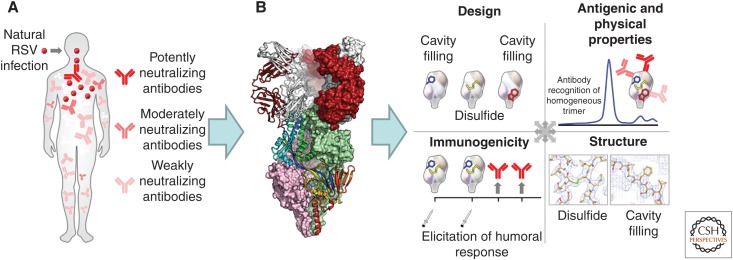
A structure-based paradigm for vaccine development. (A) Natural infection induces a variety of responses. In the first step of structure-based vaccine design, a potently neutralizing and frequently elicited response is selected as a template for vaccine design. (B) The second step involves the structural determination of the selected response, in complex with the eliciting antigen. Shown is the apex-directed antigen-binding fragment of the D25 antibody (white and red) binding to the trimeric RSV-fusion glycoprotein (pink and green surface representation, with one protomer in rainbow-colored ribbon). (C) An information matrix comprising immunogen design, antigenic and physical properties, atomic-level structures, and immunogenicity is used to determine properties that correlate with improved immunogenicity, and these properties are iteratively optimized (Joyce et al. 2016b). (Panel from McLellan et al. 2013a; adapted, with permission, from The American Association for the Advancement of Science © 2013.)
Figure 2.
Figure 2.
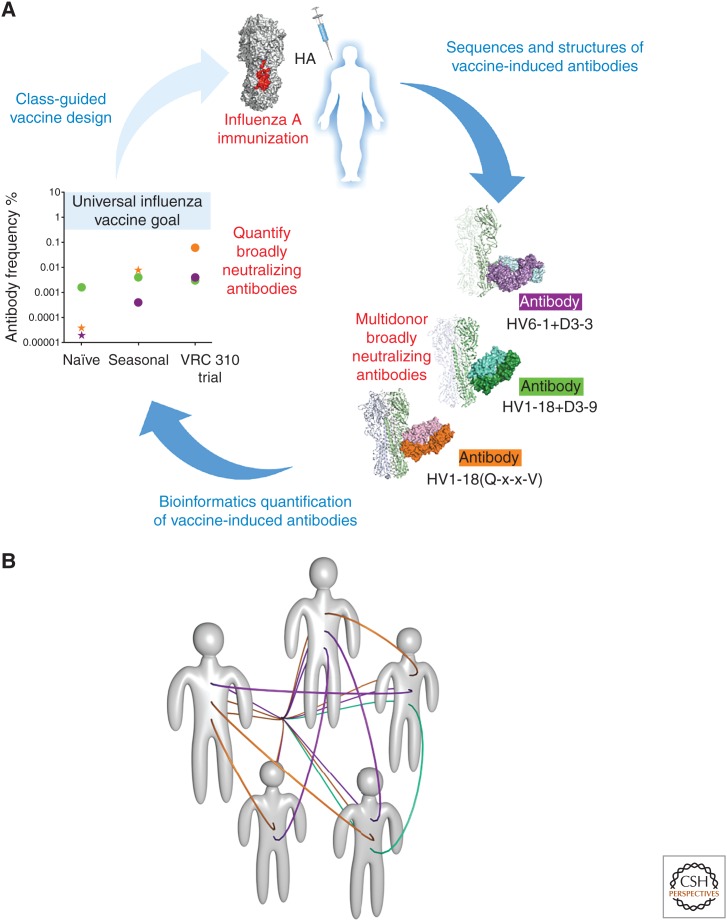
A B-cell ontogeny-based paradigm for vaccine development. (A) Reproducible antibodies, observed in multiple donors, represent vaccine solutions potentially available to the general population. Three multidonor classes of antibody (purple, orange, and green) were identified in subjects from the VRC 310 trial, which involved immunization with a diverse H5 influenza strain. Bioinformatics-delineated sequencing signatures allowed for the quantification of transcripts corresponding to these signatures, which should aid in the class-guided elicitation of these antibodies. (Panel from Joyce et al. 2016a; adapted, with permission, from Elsevier © 2016.) (B) Schematic of five humans with reproducible classes of broadly neutralizing antibodies, as represented by purple, orange, and green lines.
Figure 3.
Figure 3.
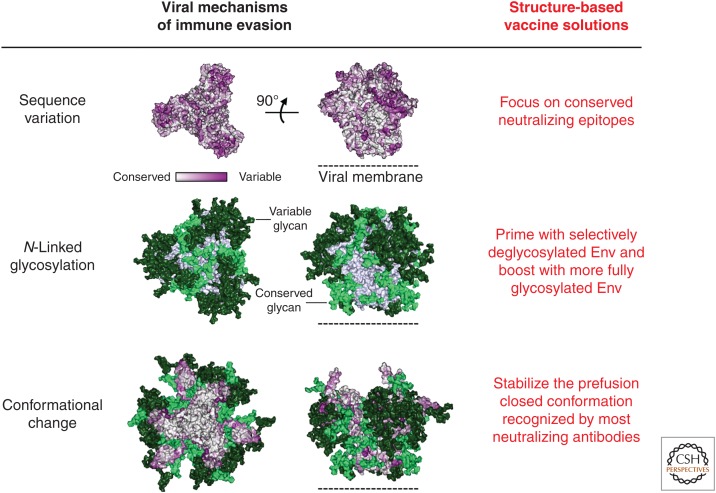
A structure-based mechanistic approach to HIV vaccine development. HIV evades the humoral immune response by Env mechanisms of sequence variation, N-linked glycosylation, and conformational change (left). Solutions to each of the mechanisms of evasion have been identified by structure-based design (right). (Figure from Pancera et al. 2014; adapted, with permission, from Nature Publishing Group © 2014.)
Figure 4.
Figure 4.
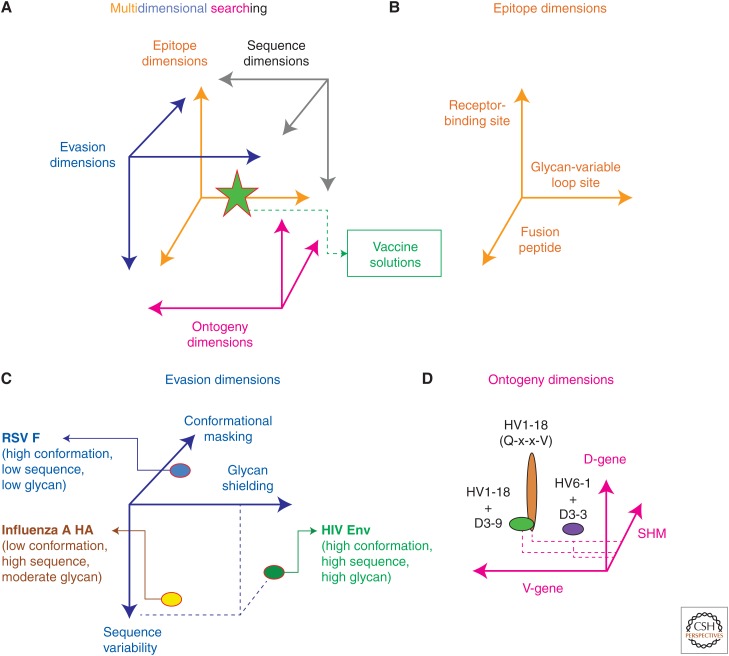
Coordinates of effective vaccines. (A) The search for an effective vaccine may involve multiple dimensions, each of which provide a different representation of the vaccine solution (Nabel 2009). (B) Promising targets for vaccine design include known epitopes of broadly neutralizing antibodies, such as fusion peptide (Kong et al. 2016) or supersites of vulnerability represented by the clusters of epitopes around the receptor-binding site (Zhou et al. 2015) or a glycan-variable loop site (Kong et al. 2013). (C) Searches of evasion dimensions may more efficiently allow for the identification of vaccine roadblocks and their solutions. Evasion mechanisms used by type 1 fusion machines of RSV, influenza A virus, and HIV are shown. (Structure-based solutions to evasion mechanisms for RSV are shown in Fig. 1 and for HIV in Fig. 3.) (D) Ontogeny dimensions comprising immunoglobulin-origin genes and SHM of multidonor-antibody classes represent reproducible vaccine solutions available to the general population (Joyce et al. 2016a), as described in the text and in Figure 2.

References

    1. Alexander DJ, Brown IH. 2000. Recent zoonoses caused by influenza A viruses. Rev Sci Technol 19: 197–225. - PubMed
    1. Beaumont T, Bakker AQ, Yasuda E. 2012. RSV specific binding molecule. U.S. Patent 20120070446 A1.
    1. Bonsignori M, Zhou TQ, Sheng ZZ, Chen L, Gao F, Joyce MG, Ozorowski G, Chuang GY, Schramm CA, Wiehe K, et al. 2016. Maturation pathway from germline to broad HIV-1 neutralizer of a CD4-mimic antibody. Cell 165: 449–463. - PMC - PubMed
    1. Boyd SD, Marshall EL, Merker JD, Maniar JM, Zhang LN, Sahaf B, Jones CD, Simen BB, Hanczaruk B, Nguyen KD, et al. 2009. Measurement and clinical monitoring of human lymphocyte clonality by massively parallel V-D-J pyrosequencing. Sci Transl Med 1: 12ra23. - PMC - PubMed
    1. Briney BS, Willis JR, Crowe JE. 2012. Human peripheral blood antibodies with long HCDR3s are established primarily at original recombination using a limited subset of germline genes. PLoS ONE 7: e36750. - PMC - PubMed

LinkOut - more resources