Review
. 2017 Feb 6;6(1):5.
doi: 10.1186/s40249-016-0229-3.

The influence of innate and adaptative immune responses on the differential clinical outcomes of leprosy

Affiliations
Review

The influence of innate and adaptative immune responses on the differential clinical outcomes of leprosy

Adriana Barbosa de Lima Fonseca et al. Infect Dis Poverty. .

Abstract

Leprosy is a chronic infectious disease caused by Mycobacterium leprae. According to official reports from 121 countries across five WHO regions, there were 213 899 newly diagnosed cases in 2014. Although leprosy affects the skin and peripheral nerves, it can present across a spectrum of clinical and histopathological forms that are strongly influenced by the immune response of the infected individuals. These forms comprise the extremes of tuberculoid leprosy (TT), with a M. leprae-specific Th1, but also a Th17, response that limits M. leprae multiplication, through to lepromatous leprosy (LL), with M. leprae-specific Th2 and T regulatory responses that do not control M. leprae replication but rather allow bacterial dissemination. The interpolar borderline clinical forms present with similar, but less extreme, immune biases. Acute inflammatory episodes, known as leprosy reactions, are complications that may occur before, during or after treatment, and cause further neurological damages that can cause irreversible chronic disabilities. This review discusses the innate and adaptive immune responses, and their interactions, that are known to affect pathogenesis and influence the clinical outcome of leprosy.

Keywords: Clinical presentation; Immune pathogenesis; Immunology; Innate immunity; Leprosy.


Figures
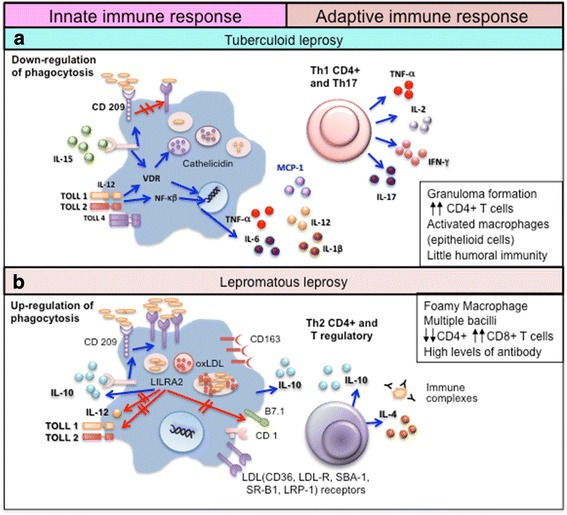
Fig. 1
Fig. 1
Immune response in the polar clinical forms of leprosy. a In tuberculoid leprosy (TT) patients, the innate immune response is activated by M. leprae through toll-like receptors (TLR2/1). IL-15 stimulates the vitamin D-dependent antimicrobial program in macrophages and inhibits phagocytosis of mycobacteria. These events promote a Th1 T-cell cytokine response (IFN-γ, IL-2, TNF, and IL-15) that contains the infection in well-formed granulomas, and a Th17 response (IL-17A, IL-17F, IL-21 and IL-22) that leads to tissue inflammation and destruction, neutrophil recruitment, macrophage activation, and enhancement of Th1 effector cells. b In lepromatous leprosy (LL) patients, IL-4, IL-10, leukocyte immunoglobulin-like receptor subfamily A member 2 (LILRA2), and oxidized phospholipids inhibit TLR2/1-induced cytokine responses but preserve IL-10 release. In addition, immune complexes trigger IL-10 production and increase phagocytosis of M. leprae, ApoB, haptoglobin-hemoglobin complex and oxidized phospholipids by macrophages through the receptors CD209 and CD163, without activating the vitamin D-dependent antimicrobial pathway. The foamy appearance of macrophages is due to the accumulation of lipid droplets (LD) inside these cells. There is an upregulation of perilipin and the adipose differentiation-related protein in the endoplasmic reticulum–Golgi complex with the formation of vesicles containing lipids, phospholipids, cholesterol ester, and cholesterol. Further, there is an increase in both the synthesis of LDL receptors (such as CD36, LDL-R, SBA-1, SR-B1, and LRP-1) and uptake of endogenous cholesterol that accumulates intracellularly. This induces a Th2 and Treg immune profile, with the production of IL-4 and IL-10, antibody production, absence of granulomas, and failure to restrict M. leprae growth [, , , –46]
Fig. 2
Fig. 2
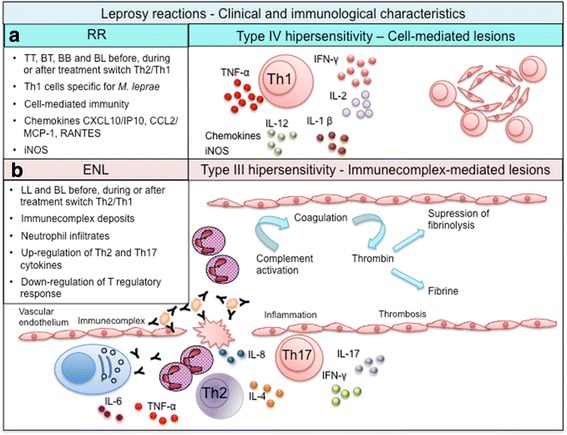
Immunological aspects of leprosy reactions. a RR represents a type IV hypersensitivity reaction. Sudden activation of an inflammatory response to M. leprae antigens, often after the initiation of treatment, triggers a transient conversion from a Th2 toward a Th1 response. The cytokine expression pattern in lesions indicates enhancement of the Th1 response along with activation of the innate response and inflammatory products. b ENL involves high levels of TNF, immune complex-associated vasculitis, and intralesional infiltration of neutrophils, eosinophils, and CD4+ T cells. ENL is initiated by the deposition of immune complexes and activation of complement, triggering elevation of several pro-inflammatory cytokines, neutrophilic infiltrates, and vasculitis [–64, 82, 83]

References

    1. Global leprosy update, 2014: need for early case detection. Wkly Epidemiol Rec. 2015;90:461–74. - PubMed
    1. Bhat RM, Prakash C. Leprosy: an overview of pathophysiology. Interdiscip Perspect Infect Dis. 2012;2012:181089. - PMC - PubMed
    1. Lastoria JC, Abreu MA. Leprosy: review of the epidemiological, clinical, and etiopathogenic aspects—part 1. An Bras Dermatol. 2014;89:205–18. doi: 10.1590/abd1806-4841.20142450. - DOI - PMC - PubMed
    1. Scollard DM, Adams LB, Gillis TP, Krahenbuhl JL, Truman RW, Williams DL. The continuing challenges of leprosy. Clin Microbiol Rev. 2006;19:338–81. doi: 10.1128/CMR.19.2.338-381.2006. - DOI - PMC - PubMed
    1. Bratschi MW, Steinmann P, Wickenden A, Gillis TP. Current knowledge on Mycobacterium leprae transmission: a systematic literature review. Lepr Rev. 2015;86:142–55. - PubMed