The Relationship Between Caffeine, Sleep, and Behavior in Children
- PMID: 28162144
- PMCID: PMC5359329
- DOI: 10.5664/jcsm.6536
The Relationship Between Caffeine, Sleep, and Behavior in Children
Abstract
Study objectives: To examine caffeine consumption from various dietary sources in a cohort of Australian children and the relationship between caffeine consumption, sleep, and daytime behavior.
Methods: Children aged 8 to 12 years and their parents/guardians completed a battery of questionnaires. Children completed a caffeine questionnaire while parents completed questionnaires regarding demographics, sleep, and behavior.
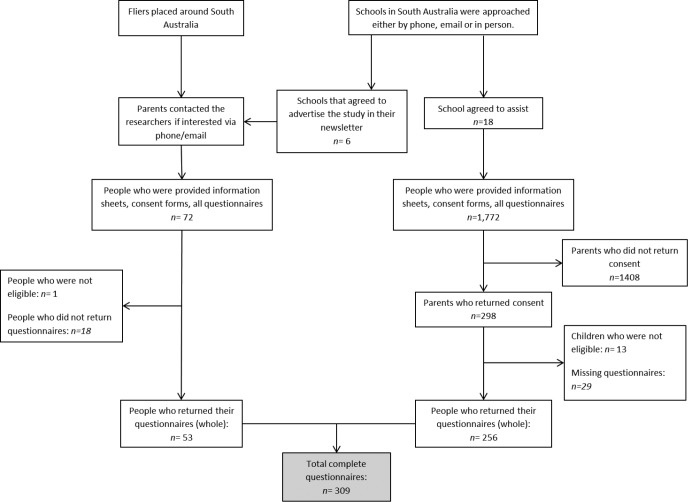
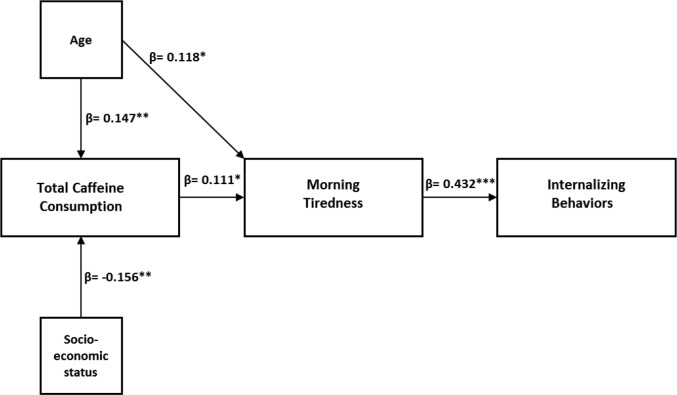
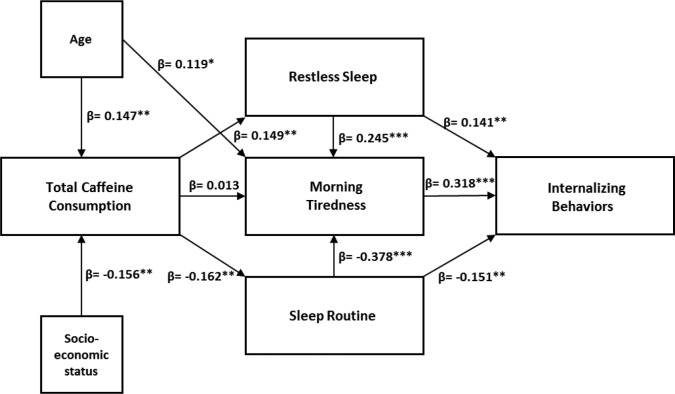
Results: The final sample consisted of 309 children (mean ± standard deviation [SD] age 10.6 ± 1.3 years, male = 48%) and corresponding parent reports. On average a mean ± SD 10.2 ± 17.4 mg/day of caffeine was consumed with a range of zero to 151 mg/day. Of the children who consumed caffeine (87% of the sample), the largest contributor was coffee and tea; making up 41% of total caffeine intake, and sodas (soft drinks) contributed to 40% of caffeine intake. Total caffeine consumption was significantly associated with sleep routine (r = 0.152); morning tiredness (r = 0.129); restless sleep (r = 0.113); and internalizing behavioral problems (r = 0.128). Using path analysis, caffeine consumption was positively associated with morning tiredness (β = 0.111, P = .050) which was positively associated with internalizing behaviors (β = 0.432, P < .001). The addition of sleep routine and restless sleep to the model led to a complete mediation of caffeine consumption on morning tiredness, as well as a partial mediation of the association between morning tiredness and internal behaviors.
Conclusions: In 8- to 12-year-olds the primary sources of caffeine are coffee/tea and sodas. Overall mean caffeine consumption is small by adult standards but has an effect on behavior and sleep in children. The effect on behavior is mediated by disrupted sleep, indicating that caffeine is a contributor to sleep problems and related behavior in children.
Keywords: behavior; caffeine; internalizing behaviors; morning tiredness; path analysis; restless sleep; school-aged children; sleep; sleep routine.
© 2017 American Academy of Sleep Medicine
Figures
References
-
- Bramstedt KA. Caffeine use by children: the quest for enhancement. Subst Use Misuse. 2007;42(8):1237–1251. - PubMed
-
- Warner M. A Jolt of Caffeine, by the Can. New York Times website. [Accessed January 3, 2017]. http://www.nytimes.com/2005/11/23/business/a-jolt-of-caffeine-by-the-can.... Published November 23, 2005.
-
- 2007 Australian National Children's Nutrition and Physical Activity Survey - Main Findings. Australian Government Department of Health website. [Accessed January 3, 2017]. http://www.health.gov.au/internet/main/publishing.nsf/content/phd-nutrit.... Updated 2007.
-
- 4364.0.55.007 - Australian Health Survey: Nutrition First Results - Foods and Nutrients, 2011-12. Australian Bureau of Statistics website. [Accessed January 3, 2017]. http://www.abs.gov.au/ausstats/abs@.nsf/Lookup/4364.0.55.007main+feature.... Published September 5, 2014. Updated December 21, 2015.
-
- Food and Nutrition: Caffeine in Food. Health Canada website. [Accessed January 3, 2017]. http://www.hcsc.gc.ca/fn-an/securit/addit/caf/food-caf-aliments-eng.php. Updated February 16, 2012.
MeSH terms
Substances
LinkOut - more resources
Full Text Sources
Other Literature Sources
Medical