


Research Needs for Effective Transition in Lifelong Care of Congenital Genitourinary Conditions: A Workshop Sponsored by the National Institute of Diabetes and Digestive and Kidney Diseases
- PMID: 28163084
- PMCID: PMC5404938
- DOI: 10.1016/j.urology.2016.12.052
Research Needs for Effective Transition in Lifelong Care of Congenital Genitourinary Conditions: A Workshop Sponsored by the National Institute of Diabetes and Digestive and Kidney Diseases
Abstract
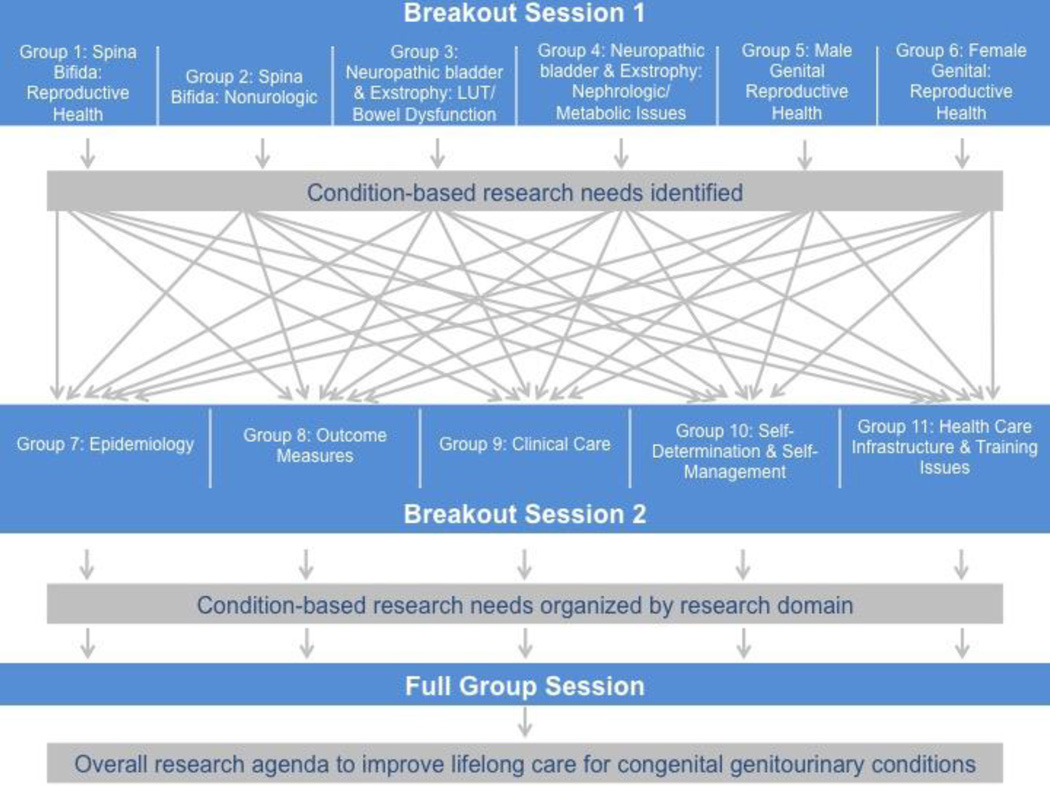
Over the last 5 decades, health-care advances have yielded quantum improvements in the life expectancy of individuals with congenital genitourinary conditions (CGCs), leading to a crisis of care. Many individuals with CGC enter adulthood unprepared to manage their condition. Pediatric CGC specialists lack training to manage adulthood-related health-care issues, whereas adult genitourinary specialists lack training within the context of CGCs. To address these challenges, the National Institutes of Diabetes and Digestive and Kidney Diseases convened individuals with CGCs and experts from a variety of fields to identify research needs to improve transitional urology care. This paper outlines identified research needs.
Copyright © 2017 Elsevier Inc. All rights reserved.
Figures

References
-
- Baird AD. Exstrophy in the adolescent and young adult population. Semin Pediatr Surg. 2011;20:109. - PubMed
-
- Berens JC, Peacock C. Implementation of an academic adult primary care clinic for adolescents and young adults with complex, chronic childhood conditions. J Pediatr Rehabil Med. 2015;8:3. - PubMed
-
- Timberlake MD, Corbett ST, Costabile RA, et al. Identification of adolescent and adult patients receiving pediatric urologic care and establishment of a dedicated transition clinic. J Pediatr Urol. 2015;11:62 e1. - PubMed
-
- Sawin KJ, Betz CL, Linroth R. Gaps and opportunities: an agenda for further research, services, and program development in spina bifida. Pediatr Clin North Am. 2010;57:1041. - PubMed
-
- Cooley WC, Sagerman PJ. American Academy of Pediatrics, American Academy of Family Physicians, American College of Physicians, Transitions Clinical Report Authoring Group. Supporting the health care transition from adolescence to adulthood in the medical home. Pediatrics. 2011;128:182. - PubMed
Publication types
MeSH terms
Grants and funding
LinkOut - more resources
Full Text Sources
Other Literature Sources
