Efficacy of low-level laser therapy in temporomandibular disorders: A systematic review
- PMID: 28163481
- PMCID: PMC5242077
- DOI: 10.4103/0975-5950.196127
Efficacy of low-level laser therapy in temporomandibular disorders: A systematic review
Abstract
Purpose: The aim of this systematic review was to assess the efficacy of low-level laser therapy (LLLT) in patients with temporomandibular disorders (TMDs).
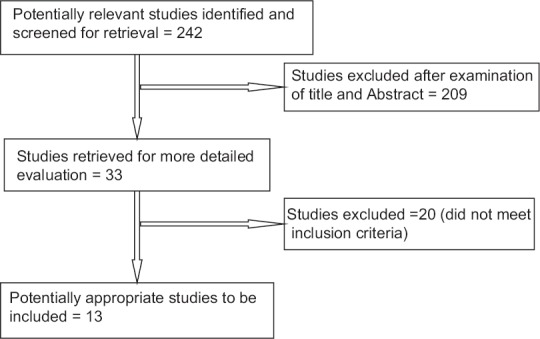
Methods: Medline search was done from 1997 to 2011 using search terms appropriate to establishing a relation between LLLT and TMD. Only randomized controlled trials were included in this study. Outcome variables related to pain, muscle tenderness, mandibular movements, and Electromyographic (EMG) activity were considered. Of the 242 articles examined, 13 were finally included in the critical analysis conducted as a part of the present systematic review.
Results: Of the 242 titles reviewed, only 13 articles were considered eligible. 7 articles showed significant improvement in the study group, whereas 5 showed no significant improvement between the study and control groups. The primary outcome of most of the studies was pain. Other variables considered were muscle tenderness, mandibular movements; EMG activity was considered.
Conclusion: Our results have shown that LLLT seems to be effective in reducing pain in TMD's. It may be a treatment option for patients with an interest in a noninvasive, complementary therapy.
Keywords: Low-level laser therapy; mandibular movements; temporomandibular disorders.
Conflict of interest statement
There are no conflicts of interest.
Figures
References
-
- Dias FJ, Issa JP, Vicentini FT, Fonseca MJ, Leão JC, Siéssere S, et al. Effects of low-level laser therapy on the oxidative metabolism and matrix proteins in the rat masseter muscle. Photomed Laser Surg. 2011;29:677–84. - PubMed
-
- Katsoulis J, Ausfeld-Hafter B, Windecker-Gétaz I, Katsoulis K, Blagojevic N, Mericske-Stern R. Laser acupuncture for myofascial pain of the masticatory muscles. A controlled pilot study. Schweiz Monatsschr Zahnmed. 2010;120:213–25. - PubMed
-
- Carrasco TG, Mazzetto MO, Mazzetto RG, Mestriner W., Jr Low intensity laser therapy in temporomandibular disorder: A phase II double-blind study. Cranio. 2008;26:274–81. - PubMed
-
- Shirani AM, Gutknecht N, Taghizadeh M, Mir M. Low-level laser therapy and myofacial pain dysfunction syndrome: A randomized controlled clinical trial. Lasers Med Sci. 2009;24:715–20. - PubMed
-
- Conti PC. Low level laser therapy in the treatment of temporomandibular disorders (TMD): A double-blind pilot study. Cranio. 1997;15:144–9. - PubMed
LinkOut - more resources
Full Text Sources
Other Literature Sources