Review
. 2017 Feb 6;7(1):20160094.
doi: 10.1098/rsfs.2016.0094.

Touchdown to take-off: at the interface of flight and surface locomotion

Affiliations
Review

Touchdown to take-off: at the interface of flight and surface locomotion

William R T Roderick et al. Interface Focus. .

Abstract

Small aerial robots are limited to short mission times because aerodynamic and energy conversion efficiency diminish with scale. One way to extend mission times is to perch, as biological flyers do. Beyond perching, small robot flyers benefit from manoeuvring on surfaces for a diverse set of tasks, including exploration, inspection and collection of samples. These opportunities have prompted an interest in bimodal aerial and surface locomotion on both engineered and natural surfaces. To accomplish such novel robot behaviours, recent efforts have included advancing our understanding of the aerodynamics of surface approach and take-off, the contact dynamics of perching and attachment and making surface locomotion more efficient and robust. While current aerial robots show promise, flying animals, including insects, bats and birds, far surpass them in versatility, reliability and robustness. The maximal size of both perching animals and robots is limited by scaling laws for both adhesion and claw-based surface attachment. Biomechanists can use the current variety of specialized robots as inspiration for probing unknown aspects of bimodal animal locomotion. Similarly, the pitch-up landing manoeuvres and surface attachment techniques of animals can offer an evolutionary design guide for developing robots that perch on more diverse and complex surfaces.

Keywords: bimodal; bioinspired; biomimetics; flight; locomotion; surface.


Figures
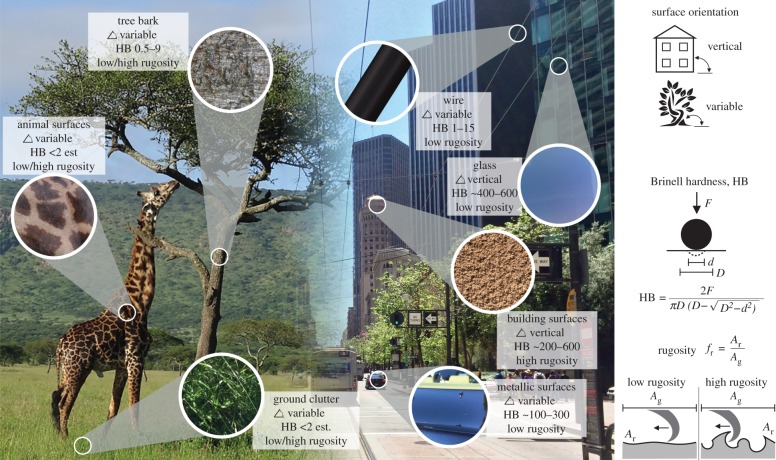
Figure 1.
Figure 1.
An overview of the range of engineered and natural surfaces that flying animals and robots can encounter for landing, locomotion and take-off. The target surfaces include cables, building walls and windows, the metallic surfaces of cars, the bark of tree trunks and branches, animal skin and ground vegetation. Engineered surfaces typically have regular surface angles, high surface hardness and low roughness. Natural surfaces typically have irregular surface angles, relatively low surface hardness and high roughness. Accordingly, each surface is labelled with the surface name, range of typical surface orientations, approximate surface hardness using the Brinell hardness scale, and a classification of the approximate surface rugosity. The surface orientation determines the range of angles at which an animal or robot can approach and perch on a landing target. The Brinell hardness, HB, determines the ability of a claw to grip onto the surface by deforming it. Surface rugosity is a measure of the surface roughness that determines the ability of a claw to grip onto the surface without indentation. It is quantified by the ratio of the three-dimensional surface area to the two-dimensional projected surface area with respect to the characteristic (average) normal direction of the three-dimensional surface. Brinell hardness values from: [–37]. (Left background photograph: courtesy of Monica Bond.)
Figure 2.
Figure 2.
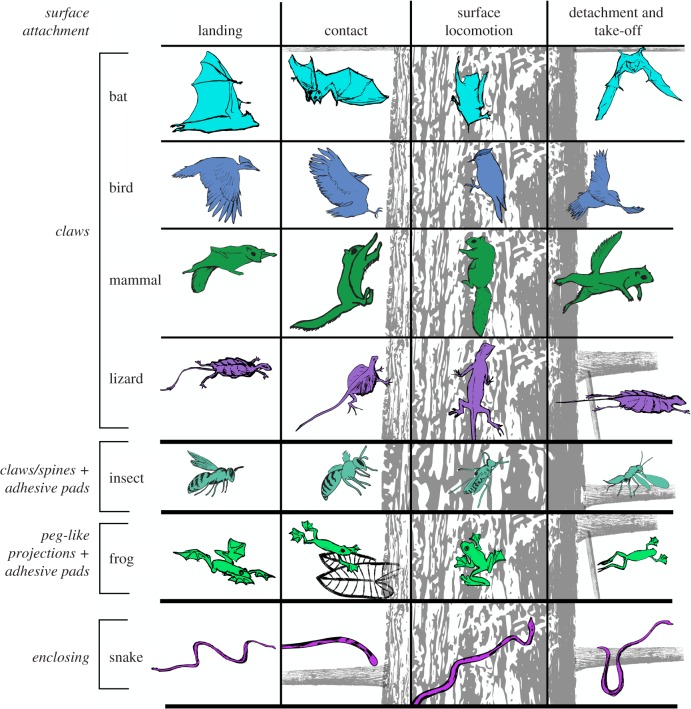
Biological solutions for landing, locomotion and take-off on highly irregular surfaces are diverse and depend on scale and flight adaptation. Powered flyers, shown in blue and teal colours, are able to use their wings to control their landing location with high precision while gliders, shown in purple and green colours, must land reliably at relatively higher velocities. Most animals pitch up to land on vertical surfaces, although bats are unusual in that they frequently invert to land upside-down. Larger animals predominantly use claws for attachment on vertical surfaces. Smaller animals typically use a combination of spines and adhesive pads. Frogs are unusual in that they typically land on leaves and stick to these smooth surfaces with wet adhesion. The flexibility of leaves dampens their impact. Flying snakes are also highly specialized and perch by wrapping their body around a landing branch. These animals all benefit from many joints that enable their bodies to adapt, comply and absorb energy upon landing. For take-off, most animals push-off from the surface with their legs or bodies. By contrast, bats usually hang upside-down and simply initiate their flight by dropping. (Animal drawings: Margarethe Roderick.)
Figure 3.
Figure 3.
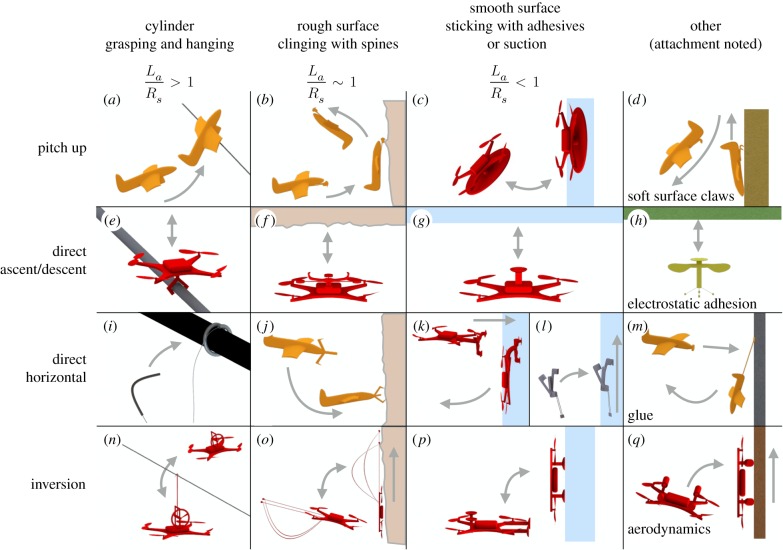
Existing robots that can land on, locomote around and take off from simple structured surfaces. The robots are organized by their aerial approach manoeuvre (vertical) and their surface attachment technique (horizontal). The aerial manoeuvres include pitch-up, direct ascent or descent, direct horizontal approach and inversion. Each manoeuvre has a specific required situational awareness, control and force sustained by the attachment mechanism. The different platforms are also organized by their ability to land from hovering: rotary robots in red, flapping robots in yellow, fixed wing robots in orange (other platforms in grey). A diverse set of approaches have been demonstrated to work for different structured surfaces, which include: cylinder grasping and hanging with La/Ls > 1, rough surface clinging using claws or spines with La/Ls ∼ 1, and smooth surface sticking using adhesives or suction with La/Ls < 1. Other specialized attachment techniques for specific surfaces include claws for soft surfaces, electrostatic adhesion, glue, as well as aerodynamic suction. The corresponding specific locomotion and take-off solutions depend on the aerial approach and attachment mechanism selected. These constraints limit the bimodal locomotion ability of these robots in specific ways, unlike the more generalist and flexible solutions found in nature. Models based on: [,,,,–,–,–147].
Figure 4.
Figure 4.
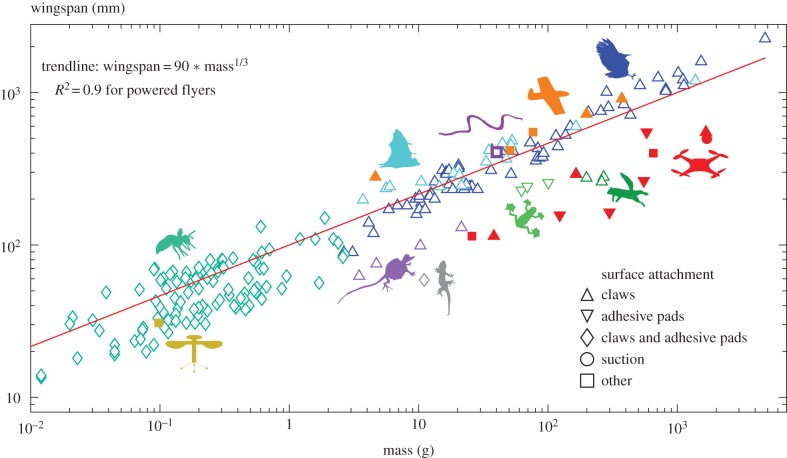
Surface attachment solutions in animals and robots as a function of wingspan versus mass. Animal groups (open symbols) and aerial robots (filled symbols) are distinguished by colour, while attachment mechanism is distinguished by symbol shape. The trend line shows the utility of scaling to explain the cubic variation in mass with wingspan, which has profound implications for the structural and aerodynamic constraints on animals and robots. The plot also shows how the preferred attachment solution depends on scale accordingly. A great divide in attachment strategy exists between insects and vertebrates, which corresponds with the differences in skeletal structure. The reason adhesive pads did not evolve in larger animals is unclear at present, though this divide may stem from the relatively greater utility of claws for larger fliers. The robot data suggest that the customization of robots for specific applications, attachment strategies and surfaces has allowed them to be more variable in size and mass. The definition of wingspan is as follows: for flapping and fixed wing flyers it is the tip to tip distance, for rotorcraft it is the distance between the outer rotors, for lizards, snakes and amphibians it is the width between the outermost positions of their appendages. Data were listed or estimated from [,,,,,–185] and given by Jim McGuire for the Draco lizards. (Animal drawings: Margarethe Roderick.)
Figure 5.
Figure 5.
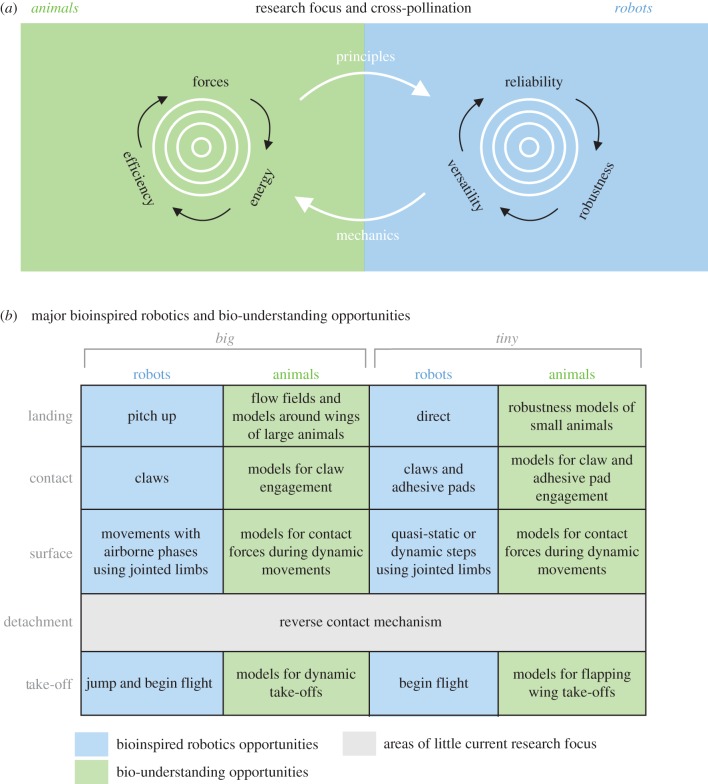
Future directions for bimodal locomotion research. (a) Current comparative biomechanics focus and bioinspired robot design paradigms. In comparative biomechanics, researchers focus on relatively simple behaviours to measure the forces animals generate and how much energy this costs to determine the overall efficiency of the locomotion apparatus, for which they use engineering mechanics and instruments (indicated by the white arrow labelled ‘mechanics’). In bioinspired robotics, researchers can readily measure forces, energy, and efficiency and aim for improving reliability, robustness and versatility inspired by biological principles (indicated by the white arrow labelled ‘principles’). (b) Overview of particularly promising opportunities for advancing bioinspired robotics (blue) and bio-understanding based on comparative biomechanics (green). The importance of scale is underscored by how tiny versus big animals converged on different attachment solutions (figure 4), and must thus be considered explicitly in comparative biomechanical research and robotic implementation of bimodal locomotion principles. We note that robots can serve as informative platforms for dissecting the physical constraints that shaped these solutions and can be used to test evolutionary hypotheses.

References

    1. Alexander DE, Vogel S. 2004. Nature‘s flyers: birds, insects, and the biomechanics of flight Baltimore, MD: JHU Press.
    1. Crutsinger GM, Short J, Sollenberger R. 2016. The future of UAVs in ecology: an insider perspective from the Silicon Valley drone industry. J. Unmanned Veh. Syst. 4, 161–168. (10.1139/juvs-2016-0008) - DOI
    1. Bertin JJ, Cummings RM. 2014. Aerodynamics for engineers, 6th edn New York City, NY: Pearson.
    1. Tennekes H. 1997. The simple science of flight from insects to jumbo jets. Cambridge, MA: MIT Press.
    1. Leishman GJ. 2007. Principles of helicopter aerodynamics. Cambridge, UK: Cambridge University Press.