


Prognostic values of blood pH and lactate levels in patients resuscitated from out-of-hospital cardiac arrest
- PMID: 28163922
- PMCID: PMC5256427
- DOI: 10.1002/ams2.217
Prognostic values of blood pH and lactate levels in patients resuscitated from out-of-hospital cardiac arrest
Abstract
Aim: Early prediction of prognosis after out-of-hospital cardiac arrest (OHCA) remains difficult. High blood lactate or low pH levels may be associated with poor prognosis in OHCA patients, but these associations remain controversial. We compared blood lactate and pH levels in OHCA patients transferred to our hospital to measure their prognostic performance.
Methods: We investigated the associations between blood lactate and pH levels on admission and neurological outcomes in 372 OHCA patients who had a return of spontaneous circulation.
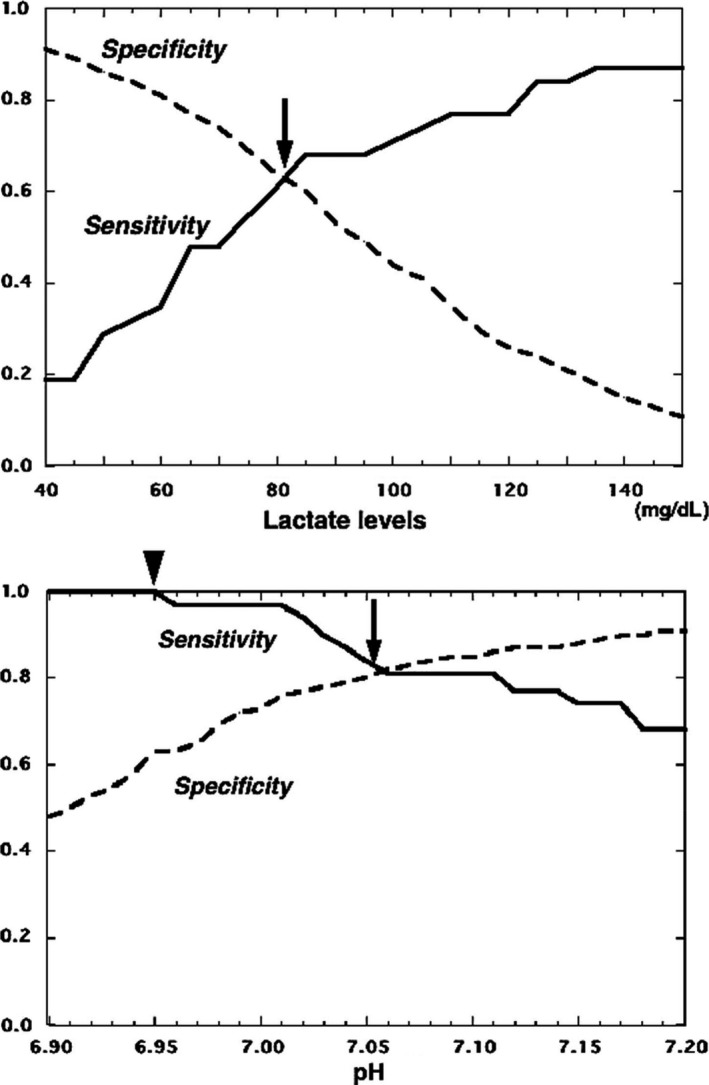
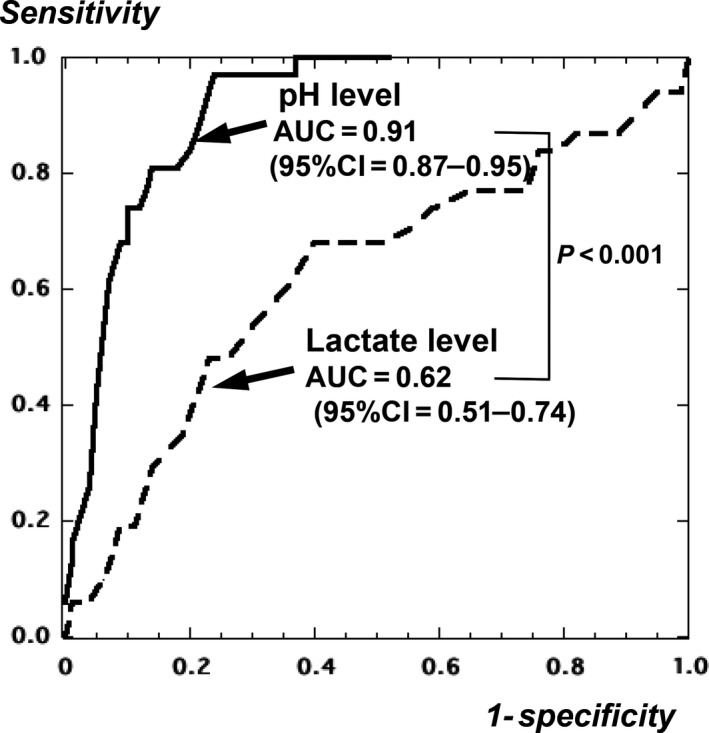
Results: Of the 372 OHCA patients, 31 had a favorable neurological outcome. Blood lactate levels were lower in patients with a favorable outcome than in those with an unfavorable outcome, but this difference did not reach statistical significance (82 ± 49 vs. 96 ± 41 mg/dL). However, pH levels were significantly higher in patients with a favorable outcome than in those with an unfavorable outcome (7.26 ± 0.16 vs. 6.93 ± 0.19, P < 0.001). The relative cumulative frequency distribution curve analysis showed the optimal cut-off points of lactate and pH to be approximately 80 mg/dL and 7.05, respectively. Sensitivity and specificity to predict a favorable outcome were 61% and 64% for lactate <80 mg/dL and 84% and 80% for pH >7.05, respectively. Areas under receiver-operating characteristic curves were significantly larger for pH than for lactate levels (P < 0.001). In multivariate analysis, pH >7.05 was an independent predictor for a favorable outcome.
Conclusion: After OHCA, patients with a favorable outcome had lower lactate and higher pH levels than those with an unfavorable outcome, but pH level was a much better predictor for neurological outcome than lactate levels.
Keywords: Blood pH; lactate; out‐of‐hospital cardiac arrest; predictors; prognosis.
Figures
References
-
- Adielsson A, Hollenberg J, Karlsson T et al Increase in survival and bystander CPR in out‐of‐hospital shockable arrhythmia: bystander CPR and female gender are predictors of improved outcome. Heart 2011; 97: 1391–6. - PubMed
-
- Blom MT, Beesems SG, Homma PCM et al Improved survival after out‐of‐hospital cardiac arrest and use of automated external defibrillators. Circulation 2014; 130: 1868–75. - PubMed
-
- Iwami T, Nichol G, Hiraide A et al Continuous improvements in “chain of survival” increased survival after out‐of‐hospital cardiac arrests. Circulation 2009; 119: 728–34. - PubMed
-
- Kitamura T, Iwami T, Kawamura T et al Nationwide improvements in survival from out‐of‐hospital cardiac arrest in Japan. Circulation 2012; 126: 2834–43. - PubMed
-
- Mullner M, Sterz F, Domanovits H, Behringer W, Binder M, Laggner AN. The association between blood lactate concentraton on admission, duration of cardiac arrest, and functional neurological recovery in patients with resuscitated from ventricular fibrillation. Intensive Care Med. 1997; 23: 1138–43. - PubMed
LinkOut - more resources
Full Text Sources
Other Literature Sources
