. 2017 Feb 6:7:41732.
doi: 10.1038/srep41732.

Structural and magnetic properties of core-shell Au/Fe3O4 nanoparticles

Affiliations

Structural and magnetic properties of core-shell Au/Fe3O4 nanoparticles

L León Félix et al. Sci Rep. .

Abstract

We present a systematic study of core-shell Au/Fe3O4 nanoparticles produced by thermal decomposition under mild conditions. The morphology and crystal structure of the nanoparticles revealed the presence of Au core of d = (6.9 ± 1.0) nm surrounded by Fe3O4 shell with a thickness of ~3.5 nm, epitaxially grown onto the Au core surface. The Au/Fe3O4 core-shell structure was demonstrated by high angle annular dark field scanning transmission electron microscopy analysis. The magnetite shell grown on top of the Au nanoparticle displayed a thermal blocking state at temperatures below TB = 59 K and a relaxed state well above TB. Remarkably, an exchange bias effect was observed when cooling down the samples below room temperature under an external magnetic field. Moreover, the exchange bias field (HEX) started to appear at T~40 K and its value increased by decreasing the temperature. This effect has been assigned to the interaction of spins located in the magnetically disordered regions (in the inner and outer surface of the Fe3O4 shell) and spins located in the ordered region of the Fe3O4 shell.


Conflict of interest statement

The authors declare no competing financial interests.

Figures
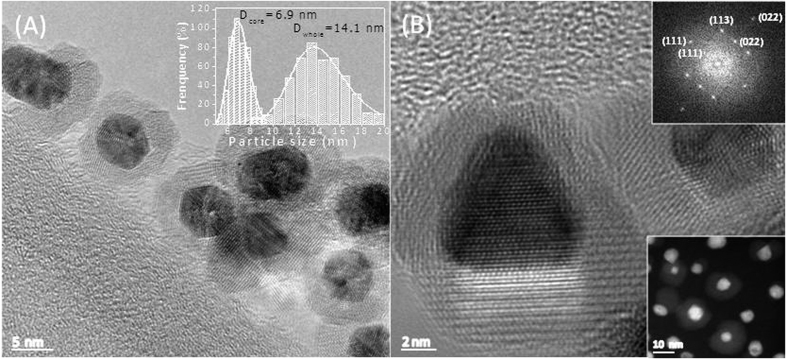
Figure 1
Figure 1
(A) TEM image of the Au/Fe3O4 CSNPs showing the successful formation of core-shell structure. In the inset it is shown the histogram of particle size mounted as described in the text. The solid lines represent the lognormal functions. (B) The HRTEM image of the NPs with its correspondent FFT at the top inset. In the low inset the HAADF-STEM image of the Au/Fe3O4 NPs is shown.
Figure 2
Figure 2
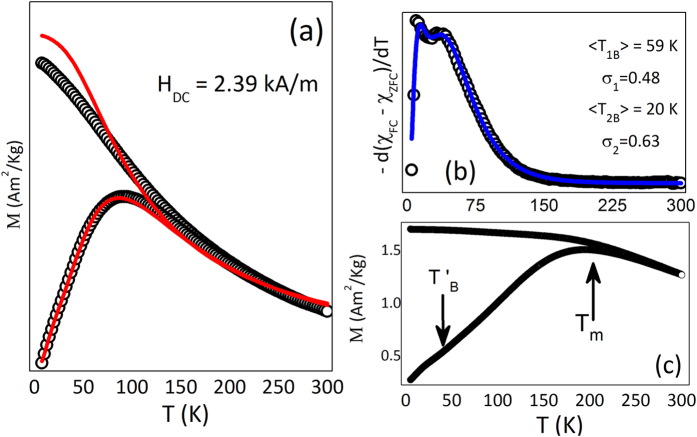
(a) ZFC – FC magnetization curves (H = 2.39 kA/m) of Au/Fe3O4 CSNPs (ferrofluid sample). (b) −d(χFC − χZFC)/dT as a function of the temperature. The solid line represents the lognormal function as a function of the temperature used to fit the data. (c) ZFC – FC traces obtained for the dried sample.
Figure 3
Figure 3
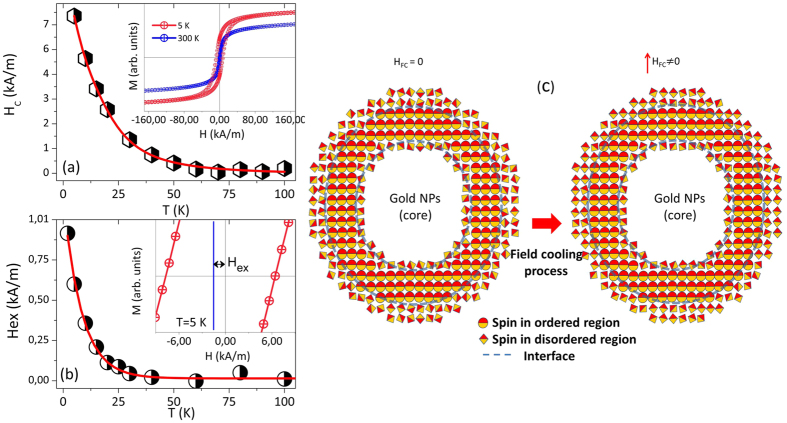
(a) Temperature dependence of the coercive field of the Au/Fe3O4 CSNPs fluid sample. Here, the temperature dependence of the coercivity was fitted for using the generalized model that proposes a temperature dependence of blocking temperature due to the coexistence of blocked and unblocked particles. The inset shows the hysteresis loops of the core-shell Au/Fe3O4 NPs obtained at 5 K and 300 K. (b) The exchanged bias field as a function of temperature obtained after a FC process with a field of 2 T. The inset illustrates the magnetization hysteresis loop shift at 5 K. (c) Schematic representations of the different magnetic regions in a particle and the effect produced by the cooling in a magnetic field.
Figure 4
Figure 4
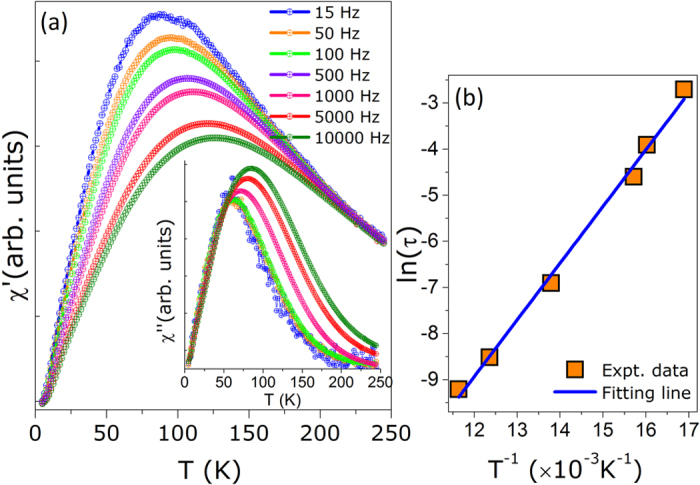
(a) In-phase component of the ac susceptibility, χ′(T), as a function of the temperature obtained by varying the excitation frequency and with an oscillating field of 5 Oe field for the ferrofluid sample containing Au/Fe3O4 CSNPs. The inset shows the out-of-phase component, χ′′(T)vs.T. (b) The relaxation time as a function of the inverse of the maximum (Tm) determined from the χ′(T)vs.T curve. The solid line is the fit to Néel-Arrhenius relation.

References

    1. Tuo Y. et al.. Microbial synthesis of Pd/Fe3O4, Au/Fe3O4 and PdAu/Fe3O4 nanocomposites for catalytic reduction of nitroaromatic compounds. Sci. Rep. 5, 13515 (2015). - PMC - PubMed
    1. Chen D., Li Ch., Liu H., Ye F. & Yang J. Core-shell Au@Pd nanoparticles with enhanced catalytic activity for oxygen reduction reaction via core-shell Au@Ag/Pd constructions. Sci. Rep. 5, 11949 (2015). - PMC - PubMed
    1. Li X. et al.. Synthesis of bi-phase dispersible core-shell FeAu@ZnO magneto-opto-fluorescent nanoparticles. Sci. Rep. 5, 16384 (2015) - PMC - PubMed
    1. Leung K. et al.. Gold and iron oxide hybrid nanocomposite materials. Chem. Soc. Rev. 41, 1911–1928 (2012). - PubMed
    1. Umut E. et al.. Magnetic, optical and relaxometric properties of organically coated gold-magnetic (Au-Fe3O4) hybrid nanoparticles for potential use in biomedical applications. J. Magn. Magn. Mater. 324, 2373(2012).

Publication types

LinkOut - more resources