Review
. 2017 Feb 4;5(1):5.
doi: 10.3390/vaccines5010005.

Human T Cell Memory: A Dynamic View

Affiliations
Review

Human T Cell Memory: A Dynamic View

Derek C Macallan et al. Vaccines (Basel). .

Abstract

Long-term T cell-mediated protection depends upon the formation of a pool of memory cells to protect against future pathogen challenge. In this review we argue that looking at T cell memory from a dynamic viewpoint can help in understanding how memory populations are maintained following pathogen exposure or vaccination. For example, a dynamic view resolves the apparent paradox between the relatively short lifespans of individual memory cells and very long-lived immunological memory by focussing on the persistence of clonal populations, rather than individual cells. Clonal survival is achieved by balancing proliferation, death and differentiation rates within and between identifiable phenotypic pools; such pools correspond broadly to sequential stages in the linear differentiation pathway. Each pool has its own characteristic kinetics, but only when considered as a population; single cells exhibit considerable heterogeneity. In humans, we tend to concentrate on circulating cells, but memory T cells in non-lymphoid tissues and bone marrow are increasingly recognised as critical for immune defence; their kinetics, however, remain largely unexplored. Considering vaccination from this viewpoint shifts the focus from the size of the primary response to the survival of the clone and enables identification of critical system pinch-points and opportunities to improve vaccine efficacy.

Keywords: dynamics; immune memory; kinetics; proliferation; survival; turnover; vaccination; vaccine.


Conflict of interest statement

The authors declare no conflict of interest.

Figures

Figure 1
Figure 1
Contrasting ways to store memories—the archive and the story teller. On the left, the Library at Trinity College Dublin (Photo by DAVID ILIFF. License: CC-BY-SA 3.0); the right-hand frame shows a traditional story-teller or Griot, describing, perhaps, what to do on encountering cognate antigen (Photograph: Bushmen, N. R. Farbman for Life magazine, 1946; http://images.google.com/hosted/life/6da6b5c69e36d1ff.html; © Time Inc).
Figure 2
Figure 2
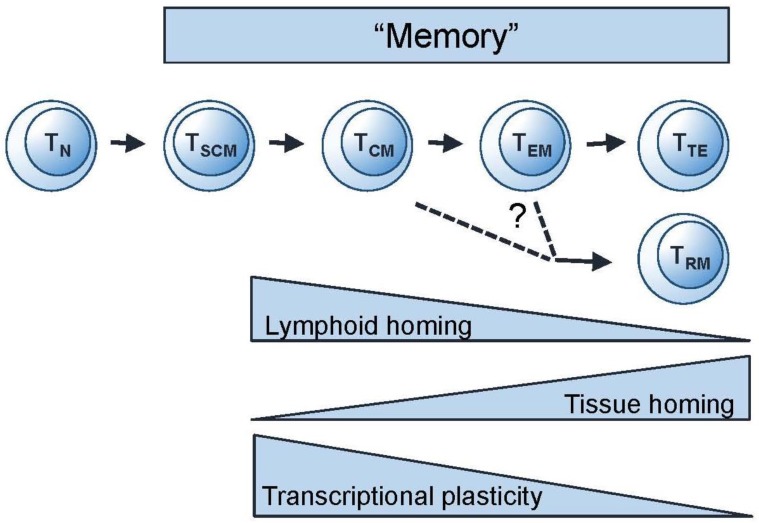
Linear differentiation model for T cells. Model for successive development of stem cell memory (TSCM), central memory (TCM), effector memory (TEM), and terminal effector memory (TTE) from naive (TN) T cells. The origin of TRM is not yet fully clarified (see reference [29]). Adapted from Mahnke et al., 2013 [30] and Youngblood et al., 2015 [31].
Figure 3
Figure 3
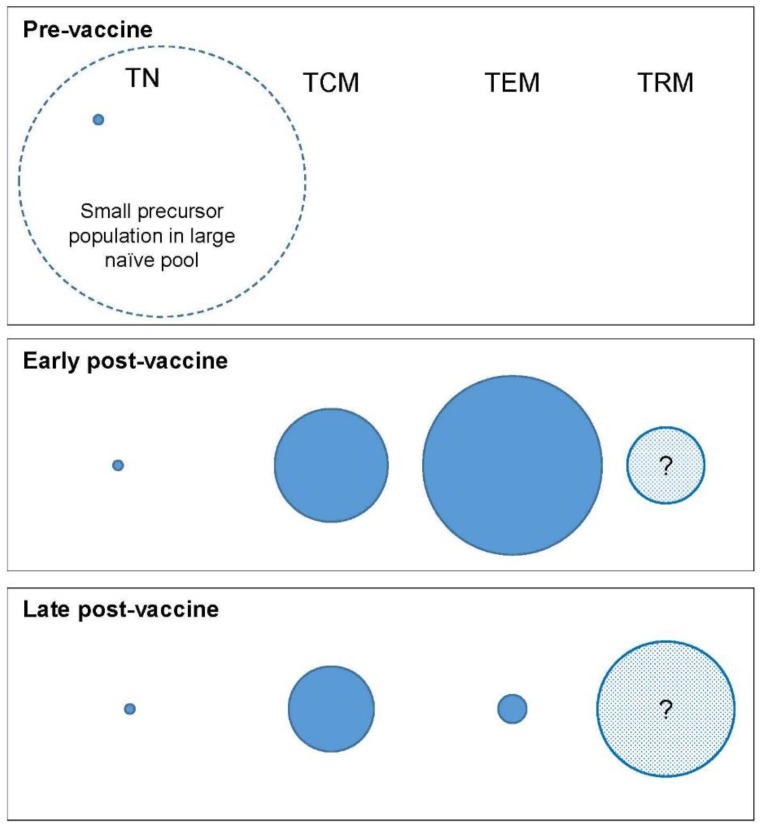
Compartment modelling in a vaccine response. Hypothetical simplified model of changes in compartment size following vaccination. The size of the circle represents schematically the relative number of cells of the corresponding phenotype—nave (TN), central memory (TCM), effector memory (TEM), and tissue-resident memory (TRM).
Figure 4
Figure 4
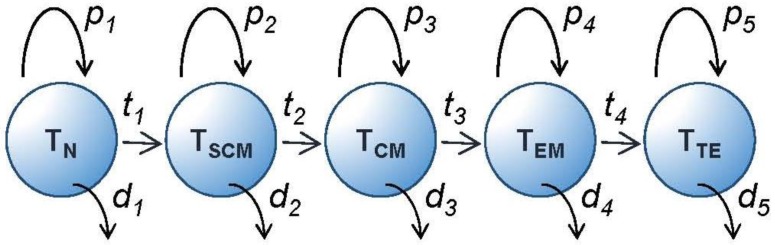
Kinetic model for T cell differentiation. Model of T cell memory population homeostasis. Circles represent phenotypically defined populations. Each population has a rate of intrinsic proliferation (p), a rate of transition to the next pool (t), and a rate of death (d). At equilibrium, all fluxes are in balance. Pool sizes are determined by the relative values of p, d and t. TRM and other populations are not shown for simplicity in this diagram.

References

    1. Gotuzzo E., Yactayo S., Cordova E. Efficacy and duration of immunity after yellow fever vaccination: Systematic review on the need for a booster every 10 years. Am. J. Trop. Med. Hyg. 2013;89:434–444. doi: 10.4269/ajtmh.13-0264. - DOI - PMC - PubMed
    1. Fisman D.N., Savage R., Gubbay J., Achonu C., Akwar H., Farrell D.J., Crowcroft N.S., Jackson P. Older age and a reduced likelihood of 2009 H1N1 virus infection. N. Engl. J. Med. 2009;361:2000–2001. doi: 10.1056/NEJMc0907256. - DOI - PubMed
    1. Xu R., Ekiert D.C., Krause J.C., Hai R., Crowe J.E., Jr., Wilson I.A. Structural basis of preexisting immunity to the 2009 H1N1 pandemic influenza virus. Science. 2010;328:357–360. doi: 10.1126/science.1186430. - DOI - PMC - PubMed
    1. Hammarlund E., Lewis M.W., Hansen S.G., Strelow L.I., Nelson J.A., Sexton G.J., Hanifin J.M., Slifka M.K. Duration of antiviral immunity after smallpox vaccination. Nat. Med. 2003;9:1131–1137. doi: 10.1038/nm917. - DOI - PubMed
    1. Crotty S., Felgner P., Davies H., Glidewell J., Villarreal L., Ahmed R. Cutting edge: Long-term B cell memory in humans after smallpox vaccination. J. Immunol. 2003;171:4969–4973. doi: 10.4049/jimmunol.171.10.4969. - DOI - PubMed