


Dense genotyping of immune-related loci implicates host responses to microbial exposure in Behçet's disease susceptibility
- PMID: 28166214
- PMCID: PMC5369770
- DOI: 10.1038/ng.3786
Dense genotyping of immune-related loci implicates host responses to microbial exposure in Behçet's disease susceptibility
Abstract
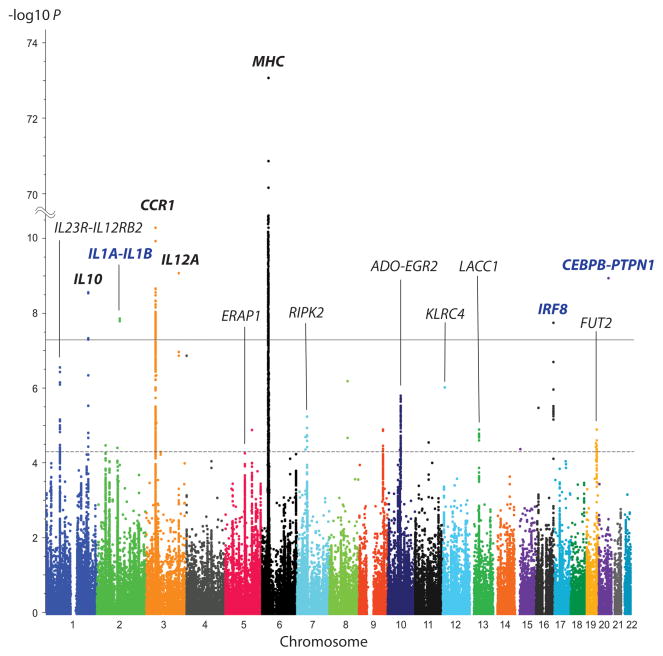
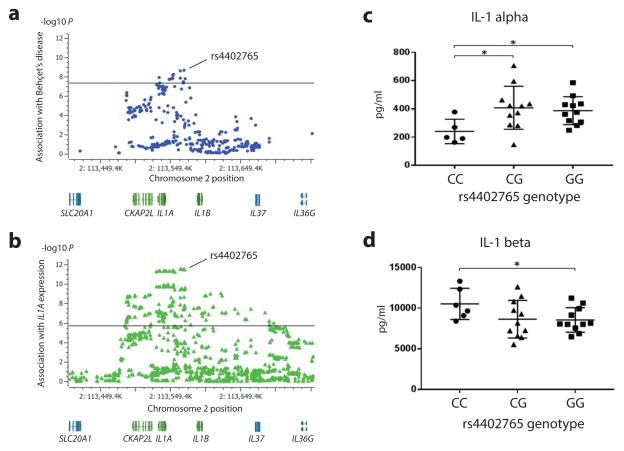
We analyzed 1,900 Turkish Behçet's disease cases and 1,779 controls genotyped with the Immunochip. The most significantly associated SNP was rs1050502, a tag SNP for HLA-B*51. In the Turkish discovery set, we identified three new risk loci, IL1A-IL1B, IRF8, and CEBPB-PTPN1, with genome-wide significance (P < 5 × 10⁻⁸) by direct genotyping and ADO-EGR2 by imputation. We replicated the ADO-EGR2, IRF8, and CEBPB-PTPN1 loci by genotyping 969 Iranian cases and 826 controls. Imputed data in 608 Japanese cases and 737 controls further replicated ADO-EGR2 and IRF8, and meta-analysis additionally identified RIPK2 and LACC1. The disease-associated allele of rs4402765, the lead marker at IL1A-IL1B, was associated with both decreased IL-1α and increased IL-1β production. ABO non-secretor genotypes for two ancestry-specific FUT2 SNPs showed strong disease association (P = 5.89 × 10⁻¹⁵). Our findings extend the list of susceptibility genes shared with Crohn's disease and leprosy and implicate mucosal factors and the innate immune response to microbial exposure in Behçet's disease susceptibility.
Conflict of interest statement
The authors declare no competing financial interests.
Figures
References
-
- Sakane T, Takeno M, Suzuki N, Inaba G. Behcet’s disease. N Engl J Med. 1999;341:1284–91. - PubMed
-
- Hatemi G, et al. EULAR recommendations for the management of Behcet disease. Ann Rheum Dis. 2008;67:1656–62. - PubMed
-
- Verity DH, Marr JE, Ohno S, Wallace GR, Stanford MR. Behcet’s disease, the Silk Road and HLA-B51: historical and geographical perspectives. Tissue Antigens. 1999;54:213–20. - PubMed
-
- Gul A, Ohno S. HLA-B*51 and Behcet Disease. Ocul Immunol Inflamm. 2012;20:37–43. - PubMed
-
- Ohno S, Aoki K, Sugiura S, Nakayama E, Itakura K. Letter: HL-A5 and Behcet’s disease. Lancet. 1973;2:1383–4. - PubMed
MeSH terms
Grants and funding
LinkOut - more resources
Full Text Sources
Other Literature Sources
Medical
Molecular Biology Databases
Research Materials
Miscellaneous
