


Occurrence and Genetic Characteristics of Cryptosporidium hominis and Cryptosporidium andersoni in Horses from Southwestern China
- PMID: 28166378
- PMCID: PMC5599969
- DOI: 10.1111/jeu.12399
Occurrence and Genetic Characteristics of Cryptosporidium hominis and Cryptosporidium andersoni in Horses from Southwestern China
Abstract
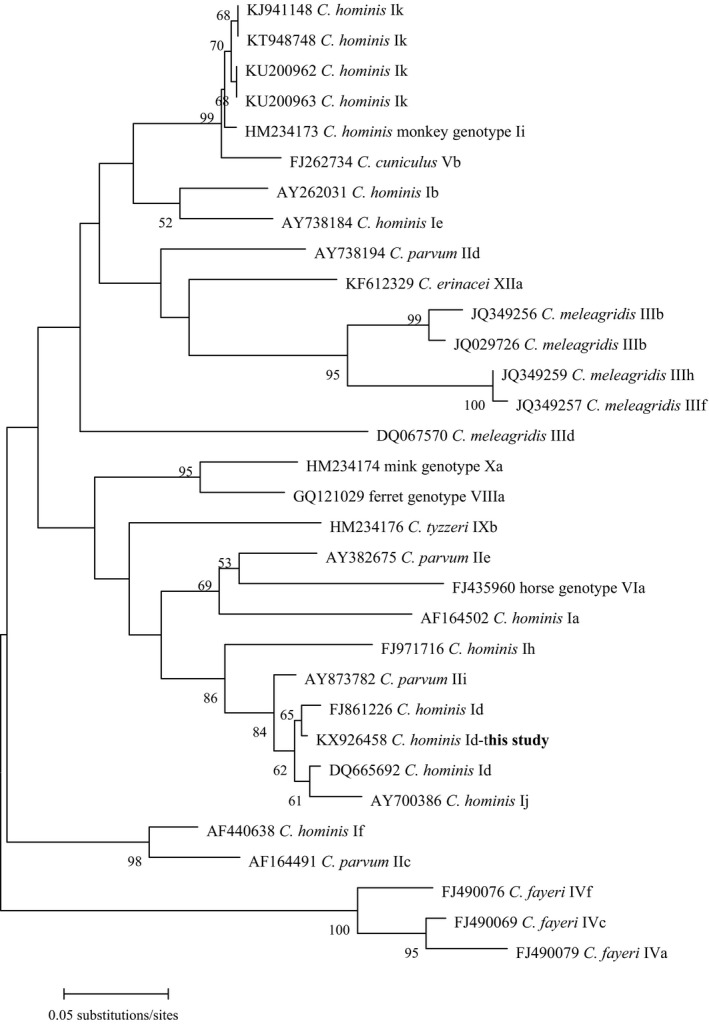
A total of 333 fecal specimens from horses in southwestern China were genotyped based on analysis of the small subunit rRNA (SSU rRNA) gene. Cryptosporidium hominis and Cryptosporidium andersoni were identified in 2 and 4 stool specimens, respectively. The identification of C. hominis was confirmed by sequence analysis of the 70-kDa heat shock protein (HSP70) and oocyst wall protein (COWP) genes. Subtyping analysis of the 60-kDa glycoprotein (GP60) gene sequence of C. hominis revealed a new rare subtype Id, named IdA15; only three Id isolates have been reported in humans to date. Multilocus sequence typing (MLST) analysis indicated that the C. andersoni subtype was A6, A5, A2, and A1 at the four minisatellite loci (MS1, MS2, MS3, and MS16, respectively). This is the first report to identify the presence of C. andersoni and C. hominis in horses in southwestern China and the first to identify a rare zoonotic subtype Id of C. hominis in horses. These findings suggest that infected horses may act as potential reservoirs of Cryptosporidium to transmit infections to humans.
Keywords: GP60; multilocus sequence typing; transmission.
© 2017 The Authors Journal of Eukaryotic Microbiology published by Wiley Periodicals, Inc. on behalf of International Society of Protistologists.
Figures
References
-
- Burton, A. J. , Nydam, D. V. , Dearen, T. K. , Mitchell, K. , Bowman, D. D. & Xiao, L. 2010. The prevalence of Cryptosporidium, and identification of the Cryptosporidium horse genotype in foals in New York State. Vet. Parasitol., 174:139–144. - PubMed
-
- Cacciò, S. M. 2005. Molecular epidemiology of human cryptosporidiosis. Parassitologia, 47:185–192. - PubMed
-
- Current, W. L. , Reese, N. C. , Ernst, J. V. , Bailey, W. S. , Heyman, M. B. & Weinstein, W. M. 1983. Human cryptosporidiosis in immunocompetent and immunodeficient persons. Studies of an outbreak and experimental transmission. N. Engl. J. Med., 308:1252–1257. - PubMed
-
- Fayer, R. , Morgan, U. & Upton, S. J. 2000. Epidemiology of Cryptosporidium: transmission, detection and identification. Int. J. Parasitol., 30:1305–1322. - PubMed
Publication types
MeSH terms
Substances
Associated data
- Actions
- Actions
- Actions
- Actions
- Actions
- Actions
- Actions
- Actions
- Actions
- Actions
- Actions
- Actions
LinkOut - more resources
Full Text Sources
Other Literature Sources
