


Dose-finding designs for trials of molecularly targeted agents and immunotherapies
- PMID: 28166468
- PMCID: PMC5383533
- DOI: 10.1080/10543406.2017.1289952
Dose-finding designs for trials of molecularly targeted agents and immunotherapies
Abstract
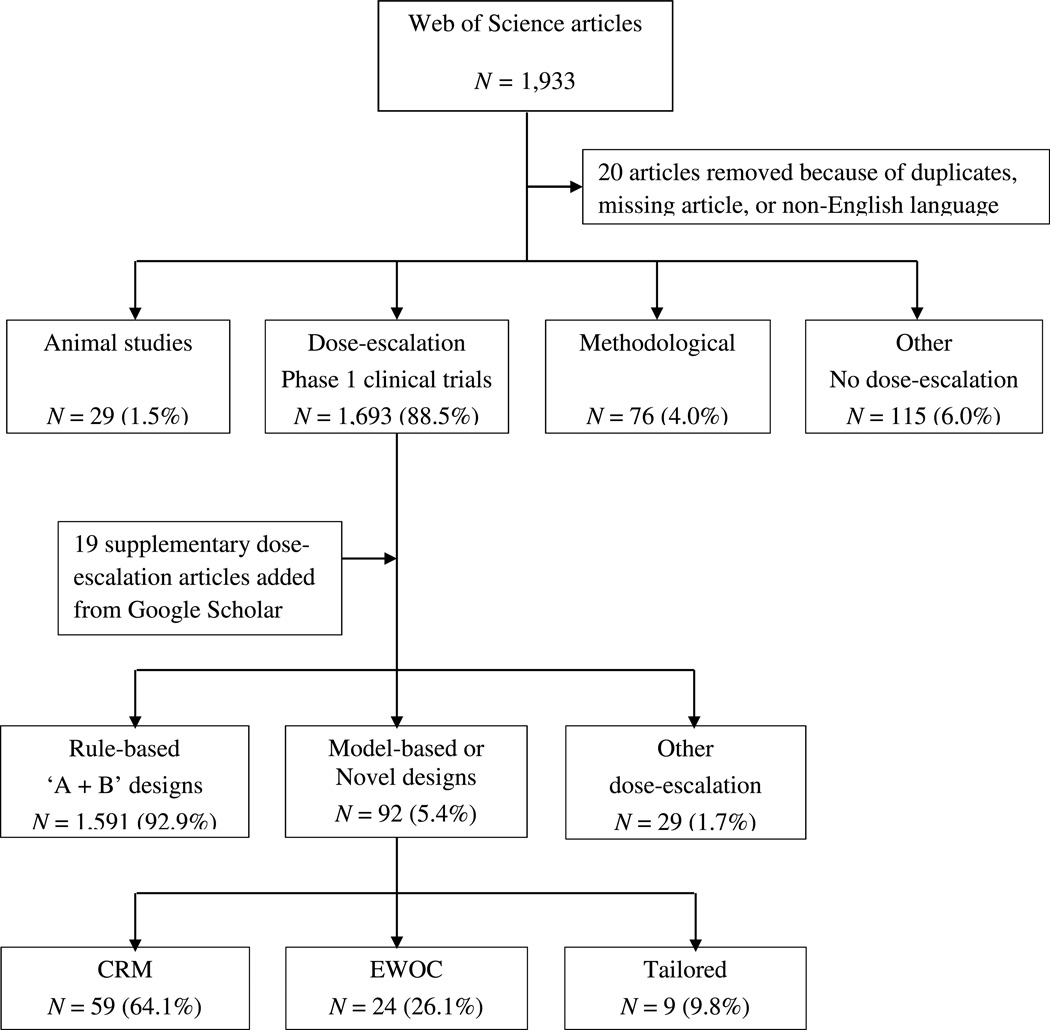
Recently, there has been a surge of early phase trials of molecularly targeted agents (MTAs) and immunotherapies. These new therapies have different toxicity profiles compared to cytotoxic therapies. MTAs can benefit from new trial designs that allow inclusion of low-grade toxicities, late-onset toxicities, addition of an efficacy endpoint, and flexibility in the specification of a target toxicity probability. To study the degree of adoption of these methods, we conducted a Web of Science search of articles published between 2008 and 2014 that describe phase 1 oncology trials. Trials were categorized based on the dose-finding design used and the type of drug studied. Out of 1,712 dose-finding trials that met our criteria, 1,591 (92.9%) utilized a rule-based design, and 92 (5.4%; range 2.3% in 2009 to 9.7% in 2014) utilized a model-based or novel design. Over half of the trials tested an MTA or immunotherapy. Among the MTA and immunotherapy trials, 5.8% used model-based methods, compared to 3.9% and 8.3% of the chemotherapy or radiotherapy trials, respectively. While the percentage of trials using novel dose-finding designs has tripled since 2007, the adoption of these designs continues to remain low.
Keywords: Dose-finding methods; immunotherapy; maximum tolerated dose; optimal dose; phase 1 designs; targeted therapy.
Figures
References
-
- Babb J, Rogatko A, Zacks S. Cancer phase I clinical trials: efficient dose escalation with overdose control. Statistics in Medicine. 1998;17:1103–1120. - PubMed
-
- Blay JY, Rutkowski P. Adherence to imatinib therapy in patients with gastrointestinal stromal tumors. Cancer Treatmeant Reviews. 2014;40:242–247. - PubMed
-
- Braun TM. The bivariate continual reassessment method. extending the CRM to phase I trials of two competing outcomes. Control Clinical Trials. 2002;23:240–256. - PubMed
-
- Cannistra SA. Challenges and pitfalls of combining targeted agents in phase I studies. Journal of Clinical Oncology. 2008;26:3665–3667. - PubMed
-
- Chen YB, Li S, Lane AA, Connolly C, Del Rio C, Valles B, Curtis M, Ballen K, Cutler C, Dey BR, El-Jawahri A, Fathi AT, Ho VT, Joyce A, McAfee S, Rudek M, Rajkhowa T, Verselis S, Antin JH, Spitzer TR, Levis M, Soiffer R. Phase I trial of maintenance sorafenib after allogeneic hematopoietic stem cell transplantation for fms-like tyrosine kinase 3 internal tandem duplication acute myeloid leukemia. Biology of Blood and Marrow Transplant. 2014;20:2042–2048. - PMC - PubMed
MeSH terms
Substances
Grants and funding
LinkOut - more resources
Full Text Sources
Other Literature Sources
Miscellaneous