


Impact of weight maintenance and loss on diabetes risk and burden: a population-based study in 33,184 participants
- PMID: 28166764
- PMCID: PMC5294882
- DOI: 10.1186/s12889-017-4081-6
Impact of weight maintenance and loss on diabetes risk and burden: a population-based study in 33,184 participants
Abstract
Background: Weight loss in individuals at high risk of diabetes is an effective prevention method and a major component of the currently prevailing diabetes prevention strategies. The aim of the present study was to investigate the public health potential for diabetes prevention of weight maintenance or moderate weight loss on a population level in an observational cohort with repeated measurements of weight and diabetes status.
Methods: Height, weight and diabetes status were objectively measured at baseline and 10 year follow-up in a population-based cohort of 33,184 participants aged 30-60 years between 1990 and 2013 in Västerbotten County, Sweden. The association between risk of incident diabetes and change in BMI or relative weight was modelled using multivariate logistic regression. Population attributable fractions (PAF) were used to assess population impact of shift in weight.
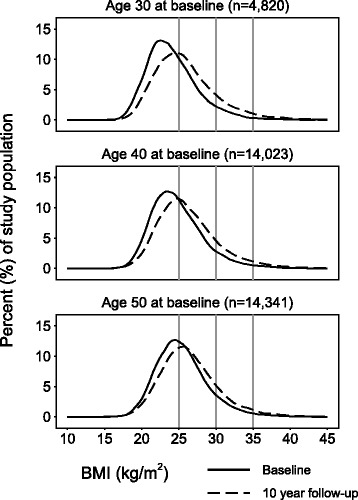
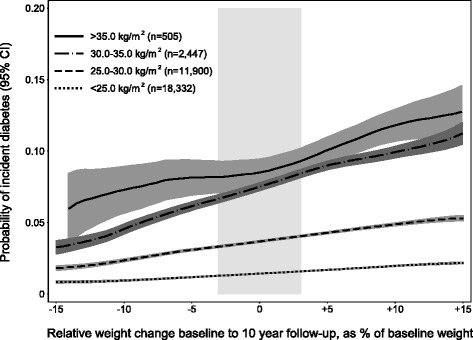
Results: Mean (SD) BMI at baseline was 25.0 (3.6) kg/m2. Increase in relative weight between baseline and follow-up was linearly associated with incident diabetes risk, odds ratio (OR) 1.05 (95% confidence interval (CI) 1.04-1.06) per 1% change in weight. Compared to weight maintenance (±1.0 kg/m2), weight gain of > +1.0 kg/m2 was associated with an increased risk of incident diabetes, OR 1.52 (95% CI 1.32, 1.74), representing a PAF of 21.9% (95% CI 15.8, 27.6%). For moderate weight loss (-1.0 to -2.0 kg/m2) the OR was 0.72 (95% CI 0.52, 0.99).
Conclusions: Weight maintenance in adulthood is strongly associated with reduced incident diabetes risk and there is considerable potential for diabetes prevention in promoting this as a whole population strategy.
Keywords: Body mass index; Body weight change; Diabetes mellitus; Epidemiology; Public health.
Figures
Comment in
-
Schon Gewichthalten hilft gegen Diabetes.MMW Fortschr Med. 2017 Oct;159(18):36. doi: 10.1007/s15006-017-0170-9. MMW Fortschr Med. 2017. PMID: 29071620 German. No abstract available.
References
-
- Gillies CL, Abrams KR, Lambert PC, Cooper NJ, Sutton AJ, Hsu RT, Khunti K. Pharmacological and lifestyle interventions to prevent or delay type 2 diabetes in people with impaired glucose tolerance: systematic review and meta-analysis. BMJ. 2007;334(7588):299. doi: 10.1136/bmj.39063.689375.55. - DOI - PMC - PubMed
-
- NHS England and Public Health England. National NHS Diabetes Initiative launched in major bid to prevent illness. https://www.gov.uk/government/news/national-nhs-diabetes-initiative-laun... (2015). [Press release published 12/03/2015]. Accessed 18 July 2016.
-
- Schwarz PE, Greaves CJ, Lindstrom J, Yates T, Davies MJ. Nonpharmacological interventions for the prevention of type 2 diabetes mellitus. Nat Rev Endocrinol. 2012;8(6):363–73. - PubMed
-
- Lindstrom J, Louheranta A, Mannelin M, Rastas M, Salminen V, Eriksson J, Uusitupa M, Tuomilehto J, Finnish Diabetes Prevention Study G The Finnish diabetes prevention study (DPS): lifestyle intervention and 3-year results on diet and physical activity. Diabetes Care. 2003;26(12):3230–6. doi: 10.2337/diacare.26.12.3230. - DOI - PubMed
Publication types
MeSH terms
Grants and funding
LinkOut - more resources
Full Text Sources
Other Literature Sources
Medical
