. 2017 Mar 24;61(4):e02574-16.
doi: 10.1128/AAC.02574-16. Print 2017 Apr.

Troponoids Can Inhibit Growth of the Human Fungal Pathogen Cryptococcus neoformans

Affiliations

Troponoids Can Inhibit Growth of the Human Fungal Pathogen Cryptococcus neoformans

Maureen J Donlin et al. Antimicrob Agents Chemother. .

Abstract

Cryptococcus neoformans is a pathogen that is common in immunosuppressed patients. It can be treated with amphotericin B and fluconazole, but the mortality rate remains 15 to 30%. Thus, novel and more effective anticryptococcal therapies are needed. The troponoids are based on natural products isolated from western red cedar, and have a broad range of antimicrobial activities. Extracts of western red cedar inhibit the growth of several fungal species, but neither western red cedar extracts nor troponoid derivatives have been tested against C. neoformans We screened 56 troponoids for their ability to inhibit C. neoformans growth and to assess whether they may be attractive candidates for development into anticryptococcal drugs. We determined MICs at which the compounds inhibited 80% of cryptococcal growth relative to vehicle-treated controls and identified 12 compounds with MICs ranging from 0.2 to 15 μM. We screened compounds with MICs of ≤20 μM for cytotoxicity in liver hepatoma cells. Fifty percent cytotoxicity values (CC50s) ranged from 4 to >100 μM. The therapeutic indexes (TI, CC50/MIC) for most of the troponoids were fairly low, with most being <8. However, two compounds had TI values that were >8, including a tropone with a TI of >300. These tropones are fungicidal and are not antagonistic when used in combination with fluconazole or amphotericin B. Inhibition by these two tropones remains unchanged under conditions favoring cryptococcal capsule formation. These data support the hypothesis that troponoids may be a productive scaffold for the development of novel anticryptococcal therapies.

Keywords: Cryptococcus neoformans; antifungal agents; tropolones.


Figures

FIG 1
FIG 1
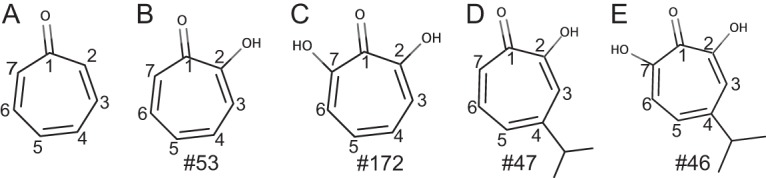
Structures of (A) tropone, (B) tropolone, (C) α-hydroxytropolone, (D) β-thujaplicin, and (E) β-thujaplicinol with the R-group numbering and the natural products. Numbered structures were tested for inhibition and are found in Fig. S2 and S3 in the supplemental material.
FIG 2
FIG 2
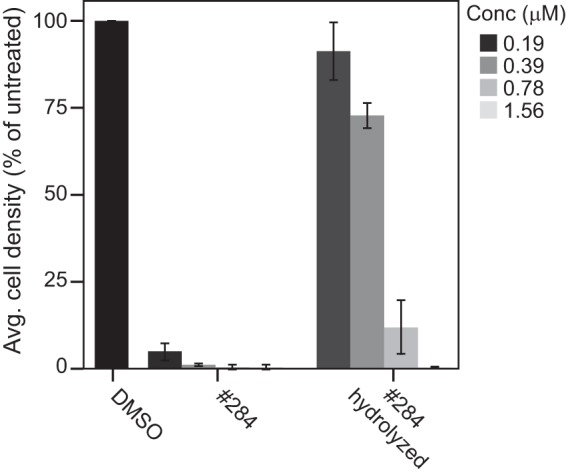
Inhibition of KN99α cells with no. 284 or hydrolyzed products of no. 284 measured by cell densities after 48 h at 35°C in YNB-02 plus 1% DMSO. Values are means ± standard deviations from three replicates.
FIG 3
FIG 3
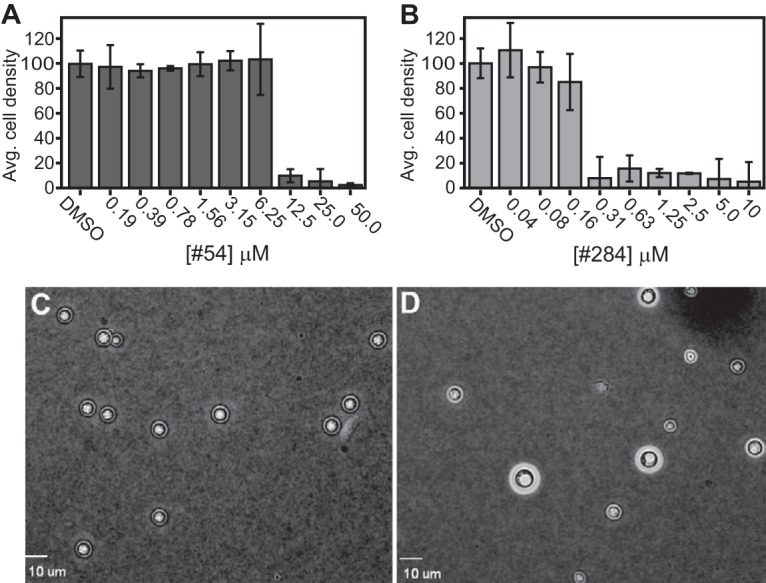
Inhibition of KN99α cells as measured by cell densities after 48 h at 37°C with 5% CO2 in YNB-02 plus 1% DMSO for (A) no. 54 or (B) no. 284. Values are means ± standard deviations from three replicates. India ink exclusion assay of capsule production of the cells cultured in YPD (C) or in YNB-02 plus 1% DMSO (D) at 37°C plus 5% CO2.
FIG 4
FIG 4
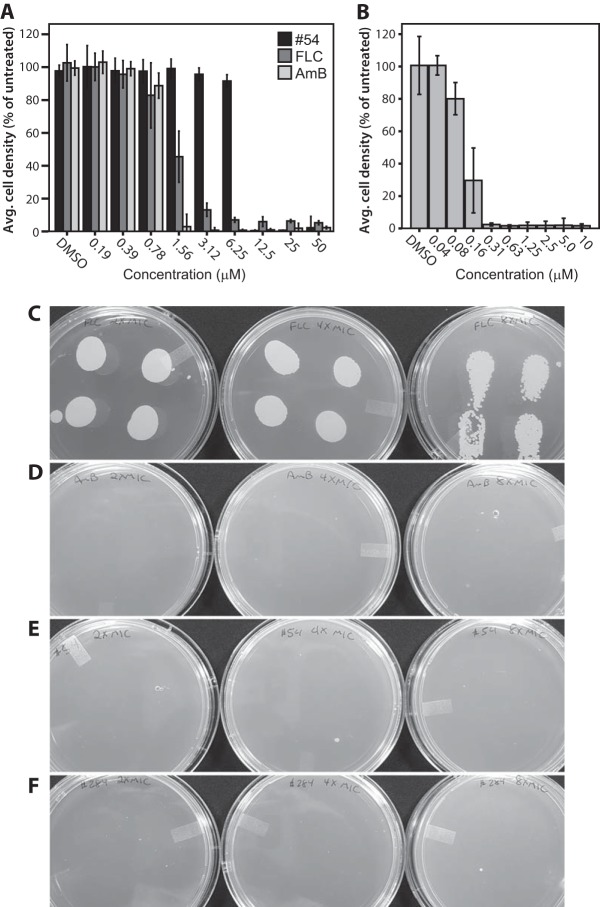
KN99α cells were treated with FLC, AMB or no. 54 at 0.19 to 50 μM (A) or no. 284 at 0.04 to 10 μM (B). (C to F) Following inhibition, 30-μl samples of the each of four replicates at 2×, 4×, and 8× the MIC were spotted on YPD agar and incubated for 48 h at 30°C.

References

    1. Park BJ, Wannemuehler KA, Marston BJ, Govender N, Pappas PG, Chiller TM. 2009. Estimation of the current global burden of cryptococcal meningitis among persons living with HIV/AIDS. AIDS 23:525–530. doi:10.1097/QAD.0b013e328322ffac. - DOI - PubMed
    1. Shoham S, Marr KA. 2012. Invasive fungal infections in solid organ transplant recipients. Future Microbiol 7:639–655. doi:10.2217/fmb.12.28. - DOI - PMC - PubMed
    1. Neofytos D, Fishman JA, Horn D, Anaissie E, Chang CH, Olyaei A, Pfaller M, Steinbach WJ, Webster KM, Marr KA. 2010. Epidemiology and outcome of invasive fungal infections in solid organ transplant recipients. Transpl Infect Dis 12:220–229. doi:10.1111/j.1399-3062.2010.00492.x. - DOI - PubMed
    1. Lortholary O. 2007. Management of cryptococcal meningitis in AIDS: the need for specific studies in developing countries. Clin Infect Dis 45:81–83. doi:10.1086/518583. - DOI - PubMed
    1. Mdodo R, Brown K, Omonge E, Jaoko W, Baddley J, Pappas P, Kempf MC, Aban I, Odera S, Suleh A, Jolly PE. 2010. The prevalence, clinical features, risk factors and outcome associated with cryptococcal meningitis in HIV positive patients in Kenya. East Afr Med J 87:481–487. - PMC - PubMed

MeSH terms