. 2017 Feb 21;114(8):1811-1816.
doi: 10.1073/pnas.1608824114. Epub 2017 Feb 6.

Timing and tempo of the Great Oxidation Event

Affiliations

Timing and tempo of the Great Oxidation Event

Ashley P Gumsley et al. Proc Natl Acad Sci U S A. .

Abstract

The first significant buildup in atmospheric oxygen, the Great Oxidation Event (GOE), began in the early Paleoproterozoic in association with global glaciations and continued until the end of the Lomagundi carbon isotope excursion ca. 2,060 Ma. The exact timing of and relationships among these events are debated because of poor age constraints and contradictory stratigraphic correlations. Here, we show that the first Paleoproterozoic global glaciation and the onset of the GOE occurred between ca. 2,460 and 2,426 Ma, ∼100 My earlier than previously estimated, based on an age of 2,426 ± 3 Ma for Ongeluk Formation magmatism from the Kaapvaal Craton of southern Africa. This age helps define a key paleomagnetic pole that positions the Kaapvaal Craton at equatorial latitudes of 11° ± 6° at this time. Furthermore, the rise of atmospheric oxygen was not monotonic, but was instead characterized by oscillations, which together with climatic instabilities may have continued over the next ∼200 My until ≤2,250-2,240 Ma. Ongeluk Formation volcanism at ca. 2,426 Ma was part of a large igneous province (LIP) and represents a waning stage in the emplacement of several temporally discrete LIPs across a large low-latitude continental landmass. These LIPs played critical, albeit complex, roles in the rise of oxygen and in both initiating and terminating global glaciations. This series of events invites comparison with the Neoproterozoic oxygen increase and Sturtian Snowball Earth glaciation, which accompanied emplacement of LIPs across supercontinent Rodinia, also positioned at low latitude.

Keywords: Great Oxidation Event; Kaapvaal Craton; Paleoproterozoic; Snowball Earth; Transvaal Supergroup.


Conflict of interest statement

The authors declare no conflict of interest.

Figures
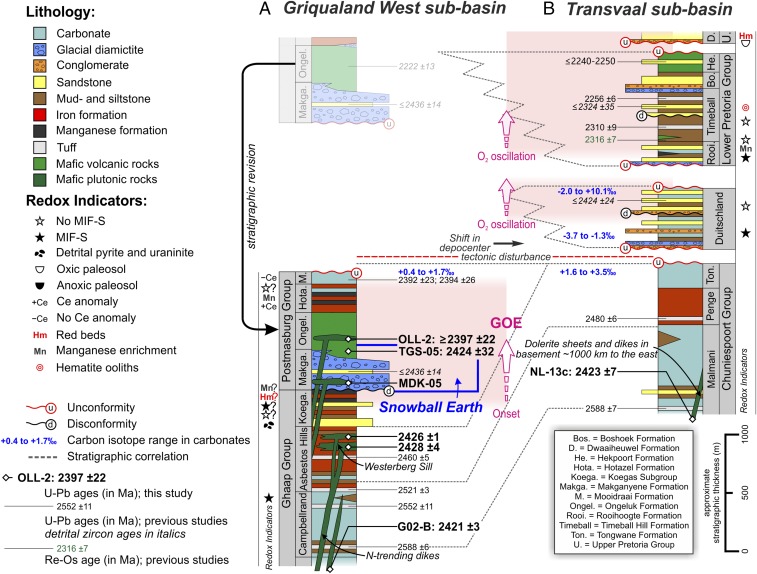
Fig. 1.
Fig. 1.
Stratigraphic synthesis (SI Methods, Stratigraphic Synthesis) of the Transvaal Supergroup as preserved in its two main subbasins: (A) Griqualand West in the southwest and (B) Transvaal in the northeast. Dated samples and results (bold) are shown in stratigraphic context and collectively, unlock the long-held correlation between the basalts of the Ongeluk and Hekpoort formations (12, 14, 18). A selection of previously published ages is schematically shown (Table S1) along with redox indicators and ranges of carbon isotope values in carbonates (Table S2). The redox records within the two subbasins tracks the rhythm of GOE and reflects at least two O2 oscillations back through 10−5 PAL after the onset of GOE (bold pink arrows and variable intensity pink background shading). Redox indicators requiring more detailed studies are denoted with question marks. All ages are quoted at 2σ uncertainty.
Fig. S1.
Fig. S1.
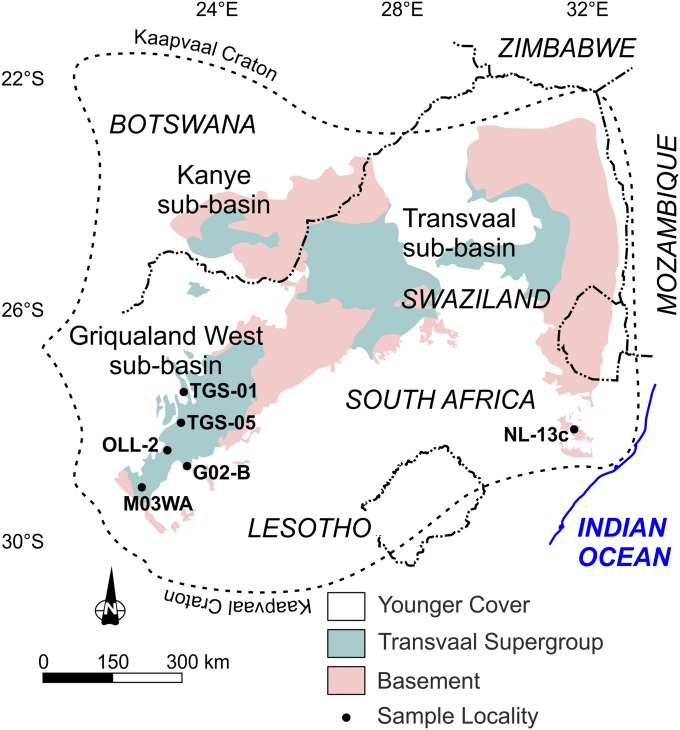
The Kaapvaal Craton in southern Africa with the three subbasins of the Transvaal Supergroup shown along with the Archean basement. Sample localities in the Ongeluk Formation and related intrusions from this study and that of the Westerberg Sill Province (28) are also shown.
Fig. 2.
Fig. 2.
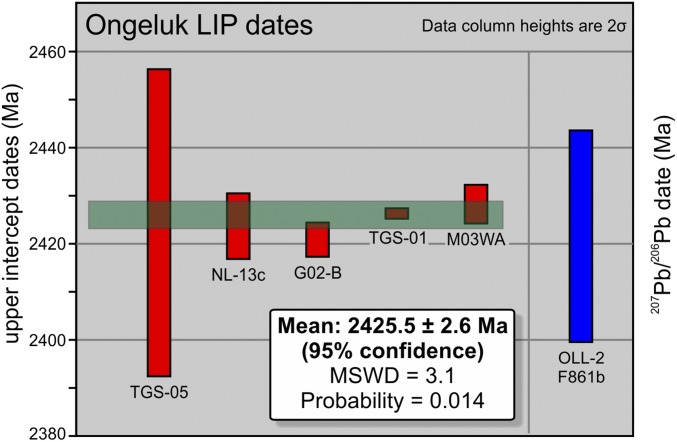
Weighted mean age of the Ongeluk LIP. Shown is a comparison of upper intercept dates with 2σ uncertainties (red columns) from five samples of the Ongeluk LIP, including the Westerberg Sill Province (samples TGS-01 and M03WA) (28), with a calculated weighted mean age of 2,425.5 ± 2.6 Ma (green bar). The result from a single analysis spot (F861b in OLL-2) is shown for comparison (blue column) (Fig. S2).
Fig. S2.
Fig. S2.
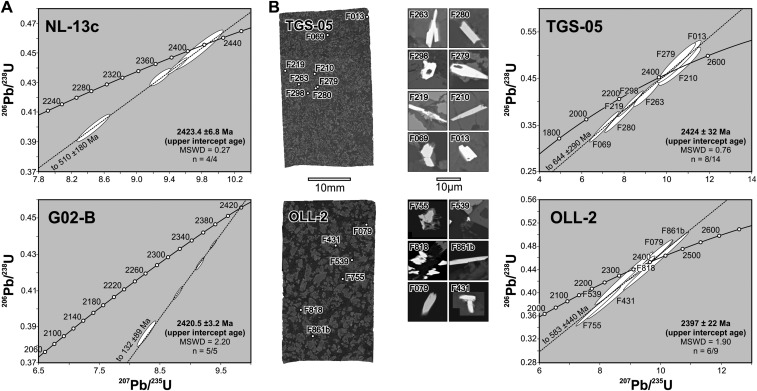
(A) ID-TIMS concordia diagrams for baddeleyite from samples NL-13c and G02-B, with data ellipses at 2σ uncertainty. (B) In situ SIMS concordia diagrams of microbaddeleyite in samples OLL-2 and TGS-05, with data ellipses at 1σ uncertainty. In addition, (B, Left) polished thin sections (with SIMS analysis points used in the age calculations) were mapped by SEM to locate and identify (B, Right) Zr-bearing accessory minerals (SEM imagery of baddeleyites and zircons analyzed with SIMS and used in the age calculations). Some baddeleyite grains (white in the back-scattered electron images) display minor alteration to zircon (light-gray rims; e.g., spot F755).
Fig. S3.
Fig. S3.
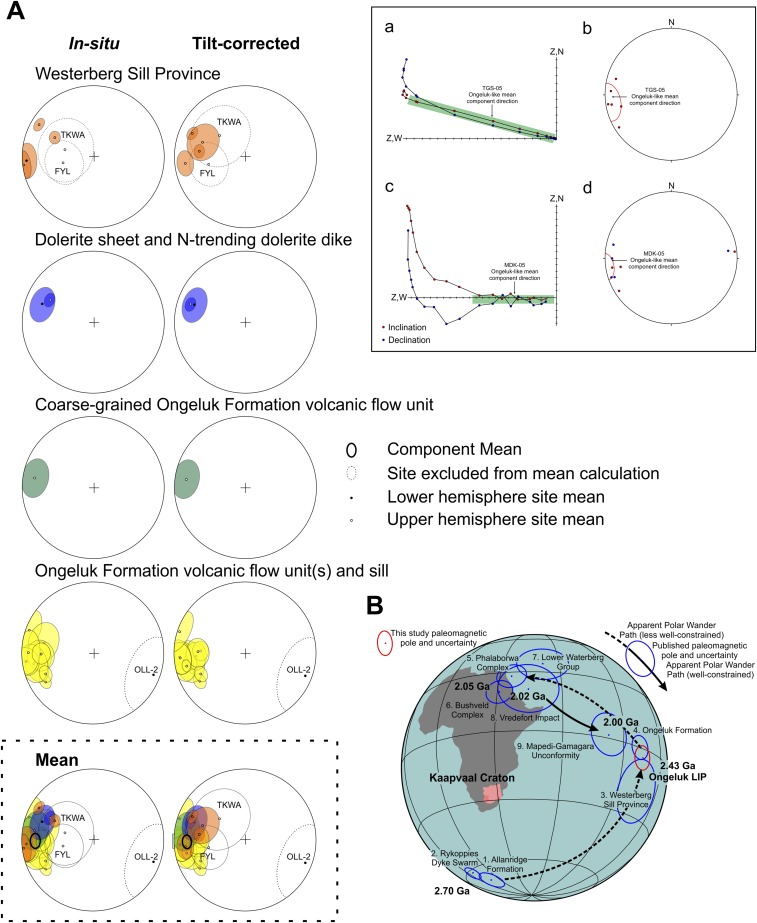
(A, Inset) Representative Zijderveld diagrams for the demagnetization behavior of (a) TGS-05 and (c) MDK-05, with (b and d) corresponding equal area projections of the characteristic magnetic components. Equal area projections are in situ. In the Zijderveld diagrams, tick marks represent 1 μA⋅m−2. (A) The magnetic components on which the Ongeluk LIP key paleomagnetic pole is based. (B) The Ongeluk LIP key paleomagnetic pole. The Ongeluk LIP is defined with error margins (red circle). In addition, the Paleoproterozoic apparent polar wander path is presented with previously published paleomagnetic poles and error margins (blue circles) (Tables S6 and S7).
Fig. 3.
Fig. 3.
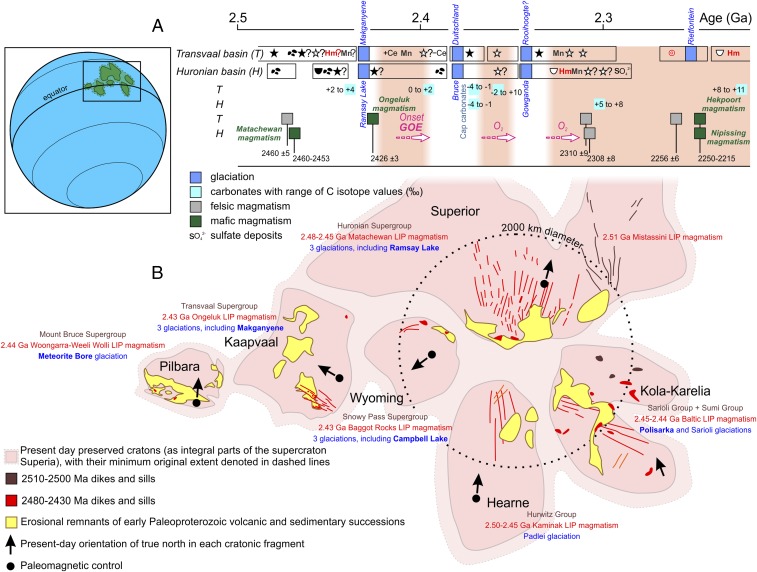
A is a graph illustrating the approximate chronology (Table S1) of the glaciations and atmospheric oxygen oscillations according to the related redox indicators in the Huronian and Transvaal basins (Table S2) using the same symbols as used in Fig. 1. Also shown are dated mafic and felsic magmatic events as well as δ13C ranges for carbonates (Tables S1 and S2) and the extent of stratigraphic records in each basin denoting gaps in records at unconformities and disconformities. (B) The early Paleoproterozoic geography of the Superior, Kola–Karelia, Hearne, and Wyoming cratons as integral parts of the supercraton Superia (5, 36) with the addition of the Kaapvaal and Pilbara cratons in the supercraton Vaalbara configuration (52). The early Paleoproterozoic basins developed on these cratonic fragments include both ca. 2.51–2.43 Ga volcanic rocks and glacial units, which can be correlated across the cratons. The glacial units in bold denote the glacial deposits likely recording the first glaciation. All of the cratonic fragments also contain dolerite dikes and sills emplaced between ca. 2.51 Ga and 2.43 Ga, showing the extent of the LIPs formed during this time. Available paleomagnetic studies indicate that the majority of the cratonic fragments (as part of supercraton Superia) were positioned near the paleoequator. The arrows denoting present-day true north in the crustal blocks illustrate the rotations necessary to make the reconstruction. (Inset) The hypothesized paleolatitude of these Archean cratons in the early Paleoproterozoic.

References

    1. Holland HD. Volcanic gases, black smokers, and the Great Oxidation Event. Geochim Cosmochim Acta. 2002;66(21):3811–3826.
    1. Hoffman PF. The Great Oxidation and a Siderian snowball Earth: MIF-S based correlation of Paleoproterozoic glacial epochs. Chem Geol. 2013;362:143–156.
    1. Goldblatt C, Lenton TM, Watson AJ. Bistability of atmospheric oxygen and the Great Oxidation. Nature. 2006;443(7112):683–686. - PubMed
    1. Daines SJ, Lenton TM. The effect of widespread early aerobic marine ecosystems on methane cycling and the Great Oxidation. Earth Planet Sci Lett. 2016;434:42–51.
    1. Ernst R, Bleeker W. Large igneous provinces (LIPs), giant dyke swarms, and mantle plumes: Significance for breakup events within Canada and adjacent regions from 2.5 Ga to the Present. Can J Earth Sci. 2010;47(5):695–739.

Publication types