Review
. 2017 Jan 23:8:43.
doi: 10.3389/fmicb.2017.00043. eCollection 2017.

Small RNA Based Genetic Engineering for Plant Viral Resistance: Application in Crop Protection

Affiliations
Review

Small RNA Based Genetic Engineering for Plant Viral Resistance: Application in Crop Protection

Annum Khalid et al. Front Microbiol. .

Abstract

Small RNAs regulate a large set of gene expression in all plants and constitute a natural immunity against viruses. Small RNA based genetic engineering (SRGE) technology had been explored for crop protection against viruses for nearly 30 years. Viral resistance has been developed in diverse crops with SRGE technology and a few viral resistant crops have been approved for commercial release. In this review we summarized the efforts generating viral resistance with SRGE in different crops, analyzed the evolution of the technology, its efficacy in different crops for different viruses and its application status in different crops. The challenge and potential solution for application of SRGE in crop protection are also discussed.

Keywords: crop protection; fruit; genetic engineering; miRNA; siRNA; staple food; vegetable; viruses.


Figures
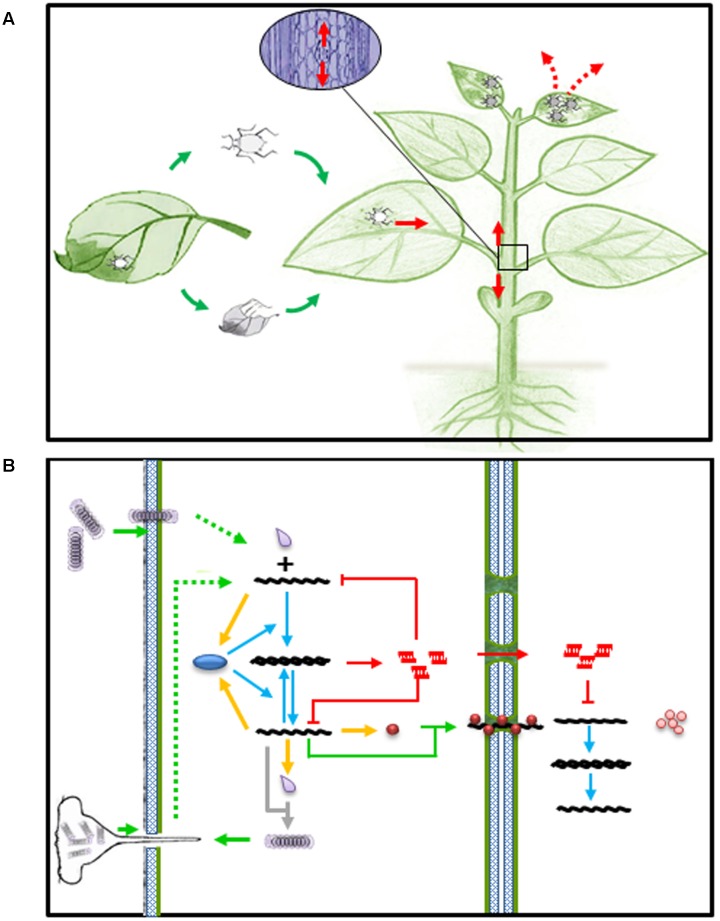
FIGURE 1
FIGURE 1
Viral infection and RNA silencing in plants. (A) Virus entry (green arrows), spread (read arrows) and exit (read dashed arrows) in host plant. (B) Virus entry and spread (green arrows) in plant cell. Green dashed arrows represent disassembly of virion upon entry into plant cell. Yellow arrows represent expression of viral products, such as replicase (blue oval), movement protein (brown ball), and capsid protein (gray droplet). Blue arrows represent transcription of viral RNAs. Gray arrow depicts virion assembly from newly synthesized capsid and genomic RNA. Red arrows and lines represent activation of small RNA mediated intra and inter-cellular immunity.
FIGURE 2
FIGURE 2
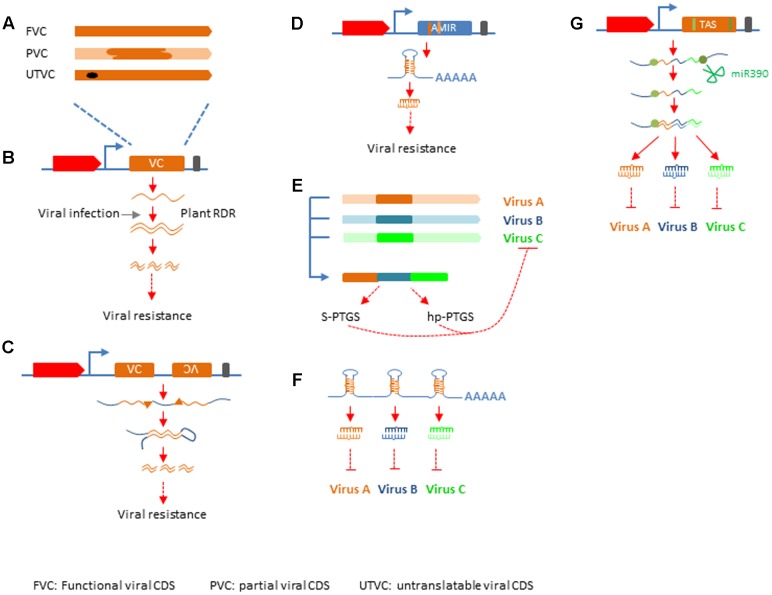
Silencing mechanisms applied in crop protection. (A) Different types of viral sequences used in genetic engineering. FVC, functional viral CDS; PVC, partial viral CDS; UTVC, untranslatable viral CDS. (B) S-PTGS, top: structure of silencing construct with red block representing plant promoter, yellow block representing inserted viral sequences, black bar representing transcription terminator. (C) hp-PTGS, top: structure of silencing construct as depicted in (B), except there are two viral sequences one in sense and the other in antisense orientation. (D) AMIR-PTGS, the structure of AMIR construct is similar to that in (B,C), except that the blue block represent a backbone sequences of a natural miRNA and the dark yellow bar within the blue block depict mature miRNA sequence designed to target viral genome and the light yellow bar represents miRNA star. (E) Strategy to generate multiple-viruses resistance in S-PTGS and hp-PTGS. The yellow, blue, and green bars represent different viral sequences. The forth bar with different colors represents the chimeric viral sequences used in S-PTGS and hp-PTGS. (F) Cluster of AMIRs for multiple-viruses resistance. (G) TAS for multiple-viruses resistance. The TAS gene structure is similar to that described in (A), except the blue block represents natural TAS3 backbone. The green bar in the gene structure and green dots in transcript lines represent miR390 binding sites.
FIGURE 3
FIGURE 3
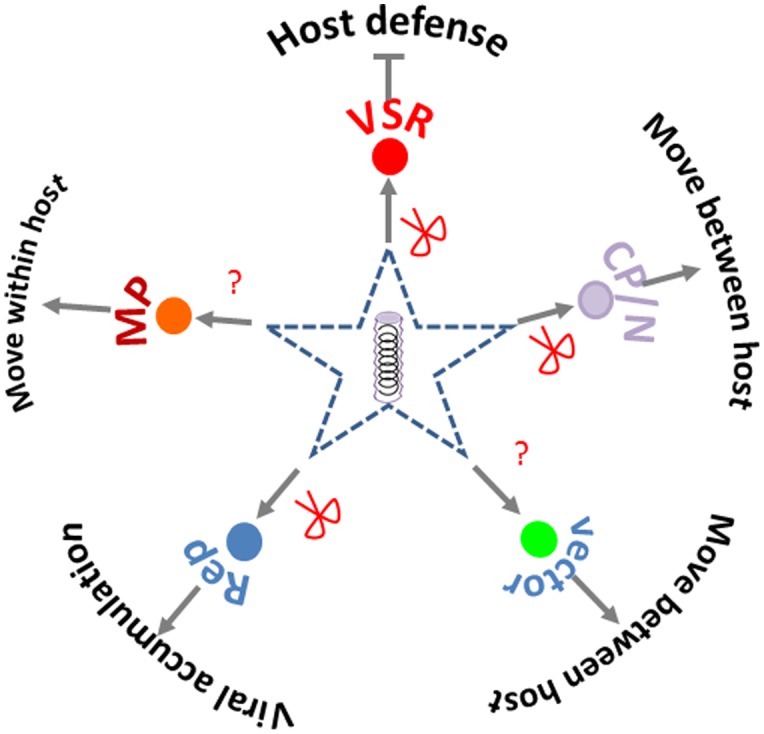
Silencing targets chosen in crop protection. The red scissors point to the viral products (functions) that had been targeted by small RNA based genetic engineering. The question marks point to the viral or vector function yet to be reported as targets for crop protection.
FIGURE 4
FIGURE 4
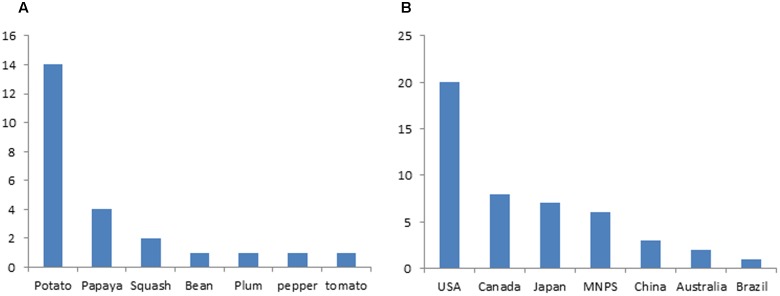
Application status of small RNA based genetic engineering in crop protection. (A) Number of small RNA based transgenic crop varieties that are approved for commercial release. (B) Number of small RNA based transgenic crop varieties in different countries that are approved for commercial release.

References

    1. Abel P. P., Nelson R. S., De B., Hoffmann N., Rogers S. G., Fraley R. T., et al. (1986). Delay of disease development in transgenic plants that express the tobacco mosaic virus coat protein gene. Science 232 738–743. 10.1126/science.3457472 - DOI - PubMed
    1. Alazem M., Lin N. S. (2015). Roles of plant hormones in the regulation of host-virus interactions. Mol. Plant Pathol. 16 529–540. 10.1111/mpp.12204 - DOI - PMC - PubMed
    1. Antignus Y., Vunsh R., Lachman O., Pearlsman M., Maslenin L., Hananya U., et al. (2004). Truncated rep gene originated from tomato yellow leaf curl virus-Israel [Mild] confers strain-specific resistance in transgenic tomato. Ann. Appl. Biol. 144 39–44. 10.1111/j.1744-7348.2004.tb00314.x - DOI
    1. Aragao F. J. L., Nogueira E. O. P. L., Tinoco M. L. P., Faria J. C. (2013). Molecular characterization of the first commercial transgenic common bean immune to the Bean golden mosaic virus. J. Biotechnol. 166 42–50. 10.1016/j.jbiotec.2013.04.009 - DOI - PubMed
    1. Arif M., Azhar U., Arshad M., Zafar Y., Mansoor S., Asad S. (2012). Engineering broad-spectrum resistance against RNA viruses in potato. Transgenic Res. 21 303–311. 10.1007/s11248-011-9533-7 - DOI - PubMed