Review
. 2017 Jan;6(1):15-21.
doi: 10.7774/cevr.2017.6.1.15. Epub 2017 Jan 25.

The development of mucosal vaccines for both mucosal and systemic immune induction and the roles played by adjuvants

Affiliations
Review

The development of mucosal vaccines for both mucosal and systemic immune induction and the roles played by adjuvants

Sae-Hae Kim et al. Clin Exp Vaccine Res. 2017 Jan.

Abstract

Vaccination is the most successful immunological practice that improves the quality of human life and health. Vaccine materials include antigens of pathogens and adjuvants potentiating the effectiveness of vaccination. Vaccines are categorized using various criteria, including the vaccination material used and the method of administration. Traditionally, vaccines have been injected via needles. However, given that most pathogens first infect mucosal surfaces, there is increasing interest in the establishment of protective mucosal immunity, achieved by vaccination via mucosal routes. This review summarizes recent developments in mucosal vaccines and their associated adjuvants.

Keywords: Adjuvants; Mucosal immunity; Vaccines.


Conflict of interest statement

No potential conflict of interest relevant to this article was reported.

Figures
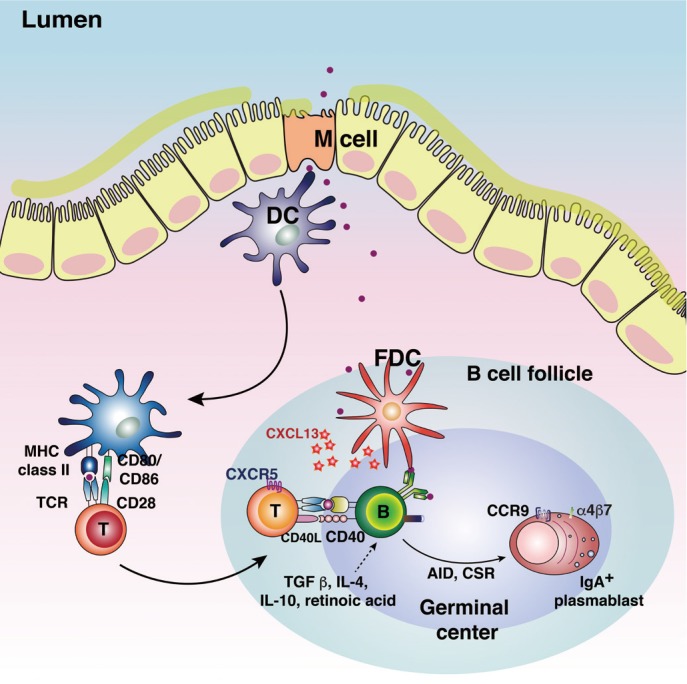
Fig. 1
Fig. 1. Schematic diagram of mucosal immune induction. The luminal antigens transcytosed by M cells encounter dendritic cells (DCs) in the subepithelial dome of Peyer's patch. DCs loaded with the antigens move into the interfollicular T cell zone and induce the effector T cells. Antigen-specific effector CD4+ T cells expressing CD40 ligand induce the IgA+ plasmablasts. FDC, follicular dendritic cell; TCR, T-cell receptor; TGF β, transforming growth factor β; IL, interleukin; AID, activation-induced cytidine deaminase; CSR, class switch recombination; CXCL13, CXC chemokine ligand 13; CXCR5, CXC chemokine receptor 5.
Fig. 2
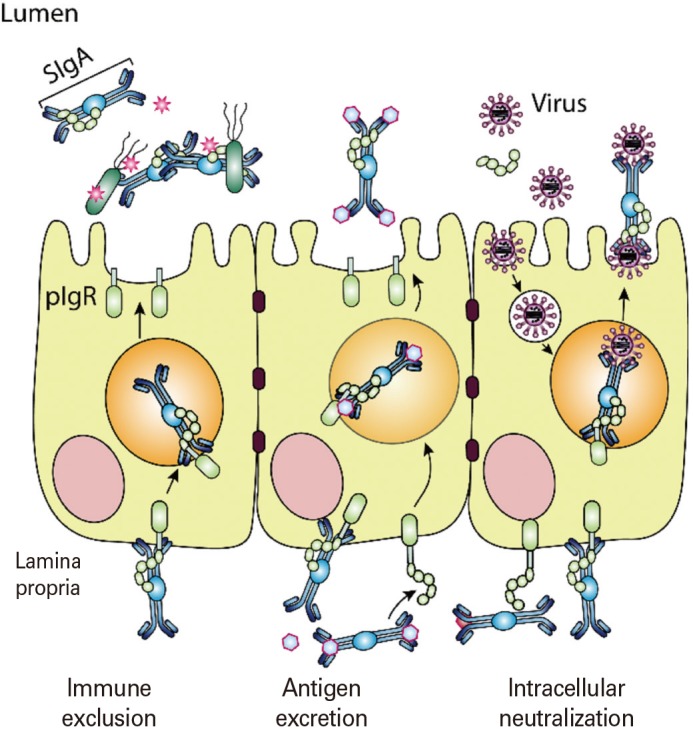
Fig. 2. The role played by secretory antibodies in the mucosal compartment. Secreted antibodies can protect mucosal surfaces by immune exclusion, antigen excretion, and intracellular neutralization. Immune exclusion is that secretory IgA (SIgA) interact with antigens and block their attachment to epithelial cells. The SIgAs bind to antigen and remove from the lamina propria through antigen excretion. The intracellular pathogen can also be eliminated by intracellular neutralization.
Fig. 3
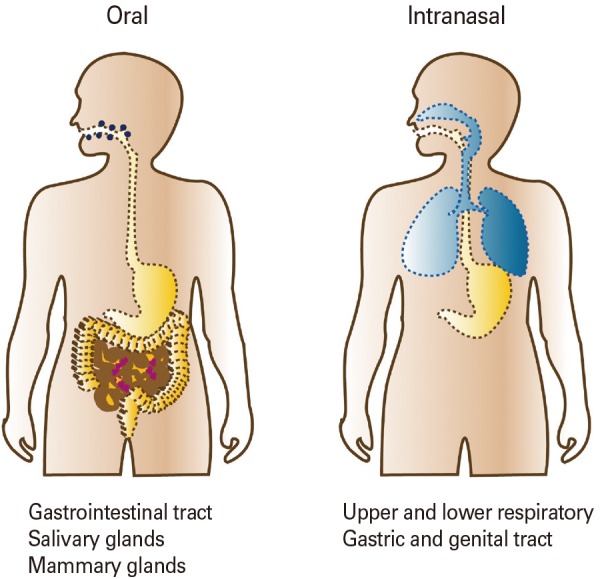
Fig. 3. Mucosal immunization routes and the regions affected. The mucosal IgA responses are differentially induced according to the routes of mucosal immunization. Oral vaccination is effective for the immune induction in the gastrointestinal tract, salivary glands, and mammary glands. Intranasal vaccination is effective for the immune induction in respiratory, gastric and genital tracts.

References

    1. Rappuoli R, Mandl CW, Black S, De Gregorio E. Vaccines for the twenty-first century society. Nat Rev Immunol. 2011;11:865–872. - PMC - PubMed
    1. Kwok R. Vaccines: the real issues in vaccine safety. Nature. 2011;473:436–438. - PubMed
    1. Gutjahr A, Tiraby G, Perouzel E, Verrier B, Paul S. Triggering intracellular receptors for vaccine adjuvantation. Trends Immunol. 2016;37:573–587. - PubMed
    1. Bachmann MF, Jennings GT. Vaccine delivery: a matter of size, geometry, kinetics and molecular patterns. Nat Rev Immunol. 2010;10:787–796. - PubMed
    1. McGhee JR, Fujihashi K. Inside the mucosal immune system. PLoS Biol. 2012;10:e1001397. - PMC - PubMed