


Recent updates on electronic cigarette aerosol and inhaled nicotine effects on periodontal and pulmonary tissues
- PMID: 28168771
- PMCID: PMC5545167
- DOI: 10.1111/odi.12652
Recent updates on electronic cigarette aerosol and inhaled nicotine effects on periodontal and pulmonary tissues
Abstract
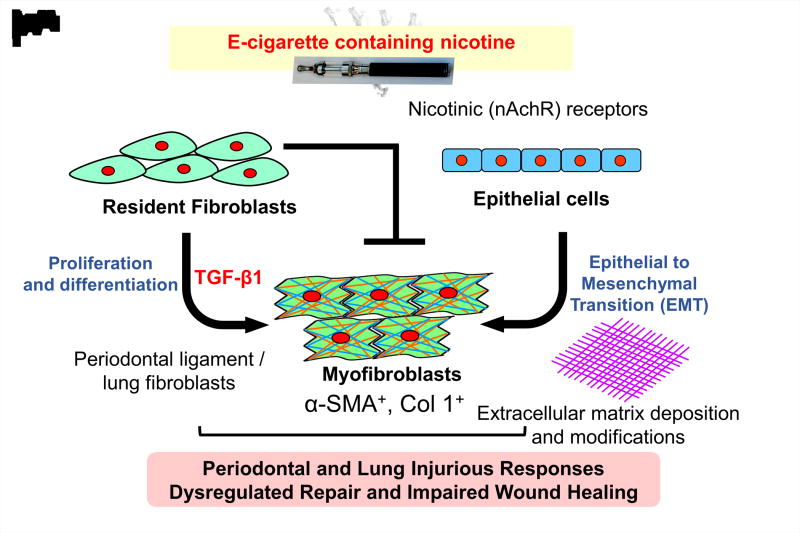
E-cigarette-derived inhaled nicotine may contribute to the pathogenesis of periodontal and pulmonary diseases in particular via lung inflammation, injurious, and dysregulated repair responses. Nicotine is shown to have antiproliferative properties and affects fibroblasts in vitro, which may interfere in tissue myofibroblast differentiation in e-cig users. This will affect the ability to heal wounds by decreasing wound contraction. In periodontics, direct exposure to e-vapor has been shown to produce harmful effects in periodontal ligament and gingival fibroblasts in culture. This is due to the generation of reactive oxygen species/aldehydes/carbonyls from e-cig aerosol, leading to protein carbonylation of extracellular matrix and DNA adducts/damage. A limited number of studies regarding the effects of e-cig in oral and lung health are available. However, no reports are available to directly link the deleterious effects on e-cigs, inhaled nicotine, and flavorings aerosol on periodontal and pulmonary health in particular to identify the risk of oral diseases by e-cigarettes and nicotine aerosols. This mini-review summarizes the recent perspectives on e-cigarettes including inhaled nicotine effects on several pathophysiological events, such as oxidative stress, DNA damage, innate host response, inflammation, cellular senescence, profibrogenic and dysregulated repair, leading to lung remodeling, oral submucous fibrosis, and periodontal diseases.
Keywords: e-cigarettes; fibrosis; inflammation, lung; oxidative stress; periodontium.
© 2017 John Wiley & Sons A/S. Published by John Wiley & Sons Ltd.
Conflict of interest statement
Figures
Comment in
-
E-cigarettes and oral health: a balanced viewpoint.Oral Dis. 2017 Nov;23(8):1180-1181. doi: 10.1111/odi.12666. Epub 2017 Apr 6. Oral Dis. 2017. PMID: 28321958 No abstract available.
References
-
- Al Amri MD, Kellesarian SV, Abduljabbar TS, Al-Rifaiy MQ, Al Baker AM, Al-Keraif AA. Comparison of Peri-Implant Soft Tissue Parameters and Crestal Bone Loss Around Immediately-Loaded and Delayed Loaded Implants Among Smokers and Nonsmokers: 5-Year Follow-Up Results. J Periodontol. 2016:1–12. - PubMed
-
- Albandar JM, Brunelle JA, Kingman A. Destructive periodontal disease in adults 30 years of age and older in the United States, 1988–1994. Journal of periodontology. 1999;70:13–29. - PubMed
-
- Ara T, Kurata K, Hirai K, Uchihashi T, Uematsu T, Imamura Y, Furusawa K, Kurihara S, Wang PL. Human gingival fibroblasts are critical in sustaining inflammation in periodontal disease. Journal of periodontal research. 2009;44:21–27. - PubMed
-
- Baltacioglu E, Akalin FA, Alver A, Deger O, Karabulut E. Protein carbonyl levels in serum and gingival crevicular fluid in patients with chronic periodontitis. Archives of oral biology. 2008;53:716–722. - PubMed
Publication types
MeSH terms
Substances
Grants and funding
LinkOut - more resources
Full Text Sources
Other Literature Sources
