


Stem Cell Technology in Cardiac Regeneration: A Pluripotent Stem Cell Promise
- PMID: 28169191
- PMCID: PMC5474503
- DOI: 10.1016/j.ebiom.2017.01.029
Stem Cell Technology in Cardiac Regeneration: A Pluripotent Stem Cell Promise
Abstract
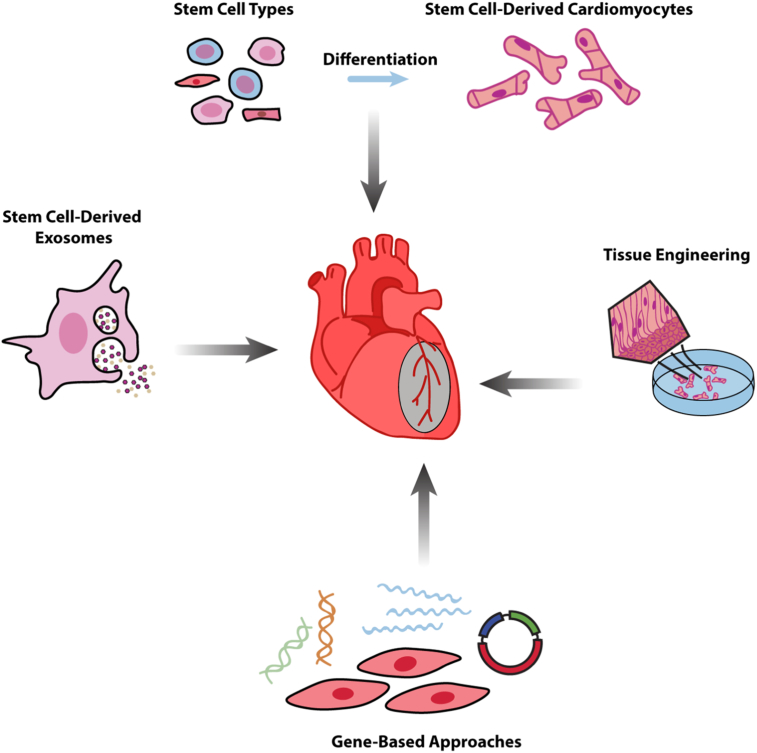
Despite advances in cardiovascular biology and medical therapy, heart disorders are the leading cause of death worldwide. Cell-based regenerative therapies become a promising treatment for patients affected by heart failure, but also underline the need for reproducible results in preclinical and clinical studies for safety and efficacy. Enthusiasm has been tempered by poor engraftment, survival and differentiation of the injected adult stem cells. The crucial challenge is identification and selection of the most suitable stem cell type for cardiac regenerative medicine. Human pluripotent stem cells (PSCs) have emerged as attractive cell source to obtain cardiomyocytes (CMs), with potential applications, including drug discovery and toxicity screening, disease modelling and innovative cell therapies. Lessons from embryology offered important insights into the development of stem cell-derived CMs. However, the generation of a CM population, uniform in cardiac subtype, adult maturation and functional properties, is highly recommended. Moreover, hurdles regarding tumorigenesis, graft cell death, immune rejection and arrhythmogenesis need to be overcome in clinical practice. Here we highlight the recent progression in PSC technologies for the regeneration of injured heart. We review novel strategies that might overcome current obstacles in heart regenerative medicine, aiming at improving cell survival and functional integration after cell transplantation.
Keywords: Embryonic cardiomyogenesis; Heart regeneration; Human pluripotent stem cell; Stem cell-based therapy; Stem cell-derived exosome.
Copyright © 2017. Published by Elsevier B.V.
Figures


References
-
- Aguirre A., Montserrat N., Zacchigna S., Nivet E., Hishida T., Krause M.N., Kurian L., Ocampo A., Vazquez-Ferrer E., Rodriguez-Esteban C., Kumar S., Moresco J.J., Yates J.R., 3rd, Campistol J.M., Sancho-Martinez I., Giacca M., Izpisua Belmonte J.C. In vivo activation of a conserved microRNA program induces mammalian heart regeneration. Cell Stem Cell. 2014;15:589–604. - PMC - PubMed
-
- Aicher A., Brenner W., Zuhayra M., Badorff C., Massoudi S., Assmus B., Eckey T., Henze E., Zeiher A.M., Dimmeler S. Assessment of the tissue distribution of transplanted human endothelial progenitor cells by radioactive labeling. Circulation. 2003;107:2134–2139. - PubMed
-
- Assmus B., Rolf A., Erbs S., Elsasser A., Haberbosch W., Hambrecht R., Tillmanns H., Yu J., Corti R., Mathey D.G., Hamm C.W., Suselbeck T., Tonn T., Dimmeler S., Dill T., Zeiher A.M., Schachinger V., Investigators, R.-A. Clinical outcome 2 years after intracoronary administration of bone marrow-derived progenitor cells in acute myocardial infarction. Circ. Heart Fail. 2010;3:89–96. - PubMed
-
- Assmus B., Walter D.H., Seeger F.H., Leistner D.M., Steiner J., Ziegler I., Lutz A., Khaled W., Klotsche J., Tonn T., Dimmeler S., Zeiher A.M. Effect of shock wave-facilitated intracoronary cell therapy on LVEF in patients with chronic heart failure: the CELLWAVE randomized clinical trial. JAMA. 2013;309:1622–1631. - PubMed
Publication types
MeSH terms
LinkOut - more resources
Full Text Sources
Other Literature Sources
Medical
