. 2017 Feb 7:8:14200.
doi: 10.1038/ncomms14200.

A unique Pd-catalysed Heck arylation as a remote trigger for cyclopropane selective ring-opening

Affiliations

A unique Pd-catalysed Heck arylation as a remote trigger for cyclopropane selective ring-opening

Sukhdev Singh et al. Nat Commun. .

Abstract

Combining functionalization at a distant position from a reactive site with the creation of several consecutive stereogenic centres, including the formation of a quaternary carbon stereocentre, in acyclic system represents a pinnacle in organic synthesis. Here we report the regioselective Heck arylation of terminal olefins as a distant trigger for the ring-opening of cyclopropanes. This Pd-catalysed unfolding of the strained cycle, driving force of the chain-walking process, remarkably proved its efficiency and versatility, as the reaction proceeded regardless of the molecular distance between the initiation (double bond) and termination (alcohol) sites. Moreover, employing stereodefined polysubstituted cyclopropane vaults allowed to access sophisticated stereoenriched acyclic scaffolds in good yields. Conceptually, we demonstrated that merging catalytically a chain walking process with a selective C-C bond cleavage represents a powerful approach to construct linear skeleton possessing two stereogenic centres.


Conflict of interest statement

The authors declare no competing financial interests.

Figures
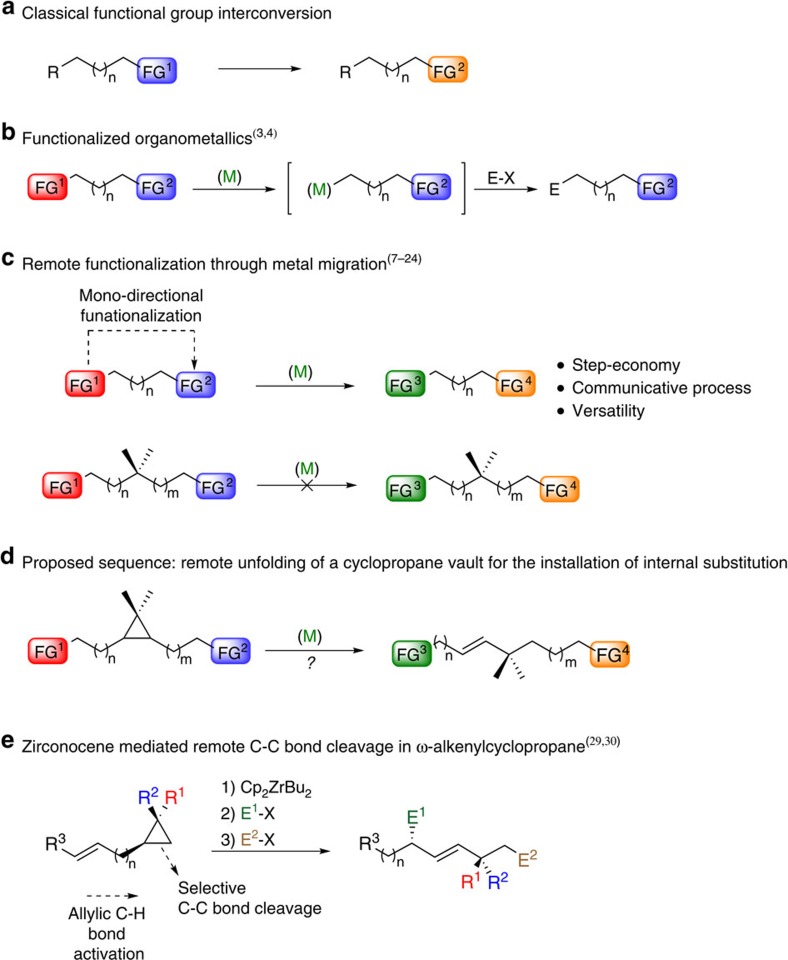
Figure 1
Figure 1. Comparison between the different strategies for the functionalization of organic skeletons.
(a) Classical approach for the selective interconversion of a functional group. (b) Chemoselective interaction between a metal and a specific moiety allowing the creation of functionalized organometallic species, leading to a variety of electrophilic substitution reactions. (c) Remote functionalization through metal migration strategy enabling a transformation away from a functional group at a distant position (FG2); located further away from (FG1). Despite many inherent advantages, this approach does not allow the presence of the highly regarded quaternary carbon stereocentre. (d) Proposed sequence where a strategically stereodefined polysubstituted cyclopropane vault is used assuming that the ring-strain release may drive the chain-walking process towards the formation of acyclic products and allowing the introduction of an internal substitution on the carbon skeleton. (e) Illustration of this sequence was reported for the addition of stoichiometric amount of low-valent zirconocene derivatives to ω-alkenyl cyclopropanes generating a cascade of events composed by successive allylic C–H bond activations, selective C–C bond cleavage and finally reaction with two different electrophiles (E1X and E2X).
Figure 2
Figure 2. Examples of Pd-catalysed Heck arylation as an initiation step triggering a remote functionalization and mechanistic hypothesis.
(a) The first report of a Pd-intramolecular migration across a molecule was pioneered by Heck and later extended by Larock showing the versatility of the method across longer alkenyl chain. (b) Sigman reported the enantioselective and site-selective Heck reaction of diazonium salts, vinyl triflates, aryl boronic acids and indole derivatives with ω-alkenyl alcohols. (c) Proposed catalytic sequence and mechanistic hypotheses for the transformation of cyclopropane 1 into regioisomers 2 and/or 3.
Figure 3
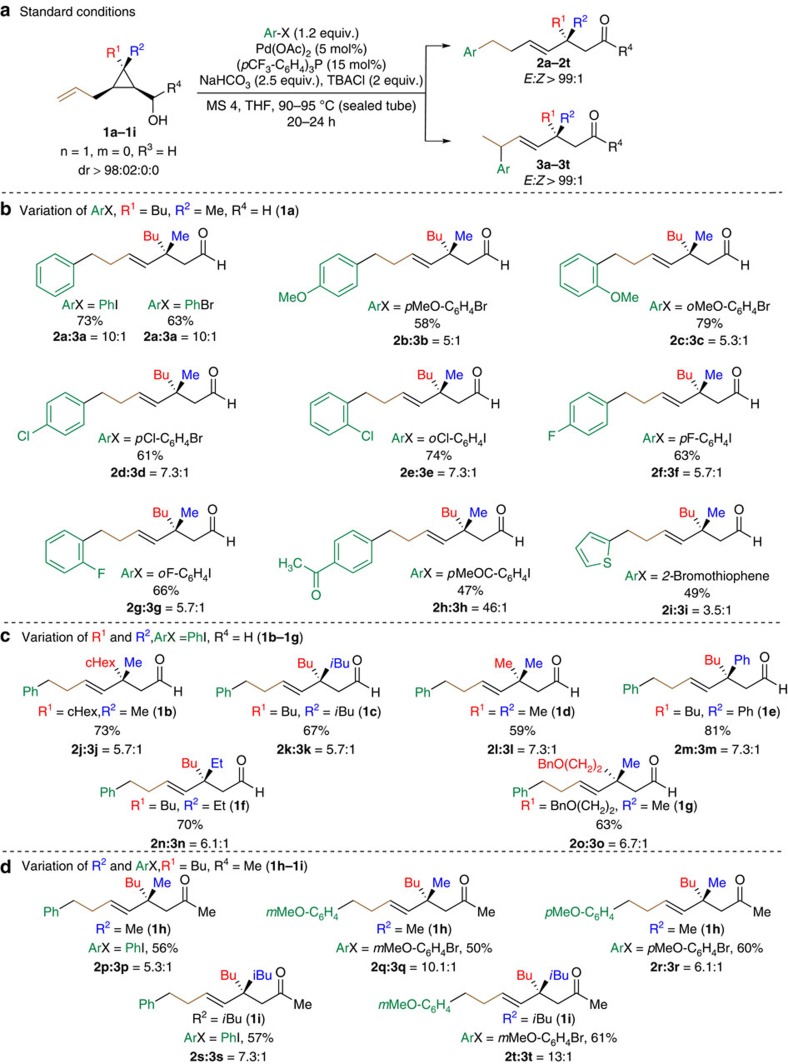
Figure 3. Scope of the reaction by varying ArX, R1, R2 and R4.
(a) Standard experiment conditions for the coupling of 1 with ArX yielding 2 and 3 using a Pd(0)-based catalytic system. (b) Scope of the aryl halide (ArX). (c) Scope of the substitution pattern on the cyclopropyl carbinol moiety (R1 and R2). (d) Examples involving the transformation of secondary alcohol derivatives (R4=Me) into ketones. Regioisomeric and E/Z ratios were determined by NMR and GC analyses of the crude reaction mixture. All represented yields are the combined yields of both regioisomers after purification by column chromatography.
Figure 4
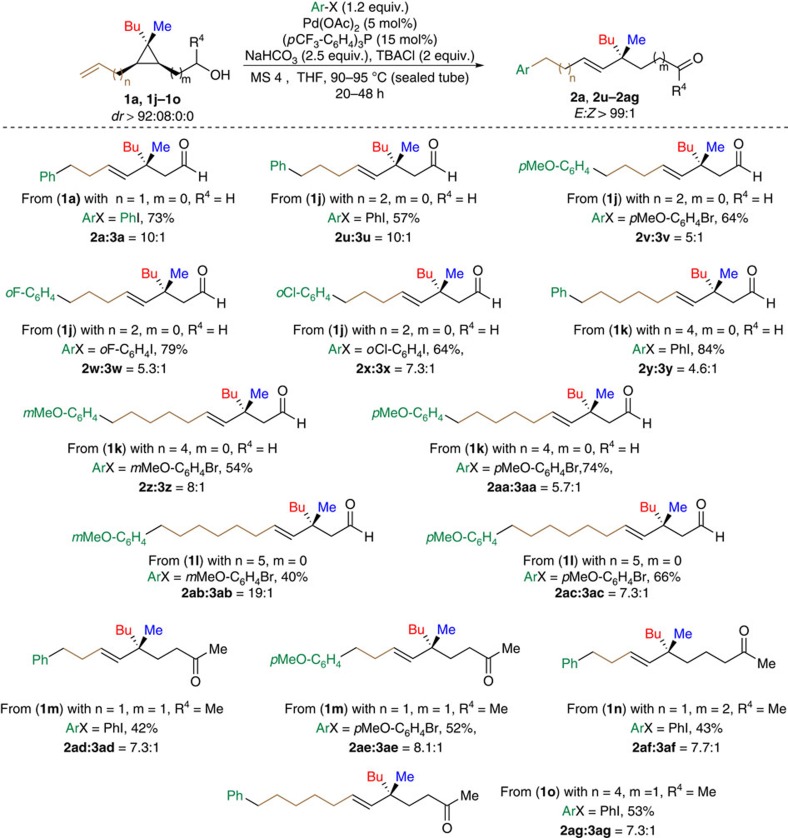
Figure 4. Scope of the chain lengths (n and m).
Increase of the molecular distance (n) between the double bond and cyclopropane moieties as well as the molecular distance (m) between the alcohol and cyclopropane and finally the situation where both chain length n and m are increased.
Figure 5
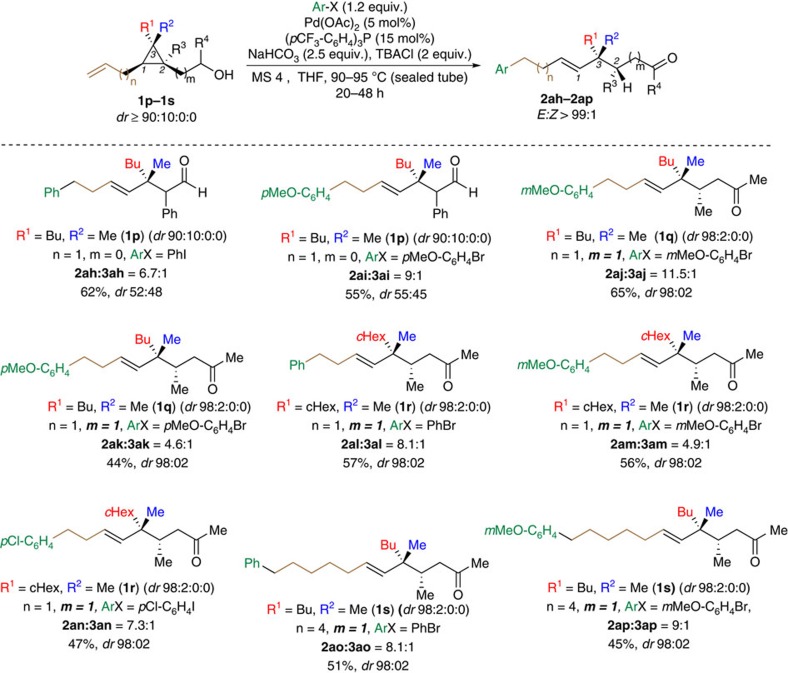
Figure 5. Scope of the chain lengths (n and m) and substitution.
Remote Pd-catalysed Heck triggered ring-opening in 1,2,2,3,3-pentasubstituted cyclopropane derivatives (1p1s). The relative configuration of 2aj was confirmed by X-ray analysis of the corresponding hydrazone 4 (see Supplementary Fig. 91). Relative configurations of other major products 2aj2ap were assigned by analogy. The described yields are the combined yields of both regioisomers after purification by column chromatography. Regioisomeric, diasteromeric and E/Z ratios were determined by NMR and GC analyses of the crude mixture.
Figure 6
Figure 6. Control and isotope labelling experiments.
(a) Effect of the relative stereochemistry between the ω-alkenyl chain and the alcohol residue on the reaction outcome using standard reaction conditions (see Fig. 3a). (b) Isotopic labelling experiments. Deuterium incorporation was confirmed by NMR and mass spectrometry analyses of products 516 after purification over column chromatography.

References

    1. Carreira E. M. & Kvaerno L. Classics in Stereoselective Synthesis Wiley-VCH (2009).
    1. Corey E. J. & Lecture R. R. Retrosynthetic thinking-essentials and examples. Chem. Soc. Rev. 17, 111–133 (1988).
    1. Benischke A. D. et al.. Polyfunctional zinc and magnesium organometallics for organic synthesis: some perspectives. Synthesis 48, 1101–1107 (2014).
    1. Boudier A. et al.. New applications of polyfunctional organometallics in organic synthesis. Angew. Chem. Int. Ed. 39, 4414–4435 (2000). - PubMed
    1. Schwarz H. Remote functionalization of C–H and C–C bonds by ‘naked' transition metal ions (Cosi Fan Tutte). Acc. Chem. Res. 22, 282–287 (1989).

Publication types

LinkOut - more resources