. 2017 Feb 7:7:42245.
doi: 10.1038/srep42245.

Microbiota composition of simultaneously colonized mice housed under either a gnotobiotic isolator or individually ventilated cage regime

Affiliations

Microbiota composition of simultaneously colonized mice housed under either a gnotobiotic isolator or individually ventilated cage regime

Randi Lundberg et al. Sci Rep. .

Abstract

Germ-free rodents colonized with microbiotas of interest are used for host-microbiota investigations and for testing microbiota-targeted therapeutic candidates. Traditionally, isolators are used for housing such gnotobiotic rodents due to optimal protection from the environment, but research groups focused on the microbiome are increasingly combining or substituting isolator housing with individually ventilated cage (IVC) systems. We compared the effect of housing systems on the gut microbiota composition of germ-free mice colonized with a complex microbiota and housed in either multiple IVC cages in an IVC facility or in multiple open-top cages in an isolator during three generations and five months. No increase in bacterial diversity as assessed by 16S rRNA gene sequencing was observed in the IVC cages, despite not applying completely aseptic cage changes. The donor bacterial community was equally represented in both housing systems. Time-dependent clustering between generations was observed in both systems, but was strongest in the IVC cages. Different relative abundance of a Rikenellaceae genus contributed to separate clustering of the isolator and IVC communities. Our data suggest that complex microbiotas are protected in IVC systems, but challenges related to temporal dynamics should be addressed.


Conflict of interest statement

The authors declare no competing financial interests.

Figures
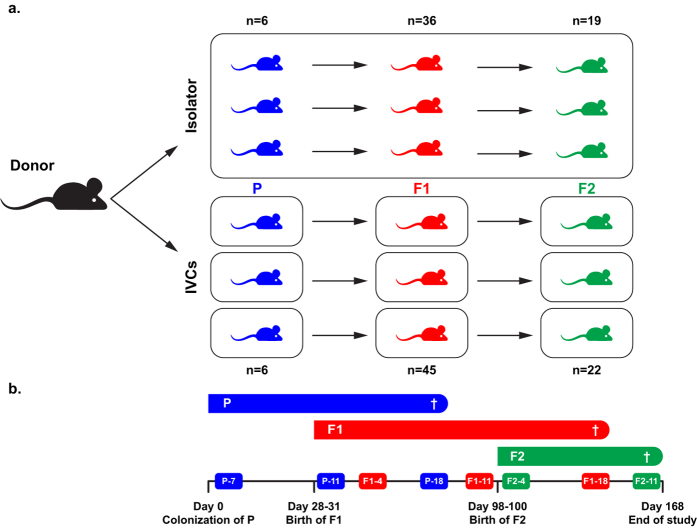
Figure 1
Figure 1. Study design and timeline.
(a) Study design. Colonic contents from C57BL/6NTac donor mice were used for inoculating germ-free Tac:SW parental (P) mice by oral gavage. P mice were housed in a flexible film isolator or in individually ventilated cages (IVCs). Mice were bred to include P, F1 and F2 generations in the study. The figure is not reflecting the actual numbers of cages. (b) Timeline of breeding and fecal samplings. Boxes on the timeline illustrate when fecal samples for 16S rRNA gene sequencing were collected, e.g., P-7 = fecal sampling from P mice 7 weeks old. † = termination of group.
Figure 2
Figure 2. Colonization efficiency and alpha diversity of the microbiota of mice from different generations.
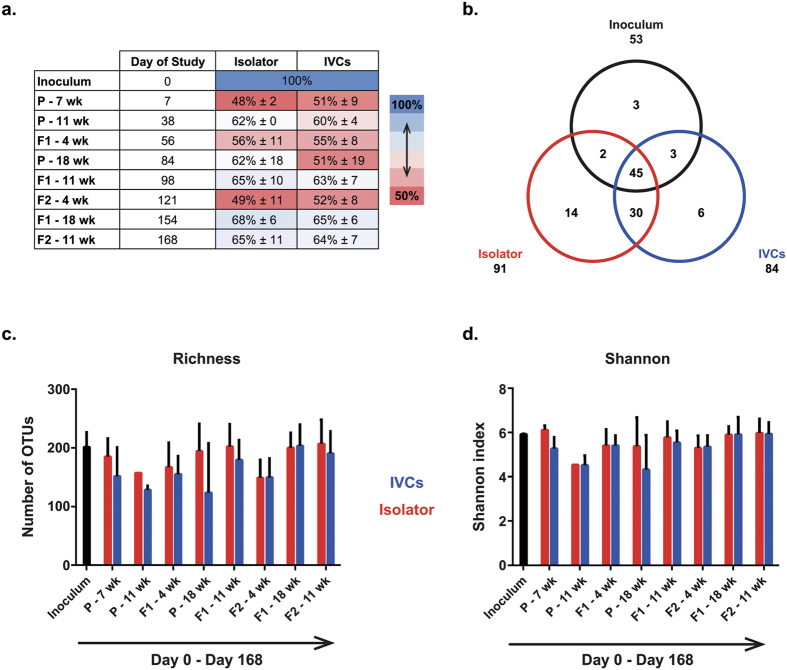
(a) Heat map of colonization efficiency of each generation compared to inoculum. Detected taxa on genus level in the inoculum correspond to 100%, and the mean percentage with s.d. in each housing system is shown for each generation and age time point. There were no differences between the housing systems, but colonization efficiency for P at 7 weeks and F1 and F2 at 4 weeks were significantly lower than the other time points in both housing systems (Supplementary Table S1). (b) Venn diagram showing number of unique genus level taxa shared between the housing systems and the inoculum. (c+d) Richness (number of OTUs not summarized to a specific taxonomic level) (c) and Shannon index (d) of inoculum and fecal samples from each generation and age sorted per the timeline of the study (Day 0-Day 168). There were no differences between the housing systems at any time point (t-test; bars are s.d.). P = parent mice inoculated at 6 weeks of age; F1 and F2 = offspring generations born with the microbiota.
Figure 3
Figure 3. Alpha diversity of the gut microbiota at different ages.
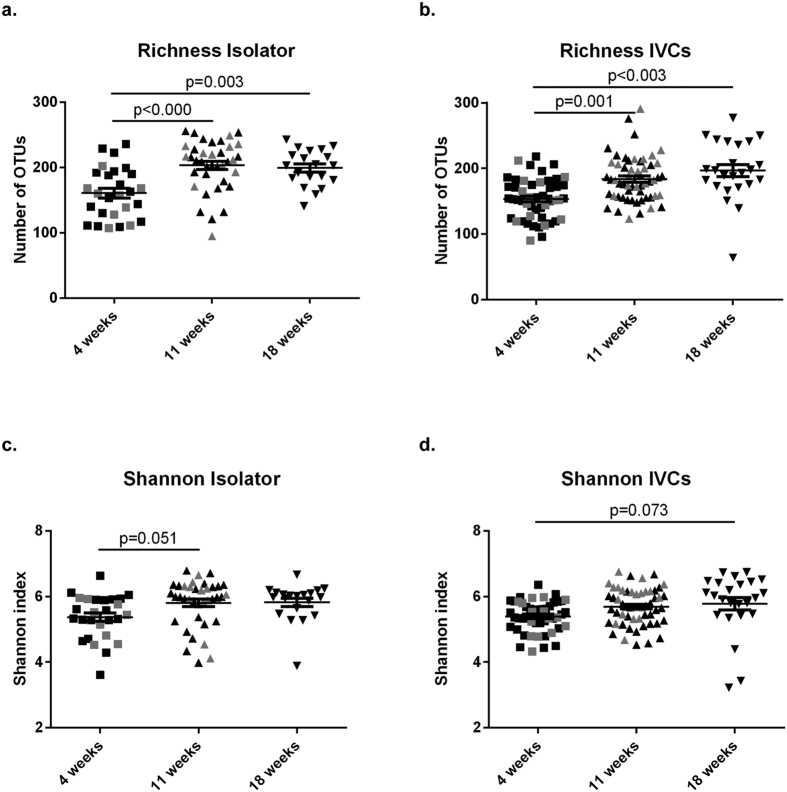
Richness (a+b) and Shannon index (c+d) of fecal samples from F1 and F2 mice aged 4, 11, and 18 weeks. The 4 and 11 week age time points represent cumulated samples from F1 (black symbols) and F2 (grey symbols), as these were not statistically different. 18 weeks represent F1 only, as the study did not include F2 mice aged 18 weeks (ANOVA with Tukey’s pairwise comparisons; bars are s.e.m.).
Figure 4
Figure 4. Unweighted UniFrac PCoA plots showing gut microbiota beta diversity of isolator- and IVC-housed mice over three generations.
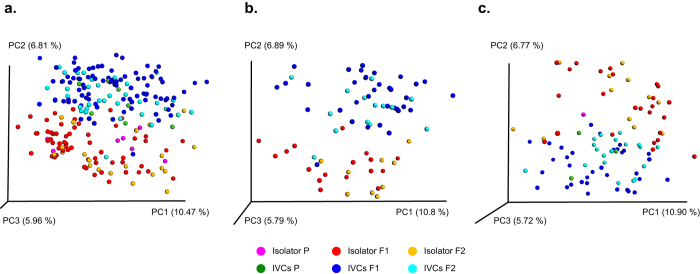
(a) Fecal samples from all isolator and IVC samples (i.e., P aged 7, 11 and 18 weeks, F1 aged 4, 11 and 18 weeks, and F2 aged 4 and 11 weeks) coloured per generation (b) Fecal samples from F1 mice aged 4 weeks only. F1 and F2 displayed low separation in both housing systems (Unweighted PCoA; Isolator: p = 0.008; R = 0.21. IVCs: p = 0.002; R = 0.23) (c) Fecal samples from F1 mice aged 11 weeks only. There was no significant separation of the F1 and F2 generation at 11 weeks of age in either housing system. P = parent mice inoculated at 6 weeks of age; F1 and F2 = offspring generations born with the microbiota.
Figure 5
Figure 5. Gut microbiota composition and beta diversity of inoculum, isolator- and IVC-housed mice.
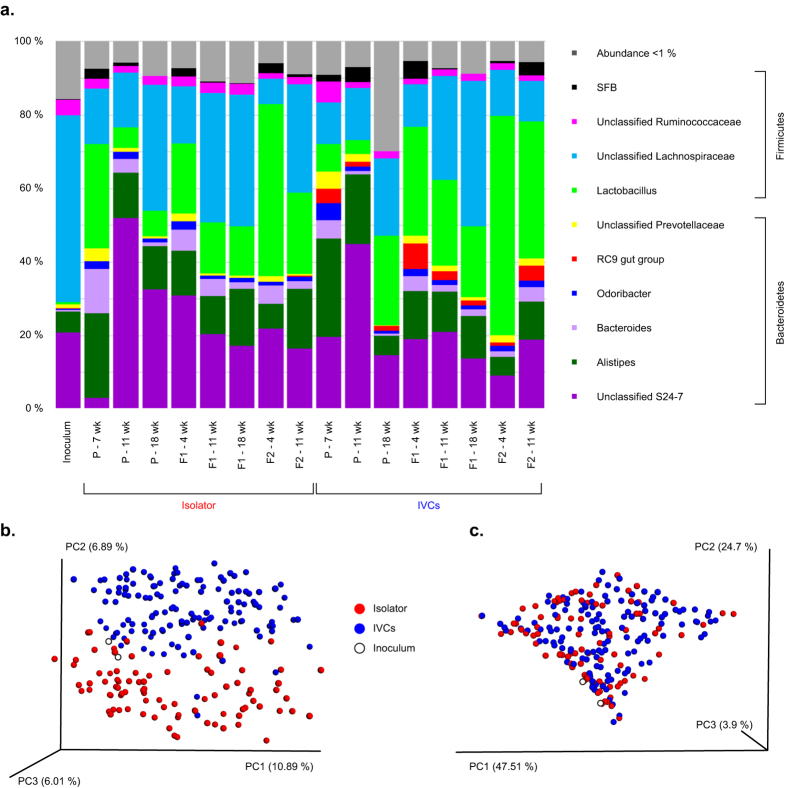
(a) Relative abundance (%) of the 10 most abundant genus level taxa in inoculum and fecal samples from the isolator and IVCs per generation and age. Taxa with an abundance <1% were collapsed. (b+c) Unweighted (b) and weighted (c) UniFrac PCoA plots of all isolator and IVC samples (i.e., P aged 7, 11 and 18 weeks, F1 aged 4, 11 and 18 weeks, and F2 aged 4 and 11 weeks), and the inoculum in PCR duplicates. Isolator and IVC samples displayed a low to moderate separate clustering from each other (Unweighted: p = 0.001, R = 0.34; Weighted: p = 0.003, R = 0.04). P = parent mice inoculated at 6 weeks of age; F1 and F2 = offspring generations born with the microbiota.

References

    1. Hecht G. et al. A simple cage-autonomous method for the maintenance of the barrier status of germ-free mice during experimentation. Lab. Anim. 48, 292–7 (2014). - PubMed
    1. Paik J. et al. Potential for using a hermetically-sealed, positive-pressured isocage system for studies involving germ-free mice outside a flexible-film isolator. Gut Microbes 6, 255–65 (2015). - PMC - PubMed
    1. Brielmeier M. et al. Microbiological monitoring of laboratory mice and biocontainment in individually ventilated cages: a field study. Lab. Anim. 40, 247–60 (2006). - PubMed
    1. Hufeldt M. R., Nielsen D. S., Vogensen F. K., Midtvedt T. & Hansen A. K. Variation in the gut microbiota of laboratory mice is related to both genetic and environmental factors. Comp. Med. 60, 336–47 (2010). - PMC - PubMed
    1. Thoene-Reineke C. et al. Composition of intestinal microbiota in immune-deficient mice kept in three different housing conditions. PLoS One 9, e113406 (2014). - PMC - PubMed

Publication types

LinkOut - more resources