Review
. 2017 May;33(3):189-195.
doi: 10.1097/MOG.0000000000000344.

Bile acid disease: the emerging epidemic

Affiliations
Review

Bile acid disease: the emerging epidemic

Ibironke Oduyebo et al. Curr Opin Gastroenterol. 2017 May.

Abstract

Purpose of review: Our objective was to review advances in bile acids in health and disease published in the last 2 years. Bile acid diarrhea (BAD) is recognized as a common cause of chronic diarrhea, and its recognition has been facilitated by development of new screening tests.

Recent findings: Primary BAD can account for 30% of cases of chronic diarrhea. The mechanisms leading to BAD include inadequate feedback regulation by fibroblast growth factor 19 (FGF-19) from ileal enterocytes, abnormalities in synthesis or degradation of proteins involved in FGF-19 regulation in hepatocytes and variations as a function of the bile acid receptor, TGR5 (GPBAR1). SeHCAT is the most widely used test for diagnosis of BAD. There has been significant validation of fasting serum FGF-19 and 7 α-hydroxy-cholesten-3-one (C4), a surrogate measure of bile acid synthesis. Bile acid sequestrants are the primary treatments for BAD; the farnesoid X-receptor-FGF-19 pathway provides alternative therapeutic targets for BAD. Bile acid-stimulated intestinal mechanisms contribute to the beneficial effects of bariatric surgery on obesity, glycemic control and the treatment of recurrent Clostridium difficile infection.

Summary: Renewed interest in the role of bile acids is leading to novel management of diverse diseases besides BAD.


Conflict of interest statement

Conflicts of Interest

The authors are currently conducting sponsored research funded by NGM Pharmaceuticals on effects of an FGF-19 analog.

Figures
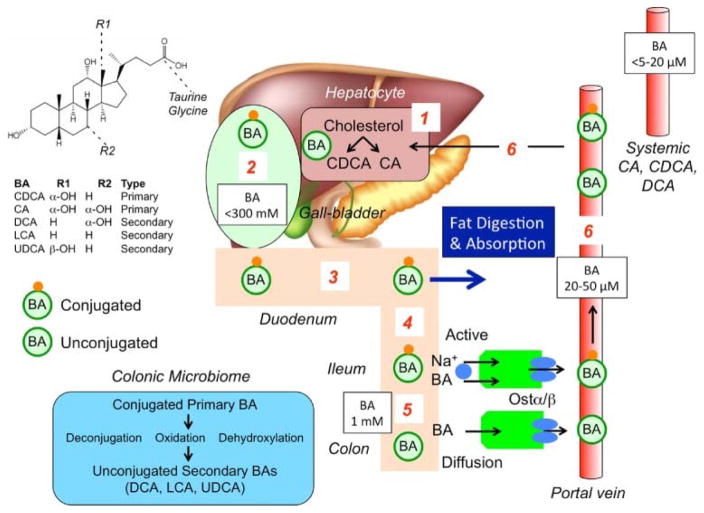
Figure 1
Figure 1. Synthesis, secretion and enterohepatic circulation of BAs in humans
(1) Primary bile acids (BAs) are synthesized in hepatocytes from cholesterol. (2) BAs are conjugated to glycine and taurine and are stored in the gallbladder at high concentrations. (3) After feeding, conjugated BAs are secreted in the intestine where they emulsify dietary fats and form mixed micelles that facilitate digestion and absorption of the products of triglyceride digestion. (4) Conjugated BAs are actively absorbed by the apical sodium BA co-transporter (ASBT [IBAT]) at the apical membrane of enterocytes of the terminal ileum. (5) In the colon, bacteria deconjugate and dehydroxylate primary BAs to form secondary BAs, which are passively absorbed. (6) Conjugated and unconjugated BAs enter the portal vein and recirculate to the liver for re-use. Reproduced with permission from ref. , Bunnett NW. Neuro-humoral signalling by bile acids and the TGR5 receptor in the gastrointestinal tract. J Physiol 2014; 592:2943-2950.
Figure 2
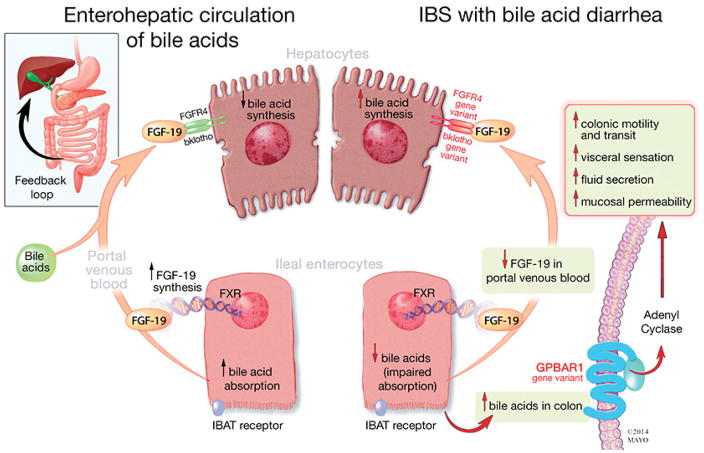
Figure 2. Enterohepatic circulation of bile acids in irritable bowel syndrome with diarrhea (IBS-D)
Ileal enterocytes absorb BAs through a receptor-mediated process [ileal bile acid transporter (IBAT)]. Intracellular BAs activate farnesoid-X receptor to increase FGF-19 synthesis. FGF-19 in portal circulation downregulates hepatocyte BA synthesis through inhibition of CYP7A1, a rate limiting enzyme. Disorders of FGF-19 synthesis by ileal enterocytes or genetic variations of FGF-R4 or β-klotho result in excess BA synthesis by the hepatocytes and, ultimately, in higher levels of BAs that reach the colon, resulting in activation of the G-protein coupled BA receptor 1 (GPBAR1) with enteroendocrine cell stimulation [(e.g. release of 5-hydroxytryptamine (5-HT)] and stimulation of colonic motility, acceleration of colonic transit, activation of visceral sensation and fluid secretion (through increased intracellular cAMP, increased mucosal permeability or chloride ion secretion). Gene variation in GPBAR1 is associated with increased colonic transit in IBS-D. Reproduced with permission from ref. , Camilleri M. Physiological underpinnings of irritable bowel syndrome: neurohormonal mechanisms. J Physiol 2014; 592:2967-2980.

References

    1. Slattery SA, Niaz O, Aziz Q, et al. Systematic review with meta-analysis: the prevalence of bile acid malabsorption in the irritable bowel syndrome with diarrhoea. Aliment Pharmacol Ther. 2015;42:3–11. - PubMed
    1. Valentin N, Camilleri M, Altayar O, et al. Biomarkers for bile acid diarrhoea in functional bowel disorder with diarrhoea: a systematic review and meta-analysis. Gut. 2015 Sep 7; doi: 10.1136/gutjnl-2015-309889. pii: gutjnl-2015–309889 Epub ahead of print. - DOI - PubMed
    1. Fernandez-Bañares F, Esteve M, Salas A, et al. Bile acid malabsorption in microscopic colitis and in previously unexplained functional chronic diarrhea. Dig Dis Sci. 2001;46:2231–2238. - PubMed
    1. Bunnett NW. Neuro-humoral signalling by bile acids and the TGR5 receptor in the gastrointestinal tract. J Physiol. 2014;592:2943–2950. - PMC - PubMed
    1. Wingate DL, Krag E, Mekhjian HS, Phillips SF. Relationships between ion and water movement in the human jejunum, ileum and colon during perfusion with bile acids. Clin Sci Mol Med. 1973;45:593–606. - PubMed