


Biomedical Informatics Approaches to Identifying Drug-Drug Interactions: Application to Insulin Secretagogues
- PMID: 28169935
- PMCID: PMC5378621
- DOI: 10.1097/EDE.0000000000000638
Biomedical Informatics Approaches to Identifying Drug-Drug Interactions: Application to Insulin Secretagogues
Abstract
Background: Drug-drug interactions with insulin secretagogues are associated with increased risk of serious hypoglycemia in patients with type 2 diabetes. We aimed to systematically screen for drugs that interact with the five most commonly used secretagogues-glipizide, glyburide, glimepiride, repaglinide, and nateglinide-to cause serious hypoglycemia.
Methods: We screened 400 drugs frequently coprescribed with the secretagogues as candidate interacting precipitants. We first predicted the drug-drug interaction potential based on the pharmacokinetics of each secretagogue-precipitant pair. We then performed pharmacoepidemiologic screening for each secretagogue of interest, and for metformin as a negative control, using an administrative claims database and the self-controlled case series design. The overall rate ratios (RRs) and those for four predefined risk periods were estimated using Poisson regression. The RRs were adjusted for multiple estimation using semi-Bayes method, and then adjusted for metformin results to distinguish native effects of the precipitant from a drug-drug interaction.
Results: We predicted 34 pharmacokinetic drug-drug interactions with the secretagogues, nine moderate and 25 weak. There were 140 and 61 secretagogue-precipitant pairs associated with increased rates of serious hypoglycemia before and after the metformin adjustment, respectively. The results from pharmacokinetic prediction correlated poorly with those from pharmacoepidemiologic screening.
Conclusions: The self-controlled case series design has the potential to be widely applicable to screening for drug-drug interactions that lead to adverse outcomes identifiable in healthcare databases. Coupling pharmacokinetic prediction with pharmacoepidemiologic screening did not notably improve the ability to identify drug-drug interactions in this case.
Conflict of interest statement
Figures
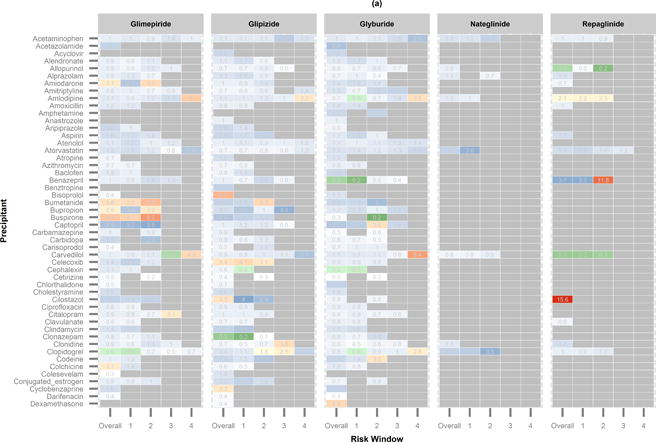
 RRSBM and 95% CI less than 1:
 RRSBM and 95% CI spanning 1:

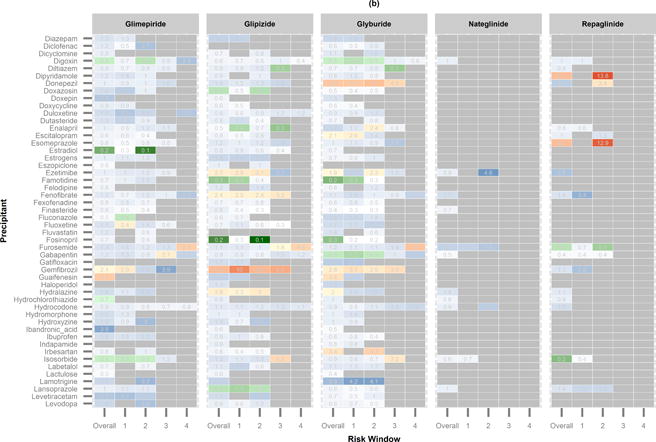 RRSBM and 95% CI less than 1:
RRSBM and 95% CI spanning 1:
RRSBM and 95% CI less than 1:
RRSBM and 95% CI spanning 1:
 RRSBM and 95% CI less than 1:
RRSBM and 95% CI spanning 1:
RRSBM and 95% CI less than 1:
RRSBM and 95% CI spanning 1:
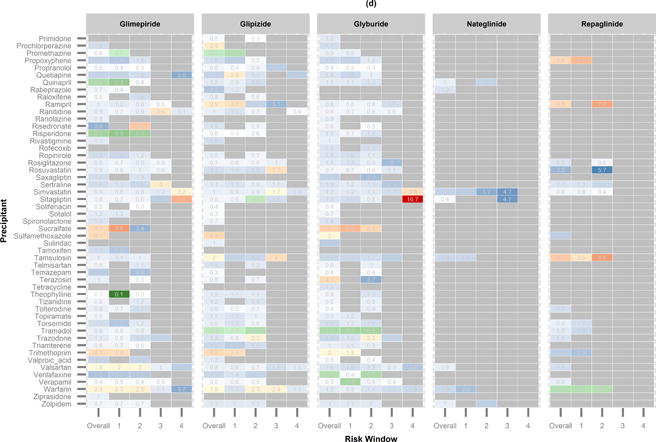 RRSBM and 95% CI less than 1:
RRSBM and 95% CI spanning 1:
RRSBM and 95% CI less than 1:
RRSBM and 95% CI spanning 1:
Comment in
-
Re: Biomedical Informatics Approaches to Identifying Drug-Drug Interactions: Application to Insulin Secretagogues.Epidemiology. 2018 Jan;29(1):e8. doi: 10.1097/EDE.0000000000000760. Epidemiology. 2018. PMID: 28938235 No abstract available.
-
The Authors Respond.Epidemiology. 2018 Jan;29(1):e8-e9. doi: 10.1097/EDE.0000000000000759. Epidemiology. 2018. PMID: 28938236 No abstract available.
References
-
- Hampp C, Borders-Hemphill V, Moeny DG, Wysowski DK. Use of antidiabetic drugs in the U.S., 2003–2012. Diabetes care. 2014;37(5):1367–1374. - PubMed
-
- Cryer PE. Mechanisms of hypoglycemia-associated autonomic failure in diabetes. The New England journal of medicine. 2013;369(4):362–372. - PubMed
-
- Desouza C, Salazar H, Cheong B, Murgo J, Fonseca V. Association of hypoglycemia and cardiac ischemia: a study based on continuous monitoring. Diabetes care. 2003;26(5):1485–1489. - PubMed
-
- Miller CD, Phillips LS, Ziemer DC, Gallina DL, Cook CB, El-Kebbi IM. Hypoglycemia in patients with type 2 diabetes mellitus. Archives of internal medicine. 2001;161(13):1653–1659. - PubMed
MeSH terms
Substances
Grants and funding
LinkOut - more resources
Full Text Sources
Other Literature Sources
Medical
