


Analyte-Responsive Hydrogels: Intelligent Materials for Biosensing and Drug Delivery
- PMID: 28170227
- PMCID: PMC6130197
- DOI: 10.1021/acs.accounts.6b00533
Analyte-Responsive Hydrogels: Intelligent Materials for Biosensing and Drug Delivery
Erratum in
-
Analyte-Responsive Hydrogels: Intelligent Materials for Biosensing and Drug Delivery.Acc Chem Res. 2018 Oct 16;51(10):2600. doi: 10.1021/acs.accounts.8b00411. Epub 2018 Sep 11. Acc Chem Res. 2018. PMID: 30204406 No abstract available.
Abstract
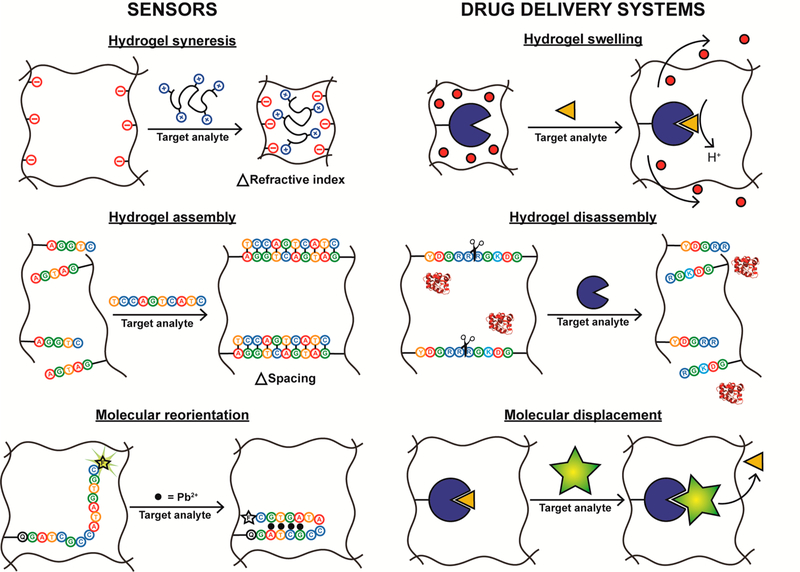
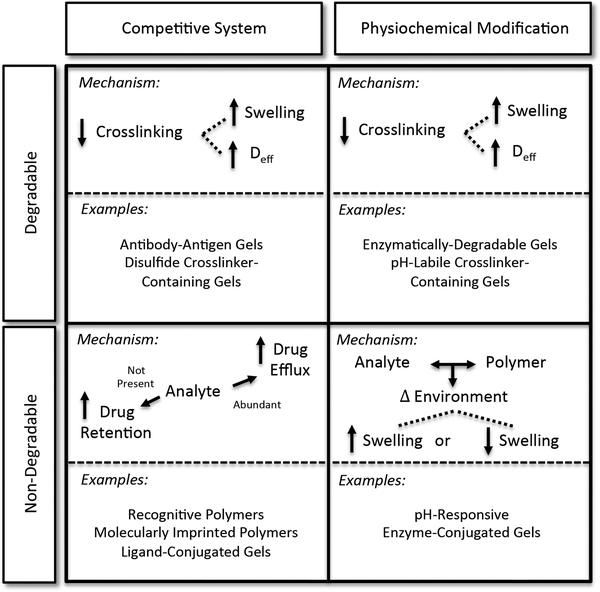
Nature has mastered the art of molecular recognition. For example, using synergistic non-covalent interactions, proteins can distinguish between molecules and bind a partner with incredible affinity and specificity. Scientists have developed, and continue to develop, techniques to investigate and better understand molecular recognition. As a consequence, analyte-responsive hydrogels that mimic these recognitive processes have emerged as a class of intelligent materials. These materials are unique not only in the type of analyte to which they respond but also in how molecular recognition is achieved and how the hydrogel responds to the analyte. Traditional intelligent hydrogels can respond to environmental cues such as pH, temperature, and ionic strength. The functional monomers used to make these hydrogels can be varied to achieve responsive behavior. For analyte-responsive hydrogels, molecular recognition can also be achieved by incorporating biomolecules with inherent molecular recognition properties (e.g., nucleic acids, peptides, enzymes, etc.) into the polymer network. Furthermore, in addition to typical swelling/syneresis responses, these materials exhibit unique responsive behaviors, such as gel assembly or disassembly, upon interaction with the target analyte. With the diverse tools available for molecular recognition and the ability to generate unique responsive behaviors, analyte-responsive hydrogels have found great utility in a wide range of applications. In this Account, we discuss strategies for making four different classes of analyte-responsive hydrogels, specifically, non-imprinted, molecularly imprinted, biomolecule-containing, and enzymatically responsive hydrogels. Then we explore how these materials have been incorporated into sensors and drug delivery systems, highlighting examples that demonstrate the versatility of these materials. For example, in addition to the molecular recognition properties of analyte-responsive hydrogels, the physicochemical changes that are induced upon analyte binding can be exploited to generate a detectable signal for sensing applications. As research in this area has grown, a number of creative approaches for improving the selectivity and sensitivity (i.e., detection limit) of these sensors have emerged. For applications in drug delivery systems, therapeutic release can be triggered by competitive molecular interactions or physicochemical changes in the network. Additionally, including degradable units within the network can enable sustained and responsive therapeutic release. Several exciting examples exploiting the analyte-responsive behavior of hydrogels for the treatment of cancer, diabetes, and irritable bowel syndrome are discussed in detail. We expect that creative and combinatorial approaches used in the design of analyte-responsive hydrogels will continue to yield materials with great potential in the fields of sensing and drug delivery.
Figures
References
-
- Peppas NA; Huang Y; Torres-Lugo M; Ward JH; Zhang J Physicochemical Foundations and Structural Design of Hydrogels in Medicine and Biology. Annu. Rev. Biomed. Eng 2000, 2 (1), 9–29. - PubMed
-
- Peppas NA; Huang Y Polymers and Gels as Molecular Recognition Agents. Pharm. Res 2002, 19 (5), 578–587. - PubMed
-
- Luchini A; Geho DH; Bishop B; Tran D; Xia C; Dufour RL; Jones CD; Espina V; Patanarut A; Zhou W; Ross MM; Tessitore A; Petricoin EF; Liotta LA Smart Hydrogel Particles: Biomarker Harvesting: One-Step Affinity Purification, Size Exclusion, and Protection against Degradation. Nano Lett. 2008, 8 (1), 350–361. - PMC - PubMed
-
- Yu M; Jambhrunkar S; Thorn P; Chen J; Gu W; Yu C Hyaluronic Acid Modified Mesoporous Silica Nanoparticles for Targeted Drug Delivery to CD44-Overexpressing Cancer Cells. Nanoscale 2013, 5 (1), 178–183. - PubMed
-
- Latza P; Gilles P; Schaller T; Schrader T Affinity Polymers Tailored for the Protein A Binding Site of Immunoglobulin G Proteins. Chem. - Eur. J 2014, 20 (36), 11479–11487. - PubMed
MeSH terms
Substances
Grants and funding
LinkOut - more resources
Full Text Sources
Other Literature Sources
