


Evaluating Diagnostic and Statistical Manual of Mental Disorders, Fifth Edition Posttraumatic Stress Disorder Diagnostic Criteria in Older Children and Adolescents
- PMID: 28170306
- PMCID: PMC5439440
- DOI: 10.1089/cap.2016.0134
Evaluating Diagnostic and Statistical Manual of Mental Disorders, Fifth Edition Posttraumatic Stress Disorder Diagnostic Criteria in Older Children and Adolescents
Abstract
Objectives: Few studies have assessed how the diagnostic criteria for posttraumatic stress disorder (PTSD) apply to older children and adolescents. With the introduction of a new, developmentally sensitive set of criteria for very young children (age 6 years and younger) in Diagnostic and Statistical Manual of Mental Disorders, fifth edition (DSM-5), this raises new questions about the validity of the criteria for older children and adolescents. The current study investigated how diagnostic changes in DSM-5 impact diagnosis rates in 7-18-year olds.
Methods: PTSD, impairment, and comorbid psychopathology were assessed in 135 trauma-exposed, treatment-seeking participants. Children (ages 7-12) were examined separately from adolescents (ages 13-18) to assess for potential developmental differences.
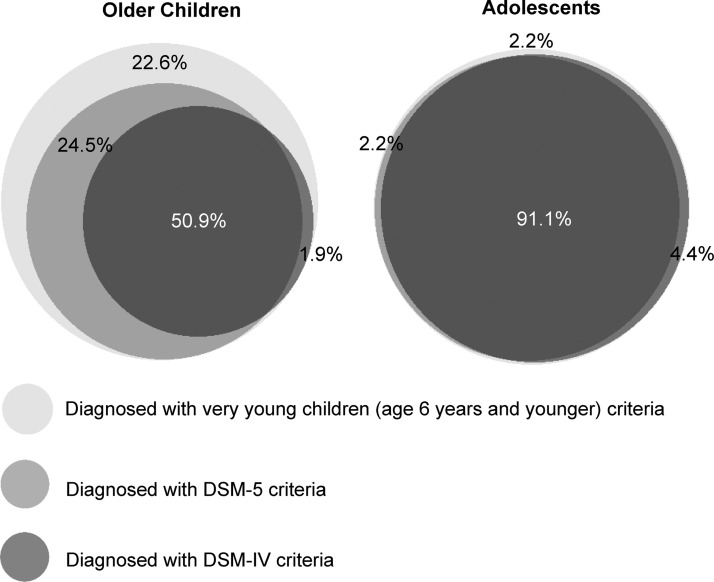
Results: A significantly higher proportion of 7-12-year-old children met criteria for DSM-5 diagnosis (53%) compared to Diagnostic and Statistical Manual of Mental Disorders, fourth edition (DSM-IV) (37%). However, among 13-18-year-old adolescents, the proportions diagnosed with DSM-5 (73%) and DSM-IV (74%) did not differ. Participants who met criteria for DSM-5 only (17%) did not differ from those diagnosed with DSM-IV in terms impairment or comorbidity. Using the newly accepted age 6 years and younger criteria resulted in a significantly higher proportion of 7-12-year-old (but not 13-18-year olds) children meeting criteria compared to DSM-IV or DSM-5. However, these children showed less impairment and comorbidity than those diagnosed with DSM-IV.
Conclusion: These findings suggest that DSM-5 criteria may be more developmentally sensitive than DSM-IV criteria, and may lead to higher prevalence rates of PTSD for 7-12-year-old children, but not for adolescents. Using the very young children criteria for 7-12-year-old children may further increase prevalence, but capture children with less severe psychopathology.
Keywords: DSM-5; adolescents; children; diagnostic criteria; posttraumatic stress disorder.
Conflict of interest statement
No competing financial interests exist.
Figures
References
-
- American Psychiatric Association: Diagnostic and Statistical Manual of Mental Disorders, 4th ed., Text Revision. Washington (DC), American Psychiatric Association, 2000
-
- American Psychiatric Association: Diagnostic and Statistical Manual of Mental Disorders, 5th ed. Arlington (Virginia), American Psychiatric Publishing, 2013
-
- Anthony JL, Lonigan CJ, Hecht SA: Dimensionality of posttraumatic stress disorder symptoms in children exposed to disaster: Results from confirmatory factor analysis. J Abnorm Psychol 108:326–336, 1999 - PubMed
-
- Asmundson GJG, Frombach I, McQuaid J, Pedrelli P, Lenos R, Stein MB: Dimensionality of posttraumatic stress symptoms: A confirmatory factor analysis of DSM-IV symptom clusters and other symptom models. Behav Res Ther 38:203–214, 2000 - PubMed
-
- Birmaher B, Brent DA, Chiapetta L, Bridge J, Monga S, Baugher M: Psychometric properties of the Screen for Child Anxiety Related Emotional Disorders (SCARED): A replication study. J Am Acad Child Adolesc Psychiatry 38:1230–1236, 1999 - PubMed
Publication types
MeSH terms
LinkOut - more resources
Full Text Sources
Other Literature Sources
Medical
Miscellaneous
