. 2017 Jul;13(7):761-769.
doi: 10.1016/j.jalz.2016.12.008. Epub 2017 Feb 5.

Survival after dementia diagnosis in five racial/ethnic groups

Affiliations

Survival after dementia diagnosis in five racial/ethnic groups

Elizabeth R Mayeda et al. Alzheimers Dement. 2017 Jul.

Abstract

Introduction: Information on anticipated survival time after dementia diagnosis among racially/ethnically diverse patients is needed to plan for care and evaluate disparities.

Methods: Dementia-free health care members aged ≥64 years were followed (1/1/2000-12/31/2013) for dementia diagnosis and subsequent survival (n = 23,032 Asian American; n = 18,778 African American; n = 21,000 Latino; n = 4543 American Indian/Alaska Native; n = 206,490 white). Kaplan-Meier curves were estimated for survival after dementia diagnosis by race/ethnicity. We contrasted mortality patterns among people with versus without dementia using Cox proportional hazards models.

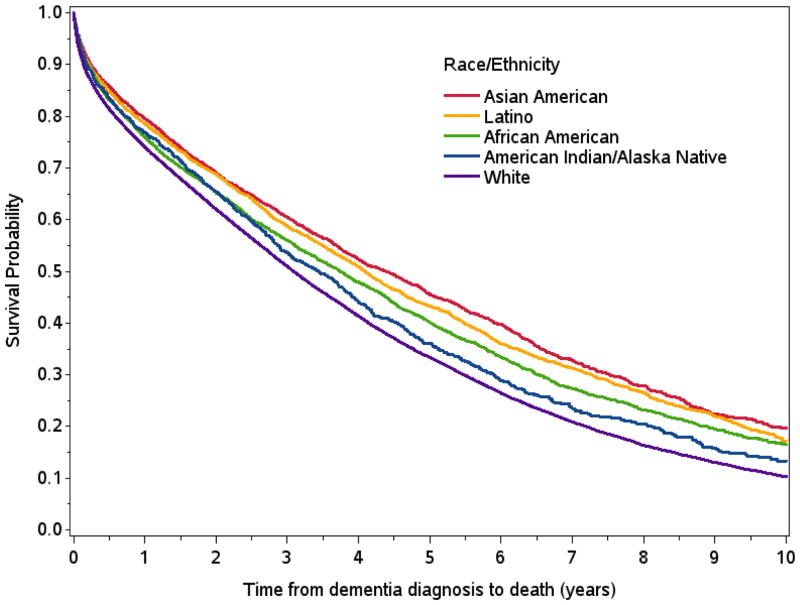
Results: After dementia diagnosis (n = 59,494), whites had shortest median survival (3.1 years), followed by American Indian/Alaska Natives (3.4 years), African Americans (3.7 years), Latinos (4.1 years), and Asian Americans (4.4 years). Longer postdiagnosis survival among racial/ethnic minorities compared with whites persisted after adjustment for comorbidities. Racial/ethnic mortality inequalities among dementia patients mostly paralleled mortality inequalities among people without dementia.

Discussion: Survival after dementia diagnosis differs by race/ethnicity, with shortest survival among whites and longest among Asian Americans.

Keywords: Cohort; Dementia; Disparities; Epidemiology; Ethnicity; Mortality; Race; Survival.


Figures

Figure 1
Figure 1
Kaplan-Meier survival curves from time of dementia diagnosis by race/ethnicity: Kaiser Permanente Northern California, 2000–2013. Total study follow-up was up to 14 years; we present Kaplan-Meier curves for 10 years because less than 25% of people with incident dementia survived more than 10 years.
Figure 2
Figure 2
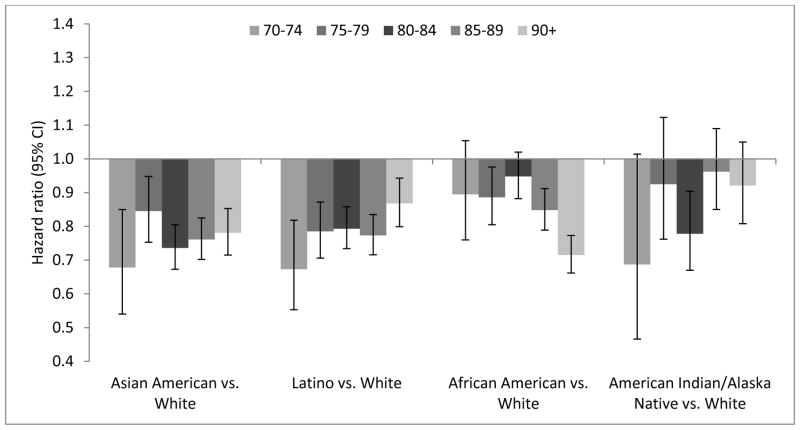
Hazard ratios (95% confidence intervals) relating race/ethnicity and mortality for people with incident dementia by age group from Cox proportional hazards models adjusted for comorbidities (Model 2): Kaiser Permanente Northern California, 2000–2013. Model 2 is adjusted for age (as timescale), sex, and comorbidities (depression, diabetes, hypertension, stroke, cardiovascular disease). Hazard ratios relating race/ethnicity and mortality for people with incident dementia are not presented for ages 64–69 because estimates were imprecise due to the small number of incident dementia cases and deaths in this age group; age 70–74 is therefore the farthest left column shown for each racial/ethnic comparison. The hazard ratios and 95% confidence intervals are presented in Table A.4.
Figure 3
Figure 3
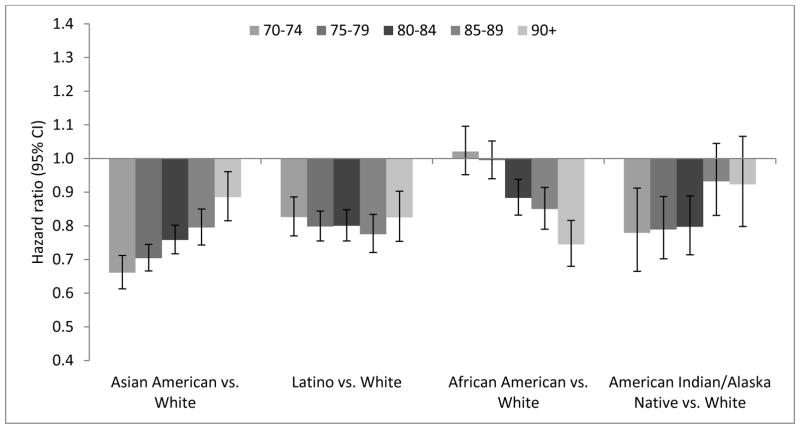
Hazard ratios (95% confidence intervals) relating race/ethnicity and mortality for people without dementia, adjusted for comorbidities (Model 2): Kaiser Permanente Northern California, 2000–2013. Model 2 is adjusted for age (as timescale), sex, and comorbidities (depression, diabetes, hypertension, stroke, cardiovascular disease). Hazard ratios relating race/ethnicity and mortality for people without dementia are not presented for ages 64–69 for consistency with Figure 2 (hazard ratios relating race/ethnicity and mortality for people with incident dementia); age 70–74 is therefore the farthest left column shown for each racial/ethnic comparison. The hazard ratios and 95% confidence intervals are presented in Table A.5.

References

    1. Todd S, Barr S, Roberts M, Passmore AP. Survival in dementia and predictors of mortality: a review. International journal of geriatric psychiatry. 2013;28:1109–24. - PubMed
    1. Mehta KM, Yaffe K, Perez-Stable EJ, Stewart A, Barnes D, Kurland BF, et al. Race/ethnic differences in AD survival in US Alzheimer’s Disease Centers. Neurology. 2008;70:1163–70. - PMC - PubMed
    1. Reuser M, Willekens FJ, Bonneux L. Higher education delays and shortens cognitive impairment: a multistate life table analysis of the US Health and Retirement Study. European journal of epidemiology. 2011;26:395–403. - PMC - PubMed
    1. Helzner EP, Scarmeas N, Cosentino S, Tang MX, Schupf N, Stern Y. Survival in Alzheimer disease: a multiethnic, population-based study of incident cases. Neurology. 2008;71:1489–95. - PMC - PubMed
    1. Yaffe K, Fox P, Newcomer R, Sands L, Lindquist K, Dane K, et al. Patient and caregiver characteristics and nursing home placement in patients with dementia. JAMA : the journal of the American Medical Association. 2002;287:2090–7. - PubMed