. 2017 Jan 24:11:2.
doi: 10.3389/fnbeh.2017.00002. eCollection 2017.

Reconsolidation-Extinction Interactions in Fear Memory Attenuation: The Role of Inter-Trial Interval Variability

Affiliations

Reconsolidation-Extinction Interactions in Fear Memory Attenuation: The Role of Inter-Trial Interval Variability

Allison Auchter et al. Front Behav Neurosci. .

Abstract

Fear extinction typically results in the formation of a new inhibitory memory that suppresses the original conditioned response. Evidence also suggests that extinction training during a retrieval-induced labile period results in integration of the extinction memory into the original fear memory, rendering the fear memory less susceptible to reinstatement. Here we investigated the parameters by which the retrieval-extinction paradigm was most effective in memory updating. Specifically, we manipulated the inter-trial intervals (ITIs) between conditional stimulus (CS) presentations during extinction, examining how having interval lengths with different degrees of variability affected the strength of memory updating. We showed that randomizing the ITI of CS presentations during extinction led to less return of fear via reinstatement than extinction with a fixed ITI. Subjects who received variable ITIs during extinction also showed higher freezing during the ITI, indicating that the randomization of CS presentations led to a higher general reactivity during extinction, which may be one potential mechanism for memory updating.

Keywords: extinction; fear attenuation; inter-trial interval; memory reactivation; reconsolidation; retrieval.


Figures
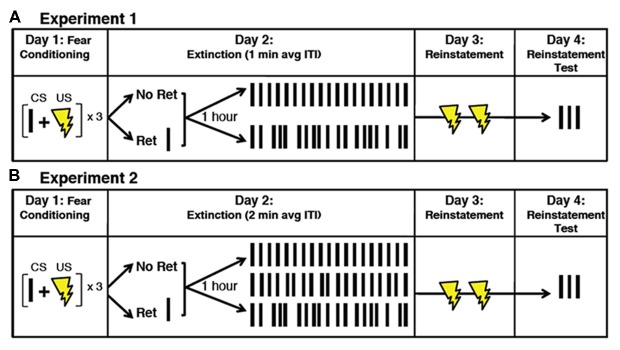
Figure 1
Figure 1
Illustration of the experimental paradigm. (A) Subjects received fear conditioning on Day 1, which consisted of three CS-US pairings. On Day 2, subjects received either a retrieval CS or no retrieval CS, followed 1 h later by extinction (19 total CSs) with either fixed ITIs or variable ITIs. Average ITIs were 1 min in Experiment 1 and 2 min in Experiment 2 min. (B) In Experiment 2 min, the ITI variability was divided into three different categories: no variability (fixed), small variability and large variability. On Day 3, subjects received two unpaired USs (reinstatement). On Day 4, subjects received three unpaired CSs as a probe for reinstatement of fear. CS, conditional stimulus; US, unconditional stimulus; ITI, inter trial interval; ret, retrieval; min, minute.
Figure 2
Figure 2
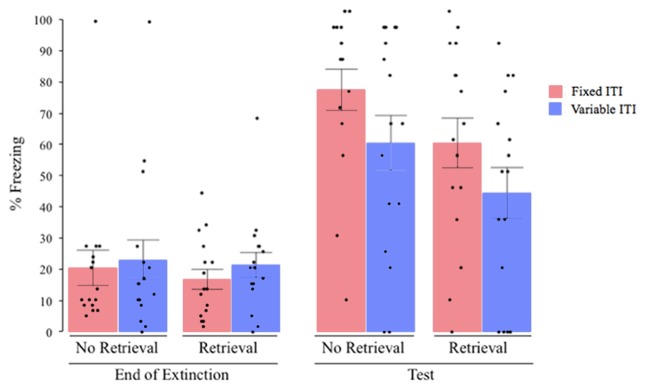
Percent freezing at the end of extinction and post reinstatement for Experiment 1 (1-min average ITI). All groups showed a significant increase in freezing from the end of extinction to post-reinstatement test, with significant main effects of ITI variability and retrieval condition on the overall amount of freezing at test, with no interaction between them. ITI, inter-trial interval; black dots represent individual data points.
Figure 3
Figure 3
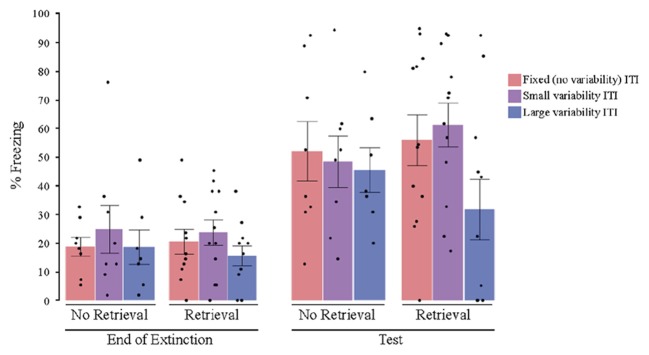
Percent freezing at the end of extinction and post reinstatement for Experiment 2 (2-min average ITI). The results showed a variability by retrieval condition interaction. The group that received both a retrieval CS and highly variable ITIs showed less post reinstatement freezing, and also did not show a significant increase in freezing from the end of extinction to post-reinstatement test. All other groups showed significant increases in freezing from the end of extinction to test, with no significant differences among the groups. ITI, inter-trial interval; black dots represent individual data points.
Figure 4
Figure 4
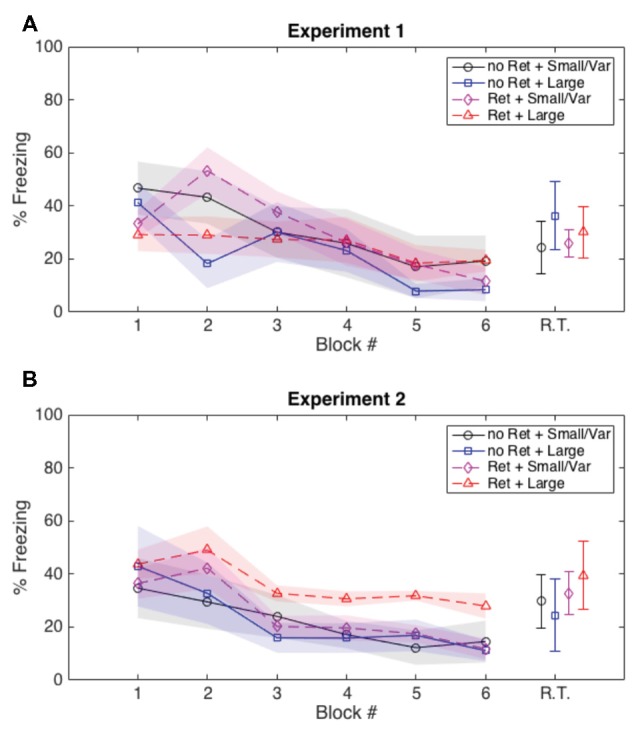
Average freezing during the 20 s prior to each CS presentation during extinction and post-reinstatement test. (A) In Experiment 1 there were no group differences in pre-CS freezing during extinction or prior to the reinstatement test. (B) In Experiment 2, all groups showed similar pre-CS freezing during the first half of extinction, but the group that received the retrieval CS and highly variable ITIs showed more preCS freezing during the second half of extinction than the other groups, presumably due to uncertainty about when the CS would appear. These group differences in pre-CS freezing did not persist through reinstatement, and thus cannot be attributed to generalized freezing rather than a response to ITI variability. R.T., retrieval test; shaded areas and error bars: ±1 standard error of the mean; “Ret”, retrieval; “Large”, large variable ITI; “Small/Var”, small variable and fixed ITI.

References

    1. Alberini C. M. (2005). Mechanisms of memory stabilization: are consolidation and reconsolidation similar or distinct processes? Trends Neurosci. 28, 51–56. 10.1016/j.tins.2004.11.001 - DOI - PubMed
    1. Anderson J. R. (1991). The adaptive nature of human categorization. Psychol. Rev. 98, 409–429. 10.1037/0033-295x.98.3.409 - DOI
    1. Barrett D., Shumake J. D., Jones D., Gonzalez-Lima F. (2003). Metabolic mapping of mouse brain activity after extinction of a conditioned emotional response. J. Neurosci. 23, 5740–5749. - PMC - PubMed
    1. Careaga M. B. L., Girardi C. E. N., Suchecki D. (2016). Understanding posttraumatic stress disorder through fear conditioning, extinction and reconsolidation. Neurosci. Biobehav. Rev. 71, 48–57. 10.1016/j.neubiorev.2016.08.023 - DOI - PubMed
    1. Clem R. L., Huganir R. L. (2010). Calcium-permeable AMPA receptor dynamics mediate fear memory erasure. Science 330, 1108–1112. 10.1126/science.1195298 - DOI - PMC - PubMed

LinkOut - more resources