


Accumulation and Transport of 1-Aminocyclopropane-1-Carboxylic Acid (ACC) in Plants: Current Status, Considerations for Future Research and Agronomic Applications
- PMID: 28174583
- PMCID: PMC5258695
- DOI: 10.3389/fpls.2017.00038
Accumulation and Transport of 1-Aminocyclopropane-1-Carboxylic Acid (ACC) in Plants: Current Status, Considerations for Future Research and Agronomic Applications
Abstract
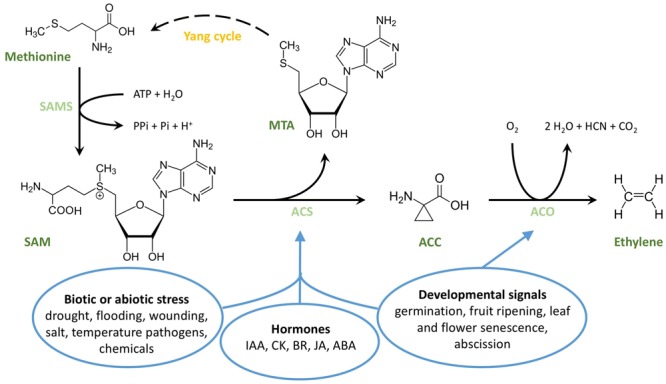
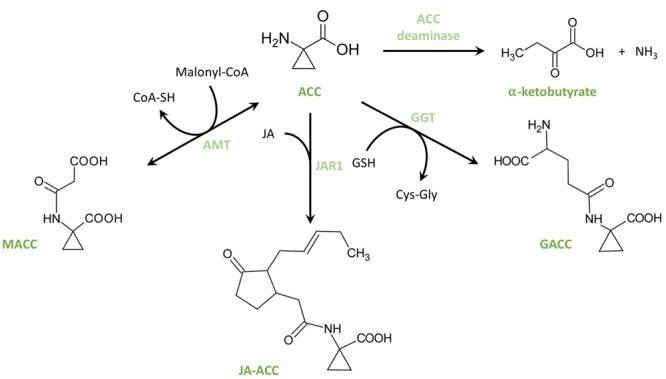
1-aminocyclopropane-1-carboxylic acid (ACC) is a non-protein amino acid acting as the direct precursor of ethylene, a plant hormone regulating a wide variety of vegetative and developmental processes. ACC is the central molecule of ethylene biosynthesis. The rate of ACC formation differs in response to developmental, hormonal and environmental cues. ACC can be conjugated to three derivatives, metabolized in planta or by rhizobacteria using ACC deaminase, and is transported throughout the plant over short and long distances, remotely leading to ethylene responses. This review highlights some recent advances related to ACC. These include the regulation of ACC synthesis, conjugation and deamination, evidence for a role of ACC as an ethylene-independent signal, short and long range ACC transport, and the identification of a first ACC transporter. Although unraveling the complex mechanism of ACC transport is in its infancy, new questions emerge together with the identification of a first transporter. In the light of the future quest for additional ACC transporters, this review presents perspectives of the novel findings and includes considerations for future research toward applications in agronomy.
Keywords: 1-aminocyclopropane-1-carboxylic acid; ACC; agriculture; conjugation; deaminase; ethylene; signal; transport.
Figures
References
-
- Abeles F. B. M., Morgan P. W., Saltveit M. E. (1992). Ethylene in Plant Biology. San Diego, CA: Academic Press.
-
- Able A. J., Wong L. S., Prasad A., O’hare T. J. (2003). The effects of 1-methylcyclopropene on the shelf life of minimally processed leafy asian vegetables. Postharvest Biol. Technol. 27 157–161. 10.1016/S0925-5214(02)00093-5 - DOI
Publication types
LinkOut - more resources
Full Text Sources
Other Literature Sources
