


Pharmacological inhibition of myostatin protects against skeletal muscle atrophy and weakness after anterior cruciate ligament tear
- PMID: 28176368
- PMCID: PMC5548641
- DOI: 10.1002/jor.23537
Pharmacological inhibition of myostatin protects against skeletal muscle atrophy and weakness after anterior cruciate ligament tear
Abstract
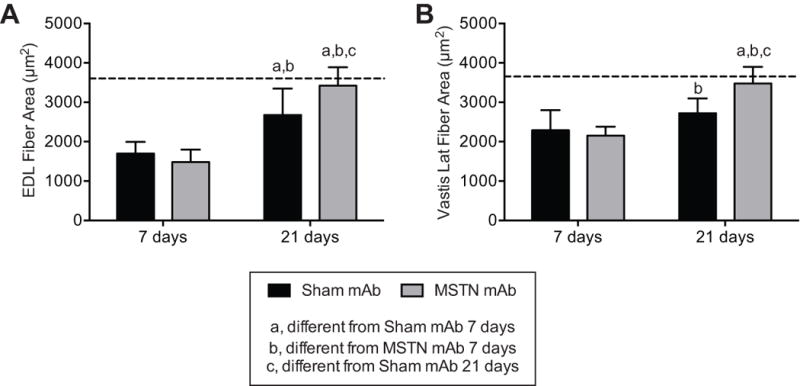
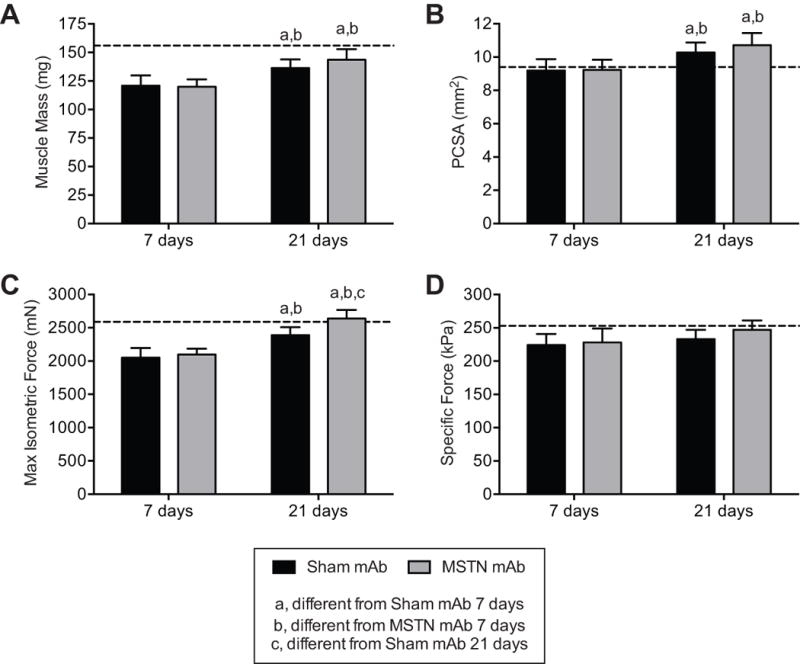
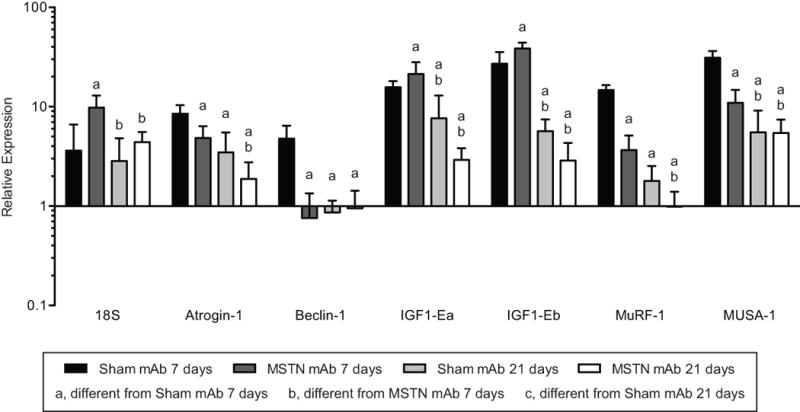
Anterior cruciate ligament (ACL) tears are among the most frequent knee injuries in sports medicine, with tear rates in the US up to 250,000 per year. Many patients who suffer from ACL tears have persistent atrophy and weakness even after considerable rehabilitation. Myostatin is a cytokine that directly induces muscle atrophy, and previous studies rodent models and patients have demonstrated an upregulation of myostatin after ACL tear. Using a preclinical rat model, our objective was to determine if the use of a bioneutralizing antibody against myostatin could prevent muscle atrophy and weakness after ACL tear. Rats underwent a surgically induced ACL tear and were treated with either a bioneutralizing antibody against myostatin (10B3, GlaxoSmithKline) or a sham antibody (E1-82.15, GlaxoSmithKline). Muscles were harvested at either 7 or 21 days after induction of a tear to measure changes in contractile function, fiber size, and genes involved in muscle atrophy and hypertrophy. These time points were selected to evaluate early and later changes in muscle structure and function. Compared to the sham antibody group, 7 days after ACL tear, myostatin inhibition reduced the expression of proteolytic genes and induced the expression of hypertrophy genes. These early changes in gene expression lead to a 22% increase in muscle fiber cross-sectional area and a 10% improvement in maximum isometric force production that were observed 21 days after ACL tear. Overall, myostatin inhibition lead to several favorable, although modest, changes in molecular biomarkers of muscle regeneration and reduced muscle atrophy and weakness following ACL tear. © 2017 Orthopaedic Research Society. Published by Wiley Periodicals, Inc. J Orthop Res 35:2499-2505, 2017.
Keywords: myostatin; GDF-8; anterior cruciate ligament; atrophy; muscle contractility.
© 2017 Orthopaedic Research Society. Published by Wiley Periodicals, Inc.
Figures
References
-
- Griffin LY, Albohm MJ, Arendt EA, et al. Understanding and preventing noncontact anterior cruciate ligament injuries: a review of the Hunt Valley II meeting, January 2005. Am J Sports Med. 2006;34:1512–1532. - PubMed
-
- Ingersoll CD, Grindstaff TL, Pietrosimone BG, Hart JM. Neuromuscular consequences of anterior cruciate ligament injury. Clin Sports Med. 2008;27(3):383–404. - PubMed
-
- Gerber JP, Marcus RL, Dibble LE, et al. Effects of early progressive eccentric exercise on muscle size and function after anterior cruciate ligament reconstruction: a 1-year follow-up study of a randomized clinical trial. Physical therapy. 2009;89:51–59. - PubMed
Publication types
MeSH terms
Substances
Grants and funding
LinkOut - more resources
Full Text Sources
Other Literature Sources
