. 2017 Feb 8:8:14366.
doi: 10.1038/ncomms14366.

Dosage sensitivity is a major determinant of human copy number variant pathogenicity

Affiliations

Dosage sensitivity is a major determinant of human copy number variant pathogenicity

Alan M Rice et al. Nat Commun. .

Abstract

Human copy number variants (CNVs) account for genome variation an order of magnitude larger than single-nucleotide polymorphisms. Although much of this variation has no phenotypic consequences, some variants have been associated with disease, in particular neurodevelopmental disorders. Pathogenic CNVs are typically very large and contain multiple genes, and understanding the cause of the pathogenicity remains a major challenge. Here we show that pathogenic CNVs are significantly enriched for genes involved in development and genes that have greater evolutionary copy number conservation across mammals, indicative of functional constraints. Conversely, genes found in benign CNV regions have more variable copy number. These evolutionary constraints are characteristic of genes in pathogenic CNVs and can only be explained by dosage sensitivity of those genes. These results implicate dosage sensitivity of individual genes as a common cause of CNV pathogenicity. These evolutionary metrics suggest a path to identifying disease genes in pathogenic CNVs.


Conflict of interest statement

The authors declare no competing financial interests.

Figures
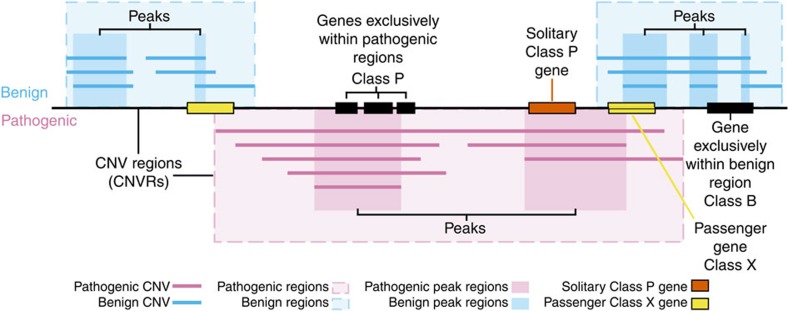
Figure 1
Figure 1. Illustration of CNVRs and intersection with genes.
Illustrative CNVs are shown with benign CNVs above the genomic region and pathogenic CNVs below (blue and pink lines respectively). Shaded boxes bound CNVRs with local peak coverage regions indicated by darker shading. Genes overlapped by both benign and pathogenic CNVs are termed Class X ‘passenger' genes here (yellow). Where only a single non-passenger pathogenic gene is within a region, it is termed a ‘solitary Class P' gene (orange).
Figure 2
Figure 2. Patterns of gene duplication and loss across mammals for orthologues of human genes in CNVs.
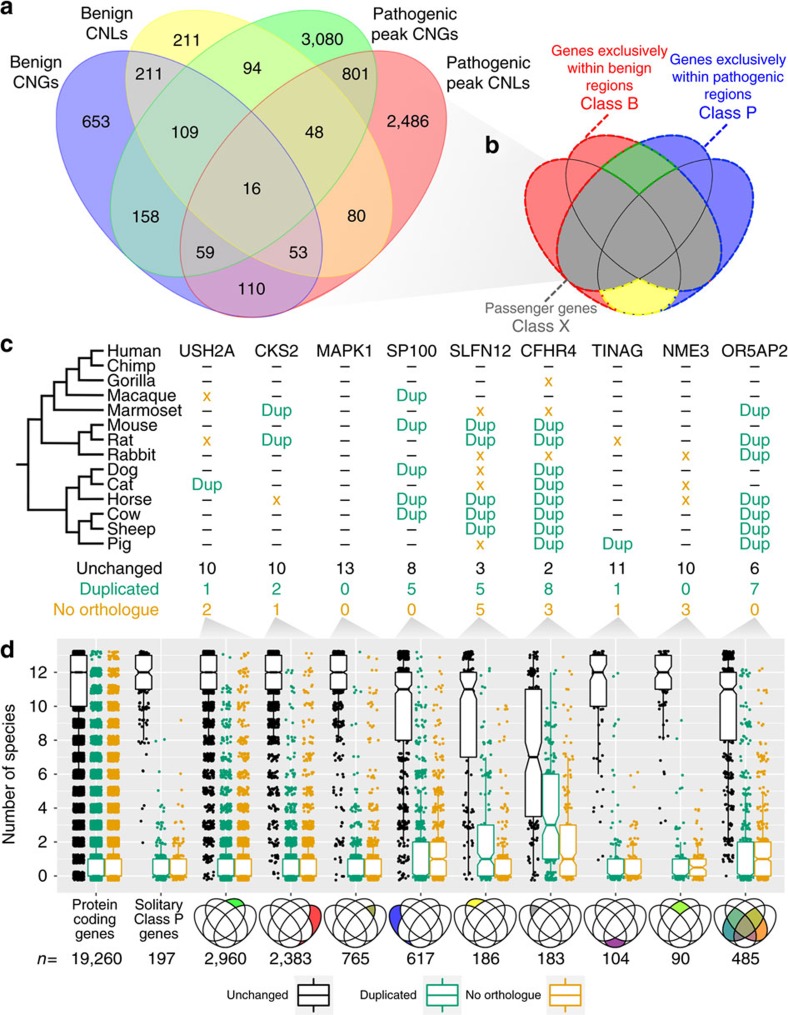
(a) Venn diagram showing the number of protein-coding genes overlapped by different combinations of CNV types (blue, benign CNGs; yellow, benign CNLs; green, pathogenic gain peak coverage regions; red, pathogenic loss peak regions). (b) Genes that are covered exclusively by benign CNVs are labelled as ‘Class B' (shaded red), those exclusive to pathogenic CNVs as ‘Class P' (shaded blue) and those falling in CNVs with both clinical interpretations for gain or loss are considered as likely to be passenger genes and labelled ‘Class x' (shaded grey). It is noteworthy that the classification refers to the CNVs that the genes fall within rather than the genes themselves. (c) Phylogenetic tree of 13 mammalian species used for gene conservation analysis and examples of human genes from each CNV overlap pattern type (Venn diagram segment) showing the orthologue distribution in the mammals. A dash indicates no change. (d) Box plot of the number of mammalian species where copy number is unchanged (black), duplication has occurred (green) and no orthologues (orange) for different categories of CNV overlap, as indicated below the boxplots. Upper and lower hinges of boxes correspond to the first and third quartiles. The median is shown within each box. Whiskers extend to values 1.5 × interquartile range. These data were calculated per gene as illustrated in c. The sample size is shown below each boxplot.
Figure 3
Figure 3. Mammalian copy number changes for genes within known pathogenic CNVRs.
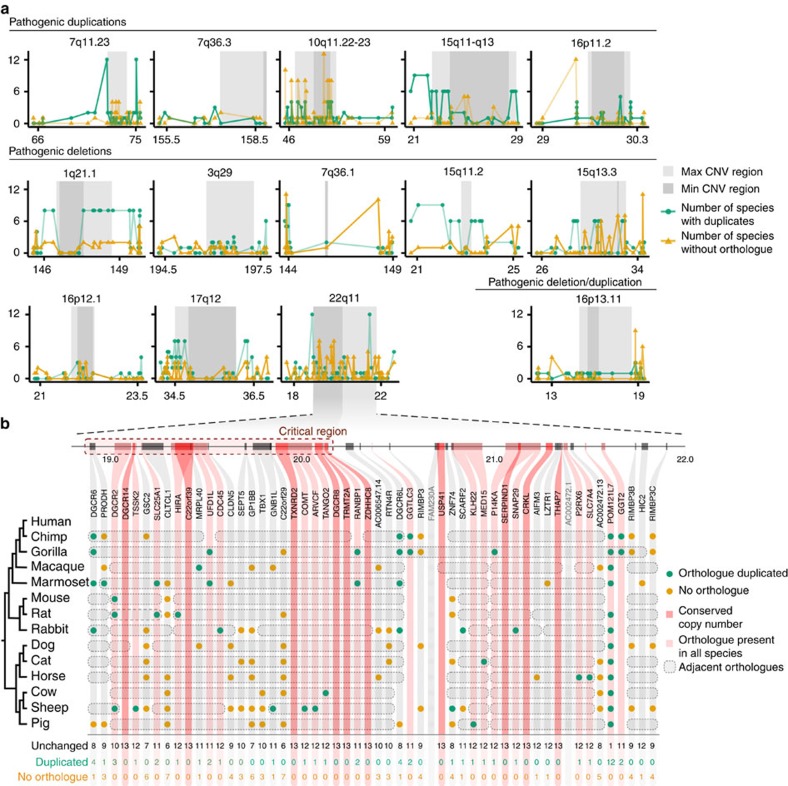
(a) Copy number changes across mammalian species for genes within known pathogenic CNVRs associated with schizophrenia and other neurodevelopmental disorders obtained from ref. . The minimal (min) CNVR (shaded dark grey) is typically the smallest region associated with the disease phenotype, while the maximal (max) CNVR (shaded light grey) is typically observed. Ten flanking genes on each side are also plotted where possible. Each region is labelled above with the chromosomal band and position along chromosome in megabases is shown on the x axis. Genes are plotted by start position. Each point represents for one human gene the number of duplications (green) and losses (orange). Genes within regions are listed in Supplementary Data 6. (b) For each protein-coding gene within the 22q11 region, copy number changes across 13 mammalian species are shown. Green circles indicate where orthologues are duplicated, orange circles where orthologues are missing. Genes highlighted in light red are genes where at least one orthologue is present in all species and genes highlighted in dark red are genes with conserved one-to-one orthology across the mammalian species tested (completely conserved genes). Grey dashed outlines group orthologues that are neighbouring on their respective chromosome/scaffold in each species. Genes with greyed-out names were not included in copy number analysis and so no data are displayed for them.

References

    1. Volker M. et al.. Copy number variation, chromosome rearrangement, and their association with recombination during avian evolution. Genome Res. 20, 503–511 (2010). - PMC - PubMed
    1. Liu G. E. et al.. Analysis of copy number variations among diverse cattle breeds. Genome Res. 20, 693–703 (2010). - PMC - PubMed
    1. Nicholas T. J. et al.. The genomic architecture of segmental duplications and associated copy number variants in dogs. Genome Res. 19, 491–499 (2009). - PMC - PubMed
    1. Yan Li et al.. Identification of genome-wide copy number variations among diverse pig breeds by array CGH. BMC Genomics 13, 725 (2012). - PMC - PubMed
    1. Pezer Ž., Harr B., Teschke M., Babiker H. & Tautz D. Divergence patterns of genic copy number variation in natural populations of the house mouse (Mus musculus domesticus) reveal three conserved genes with major population-specific expansions. Genome Res. 25, 1114–1124 (2015). - PMC - PubMed

Publication types