


Effects of Switching to the Menthol Tobacco Heating System 2.2, Smoking Abstinence, or Continued Cigarette Smoking on Clinically Relevant Risk Markers: A Randomized, Controlled, Open-Label, Multicenter Study in Sequential Confinement and Ambulatory Settings (Part 2)
- PMID: 28177498
- PMCID: PMC5896432
- DOI: 10.1093/ntr/ntx028
Effects of Switching to the Menthol Tobacco Heating System 2.2, Smoking Abstinence, or Continued Cigarette Smoking on Clinically Relevant Risk Markers: A Randomized, Controlled, Open-Label, Multicenter Study in Sequential Confinement and Ambulatory Settings (Part 2)
Abstract
Introduction: Modified-risk tobacco products are expected to reduce exposure to harmful and potentially harmful constituents of cigarette smoke, and ultimately reduce the health burden of smoking-related diseases. Clinically relevant risk markers of smoking-related diseases inform about the risk profile of new tobacco products in the absence of in-market epidemiological data. The menthol Tobacco Heating System 2.2 (mTHS) is a modified-risk tobacco product in development as an alternative to cigarettes (conventional cigarettes [CCs]).
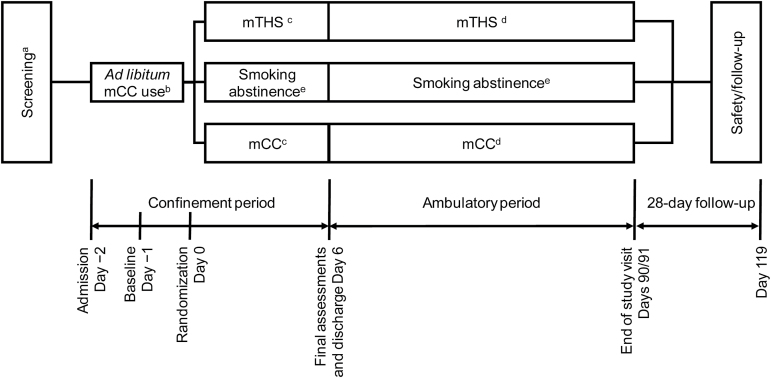
Methods: In this parallel-group study, Japanese adult smokers (23-65 years; ≥10 mCCs/day) were randomized to mTHS, menthol CCs (mCC), or smoking abstinence (SA) for 5 days in confinement and 85 days in ambulatory settings. Endpoints included biomarkers of exposure to harmful and potentially harmful constituents and clinically relevant risk markers of smoking-related diseases.
Results: One-hundred and sixty participants were randomized to the mTHS (n = 78), mCC (n = 42), and SA (n = 40) groups. Switching to the mTHS was associated with reductions in biomarkers of exposure compared with continuing mCCs. Reductions in 8-epi-prostaglandin F2α (biomarker of oxidative stress), 11-dehydro-thromboxane B2 (biomarker of platelet activation), soluble intracellular adhesion molecule-1 (biomarker of endothelial function), and an increase in high-density lipoprotein cholesterol (biomarker of lipid metabolism) and forced expiratory volume in 1 second (biomarker of lung function) occurred in the mTHS group compared with the mCC group. The changes in the mTHS group approached those in the SA group.
Conclusions: Switching from mCCs to mTHS was associated with improvements in clinically relevant risk markers linked to mechanistic pathways involved in smoking-related diseases.
Implications: In this three-way randomized study, switching from menthol cigarettes to mTHS for 5 days in confinement and 85 days in ambulatory settings was associated with reductions in biomarkers of exposure to cigarette smoke, and changes were observed in clinically relevant biomarkers of oxidative stress (8-epi-prostaglandin F2α), platelet activity (11-dehydro-thromboxane B2), endothelial function (soluble intracellular adhesion molecule-1), lipid metabolism (high-density lipoprotein cholesterol) and lung function (forced expiratory volume in 1 second), similar to the SA group. The results suggest that switching to the mTHS has the potential to reduce the adverse health effects of conventional cigarettes.
© The Author 2017. Published by Oxford University Press on behalf of the Society for Research on Nicotine and Tobacco.
Figures
References
-
- U.S. Department of Health and Human Services, Food and Drug Administration, Center for Tobacco Products. Guidance for Industry: Modified Risk Tobacco Product Applications. Rockville, MD: Food and Drug Administration; 2012.
-
- Committee on Scientific Standards for Studies on Modified Risk Tobacco Products, Board on Population Health and Public Health Practice, Institute of Medicine. Scientific Standards for Studies on Modified Risk Tobacco Products. Washington, DC: The National Academies Press; 2012.
-
- Lee PN, Fry JS, Forey BA. Estimating the decline in excess risk of chronic obstructive pulmonary disease following quitting smoking - a systematic review based on the negative exponential model. Regul Toxicol Pharmacol. 2014;68(2):231–239. doi:10.1016/j.yrtph.2013.12.006. - PubMed
-
- Lee PN, Fry JS, Hamling JS. Using the negative exponential distribution to quantitatively review the evidence on how rapidly the excess risk of ischaemic heart disease declines following quitting smoking. Regul Toxicol Pharmacol. 2012;64(1):51–67. doi:10.1016/j.yrtph.2012.06.009. - PubMed
-
- Lee PN, Fry JS, Thornton AJ. Estimating the decline in excess risk of cerebrovascular disease following quitting smoking–a systematic review based on the negative exponential model. Regul Toxicol Pharmacol. 2014;68(1):85–95. doi:10.1016/j.yrtph.2013.11.013. - PubMed
Publication types
MeSH terms
Substances
LinkOut - more resources
Full Text Sources
Other Literature Sources
