


Indicators of patients with major depressive disorder in need of highly specialized care: A systematic review
- PMID: 28178306
- PMCID: PMC5298252
- DOI: 10.1371/journal.pone.0171659
Indicators of patients with major depressive disorder in need of highly specialized care: A systematic review
Abstract
Objectives: Early identification of patients with major depressive disorder (MDD) that cannot be managed by secondary mental health services and who require highly specialized mental healthcare could enhance need-based patient stratification. This, in turn, may reduce the number of treatment steps needed to achieve and sustain an adequate treatment response. The development of a valid tool to identify patients with MDD in need of highly specialized care is hampered by the lack of a comprehensive understanding of indicators that distinguish patients with and without a need for highly specialized MDD care. The aim of this study, therefore, was to systematically review studies on indicators of patients with MDD likely in need of highly specialized care.
Methods: A structured literature search was performed on the PubMed and PsycINFO databases following PRISMA guidelines. Two reviewers independently assessed study eligibility and determined the quality of the identified studies. Three reviewers independently executed data extraction by using a pre-piloted, standardized extraction form. The resulting indicators were grouped by topical similarity, creating a concise summary of the findings.
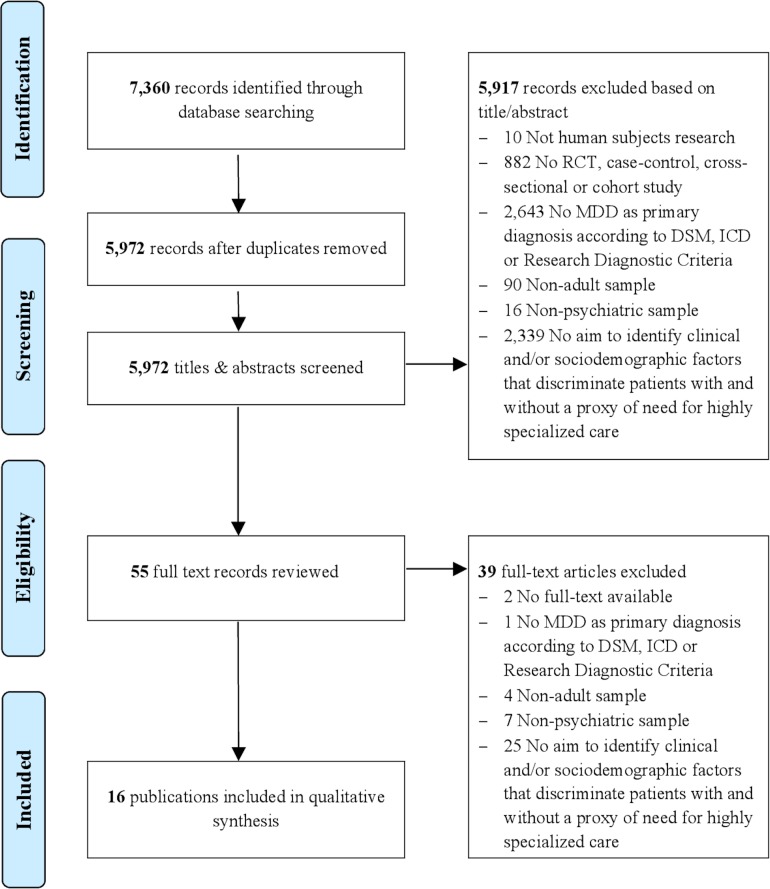
Results: The systematic search of all databases yielded a total of 7,360 references, of which sixteen were eligible for inclusion. The sixteen papers yielded a total of 48 unique indicators. Overall, a more pronounced depression severity, a younger age of onset, a history of prior poor treatment response, psychiatric comorbidity, somatic comorbidity, childhood trauma, psychosocial impairment, older age, and a socioeconomically disadvantaged status were found to be associated with proxies of need for highly specialized MDD care.
Conclusions: Several indicators are associated with the need for highly specialized MDD care. These indicators provide easily measurable factors that may serve as a starting point for the development of a valid tool to identify patients with MDD in need of highly specialized care.
Conflict of interest statement
The authors have declared that no competing interests exist.
Figures
References
-
- Boenisch S, Kocalevent RD, Matschinger H, Mergl R, Wimmer-Brunauer C, Tauscher M, et al. Who receives depression-specific treatment? A secondary data-based analysis of outpatient care received by over 780,000 statutory health-insured individuals diagnosed with depression. Soc Psychiatry Psychiatr Epidemiol. 2012;47: 475–486. 10.1007/s00127-011-0355-y - DOI - PubMed
Publication types
MeSH terms
LinkOut - more resources
Full Text Sources
Other Literature Sources
Medical
Molecular Biology Databases
