. 2017 Feb 8;13(2):e1006215.
doi: 10.1371/journal.ppat.1006215. eCollection 2017 Feb.

Comparative analysis estimates the relative frequencies of co-divergence and cross-species transmission within viral families

Affiliations

Comparative analysis estimates the relative frequencies of co-divergence and cross-species transmission within viral families

Jemma L Geoghegan et al. PLoS Pathog. .

Abstract

The cross-species transmission of viruses from one host species to another is responsible for the majority of emerging infections. However, it is unclear whether some virus families have a greater propensity to jump host species than others. If related viruses have an evolutionary history of co-divergence with their hosts there should be evidence of topological similarities between the virus and host phylogenetic trees, whereas host jumping generates incongruent tree topologies. By analyzing co-phylogenetic processes in 19 virus families and their eukaryotic hosts we provide a quantitative and comparative estimate of the relative frequency of virus-host co-divergence versus cross-species transmission among virus families. Notably, our analysis reveals that cross-species transmission is a near universal feature of the viruses analyzed here, with virus-host co-divergence occurring less frequently and always on a subset of viruses. Despite the overall high topological incongruence among virus and host phylogenies, the Hepadnaviridae, Polyomaviridae, Poxviridae, Papillomaviridae and Adenoviridae, all of which possess double-stranded DNA genomes, exhibited more frequent co-divergence than the other virus families studied here. At the other extreme, the virus and host trees for all the RNA viruses studied here, particularly the Rhabdoviridae and the Picornaviridae, displayed high levels of topological incongruence, indicative of frequent host switching. Overall, we show that cross-species transmission plays a major role in virus evolution, with all the virus families studied here having the potential to jump host species, and that increased sampling will likely reveal more instances of host jumping.


Conflict of interest statement

The authors have declared that no competing interests exist.

Figures
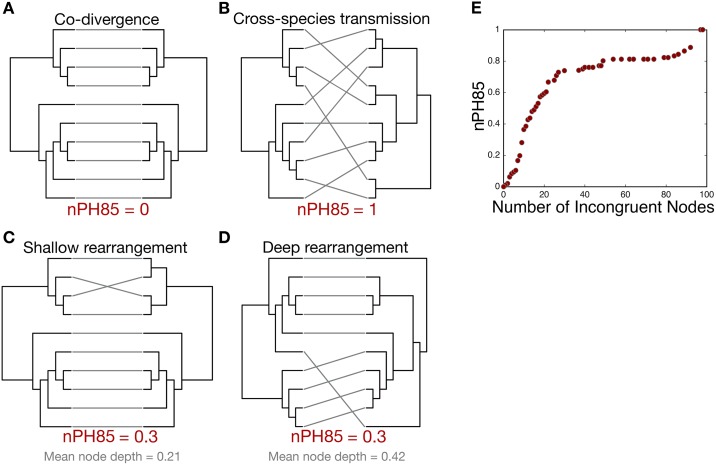
Fig 1
Fig 1. Tanglegrams of phylogenetic trees created using simulated data.
Lines connect the virus with its respective host. Hence, if viruses and hosts have congruent phylogenies—indicative of strong virus-host co-divergence—then there will obviously be more horizontal than diagonal lines. Panel (A) illustrates a perfectly matched topology between virus and host trees and thus the nPH85 = 0. Panel (B) exemplifies an entirely mismatched topology between virus and host trees, where the nPH85 = 1. Data from viruses in nature will fall between these two extremes. Panels (C) and (D) illustrate two examples where the host trees have one incongruent node. Panel (C) corresponds to a shallower section of the tree than in panel (D), but the two nPH85 are the same, such that the position of the incongruence does not produce a systematic bias. Panel (E) elucidates the relationship between the nPH85 distance and the number of incongruent nodes between a pair of simulated trees with 100 tips.
Fig 2
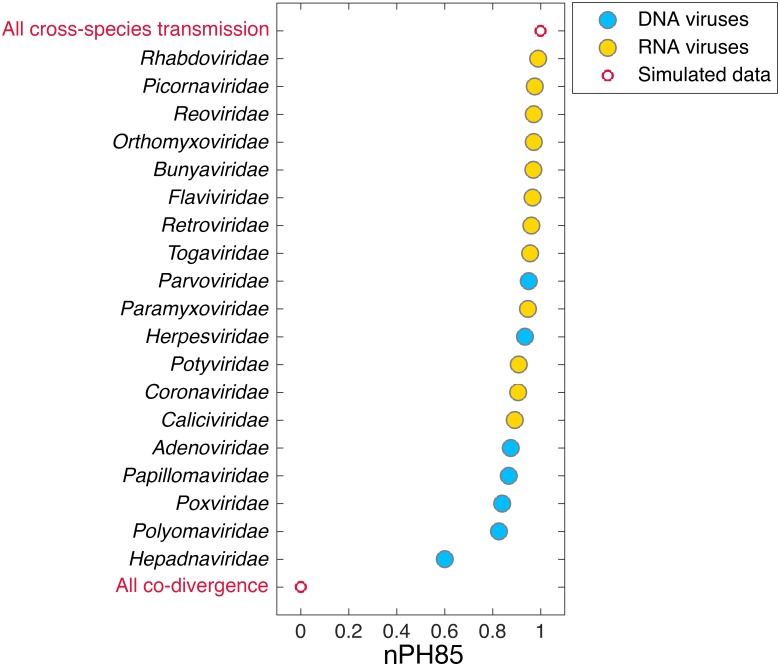
Fig 2. Overall normalized topological distance between two unrooted phylogenetic trees for each virus family by normalizing the Penny and Hendy [14] metric (i.e. nPH85).
A range of DNA (blue) and RNA (yellow) virus families are shown. If nPH85 = 0, it is indicative of virus-host co-divergence, while nPH85 = 1 suggests frequent cross-species transmission (red). For ease of interpretation virus families are ranked by descending frequency of cross-species transmission.
Fig 3
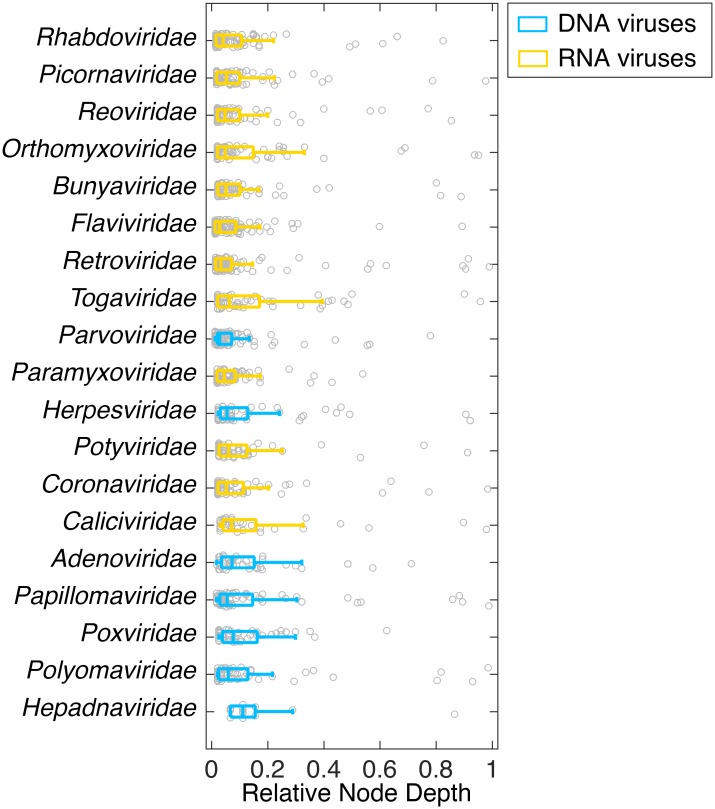
Fig 3. Relative node depths of incongruences between host and virus phylogenies showing the median and 25th and 75th percentiles (boxplots) as well as the raw data.
A relative node depth close to 0 can be interpreted as the occurrence of host-switching events at the tips of the phylogenetic tree, whereas a relative node depth close to 1 suggests host-switching events at the root of the phylogenetic tree. A range of DNA (blue) and RNA (yellow) virus families are shown. For ease of interpretation virus families are ranked as in Fig 2.
Fig 4
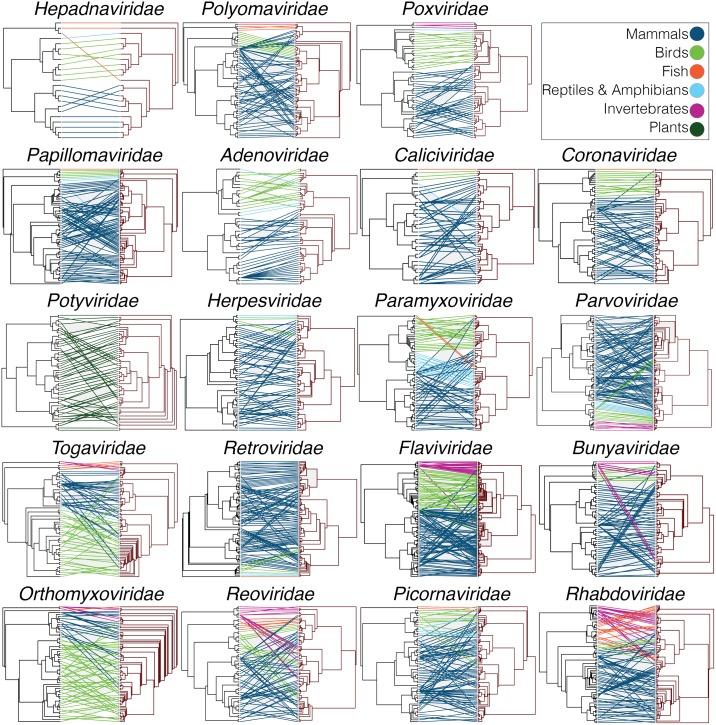
Fig 4. Tanglegrams of rooted phylogenetic trees for each virus family.
Host trees were rooted first following their known phylogenetic history, with virus trees then rooted based on the host tree. The ‘untangle’ function was used to maximize the congruence between the host and virus phylogenies. Lines that connect the host (left) with its virus (right) are colored according to the host type (dark blue: mammals; light green: birds; light blue: reptiles and amphibians; red: fish; pink: invertebrates; dark green: plants). Phylogenies with the individual tip labels visible are shown in S1 Fig.
Fig 5
Fig 5
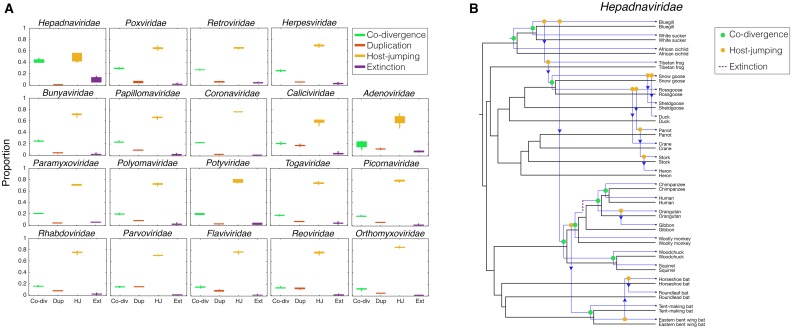
(A) Reconciliation analysis of each virus family using Jane [15]. Boxplots illustrate the range of the proportion of possible events. The ‘event costs’ associated with incongruences between trees were conservative towards co-divergence and defined here as: 0 for co-divergence, 1 for duplication, 1 for host-jumping and 1 for extinction. Virus families are ranked in order of highest mean co-divergence to lowest mean co-divergence. Abbreviations on the x-axis are as follows: ‘Co-div’ = co-divergence, ‘Dup’ = duplication, ‘HJ’ = host-jumping, ‘Ext’ = extinction. (B) Reconciliation of the Hepadnaviridae phylogeny with that of their vertebrate hosts, again utilizing the co-phylogenetic method implemented in Jane [15]. The figure illustrates all possible co-divergence, extinction and host-jumping events (no lineage duplication events were reconstructed in this case).
Fig 6
Fig 6
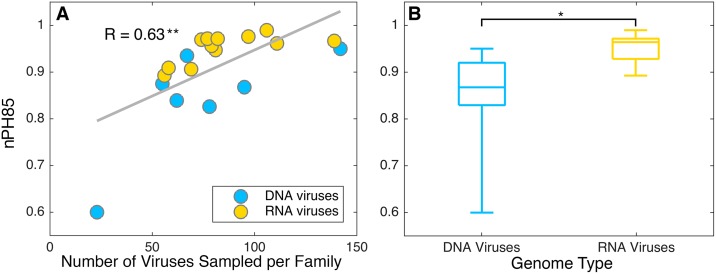
(A) The nPH85 distance as a function of the number of viruses per virus family. Pearson’s correlation coefficient, R, was found to be statistically significant (p<0.005). (B) nPH85 distances by genome type showing the median (horizontal line) and 25th and 75th percentiles. A t-test showed that the difference between these distances was significant (p<0.05). As before, a range of DNA (blue) and RNA (yellow) virus families are shown.

References

    1. McGeoch DJ, Gatherer D. Integrating reptilian herpesviruses into the family herpesviridae. Journal of virology. 2005;79(2):725–31. Epub 2004/12/23. 10.1128/JVI.79.2.725-731.2005 - DOI - PMC - PubMed
    1. Thézé J, Bézier A, Periquet G, Drezen J-M, Herniou EA. Paleozoic origin of insect large dsDNA viruses. Proc Natl Acad Sci USA. 2011;108(38):15931–5. 10.1073/pnas.1105580108 - DOI - PMC - PubMed
    1. Villarreal LP, Defilippis VR, Gottlieb KA. Acute and persistent viral life strategies and their relationship to emerging diseases. Virology. 2000;272(1):1–6. 10.1006/viro.2000.0381 - DOI - PubMed
    1. Holmes EC. Evolution and emergence of RNA viruses: Oxford University Press; 2009.
    1. Geoghegan JL, Senior AM, Di Giallonardo F, Holmes EC. Virological factors that increase the transmissibility of emerging human viruses. Proc Natl Acad Sci USA. 2016;113(15):4170–5. 10.1073/pnas.1521582113 - DOI - PMC - PubMed

Publication types