


Polymorphisms of ESR1, UGT1A1, HCN1, MAP3K1 and CYP2B6 are associated with the prognosis of hormone receptor-positive early breast cancer
- PMID: 28178648
- PMCID: PMC5400556
- DOI: 10.18632/oncotarget.14995
Polymorphisms of ESR1, UGT1A1, HCN1, MAP3K1 and CYP2B6 are associated with the prognosis of hormone receptor-positive early breast cancer
Abstract
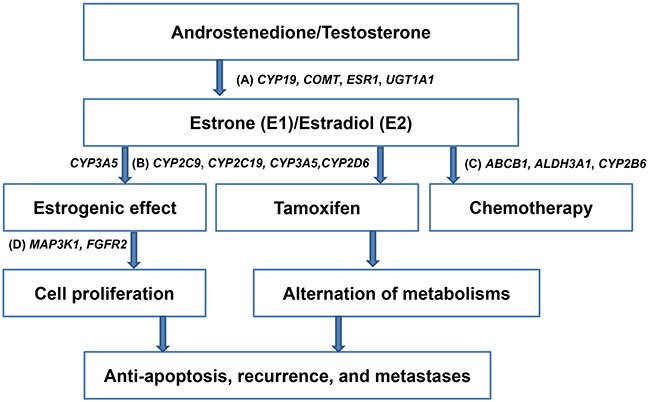
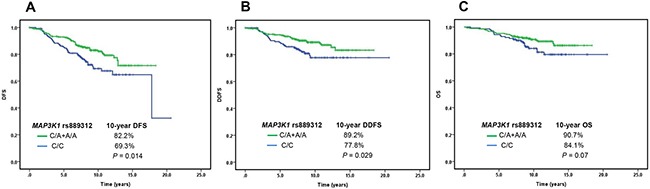
In this study, we investigated whether single nucleotide polymorphisms (SNPs) identified by genome-wide association study (GWAS) (MAP3K1, FGFR2, TNRC9, HCN1, and 5p12), and SNPs involved in the metabolism of estrogen (CYP19, COMT, ESR1, and UGT1A1), tamoxifen (CYP2C9, CYP2C19, CYP3A5, and CYP2D6), and chemotherapeutic agents (ABCB1, ALDH3A1, and CYP2B6) are associated with the prognoses of 414 hormone receptor (HR)-positive early breast cancers with negative or 1 to 3 nodal metastases. At a median follow-up period of 10.6 years, 363 patients were alive, and 51 (12.3%) had died. Multiple-adjusted hazard ratios (aHRs) and the corresponding 95% confidence intervals for distant disease-free survival (DDFS), disease-free survival (DFS), and overall survival (OS) in association with the genotypes of 34 SNPs from the above-mentioned 16 genes were evaluated, using the stepwise selection Cox model. We found that the SNP, ESR1-codon325 rs1801132 (G/G+G/C), was associated with a longer DDFS, whereas UGT1A1 rs4148323 (A/A+A/G), and HCN1 rs981782 (A/A+A/C) were significantly associated with poorer DDFS. MAP3K1 rs889312 (C/C) and CYP2B6 rs3211371 (T/C) were significantly associated with poor DFS, DDFS and OS. Among premenopausal women, MAP3K1 rs889312 (C/C), CYP2B6 rs3211371 (T/C), CYP2B6 rs4802101 (T/T), ABCB1 rs2032582 (C/C), and ALDH3A1 rs2231142 (G/G) were significantly associated with poor DDFS, DFS, or OS. Our results provide additional evidence that genetic polymorphisms observed in SNPs are associated with the prognoses of patients with HR-positive breast cancers; this may indicate different treatment strategies for these patients.
Keywords: GWAS; breast cancer; genetic polymorphism; prognostic factor; survival.
Conflict of interest statement
The authors declare no conflict of interest.
Figures
References
-
- Breast Early. Cancer Trialists’ Collaborative Group (EBCTCG). Effects of chemotherapy and hormonal therapy for early breast cancer on recurrence and 15-year survival: an overview of the randomised trials. Lancet. 2005;365:1687–1717. - PubMed
-
- Kuo SH, Lien HC, You SL, Lu YS, Lin CH, Chen TZ, Huang CS. Dose variation and regimen modification of adjuvant chemotherapy in daily practice affect survival of stage I-II and operable stage III Taiwanese breast cancer patients. Breast. 2008;17:646–653. - PubMed
-
- Sørlie T, Perou CM, Tibshirani R, Aas T, Geisler S, Johnsen H, Hastie T, Eisen MB, van de Rijn M, Jeffrey SS, Thorsen T, Quist H, Matese JC, et al. Gene expression patterns of breast carcinomas distinguish tumor subclasses with clinical implications. Proc Natl Acad Sci USA. 2001;98:10869–10874. - PMC - PubMed
-
- Paik S, Shak S, Tang G, Kim C, Baker J, Cronin M, Baehner FL, Walker MG, Watson D, Park T, Hiller W, Fisher ER, Wickerham DL, et al. A multigene assay to predict recurrence of tamoxifen-treated, node-negative breast cancer. N Engl J Med. 2004;351:2817–2826. - PubMed
-
- Sotiriou C, Pusztai L. Gene-expression signatures in breast cancer. N Engl J Med. 2009;360:790–800. - PubMed
MeSH terms
Substances
LinkOut - more resources
Full Text Sources
Other Literature Sources
Medical
Miscellaneous
