


Metacognitive ability correlates with hippocampal and prefrontal microstructure
- PMID: 28179164
- PMCID: PMC5387158
- DOI: 10.1016/j.neuroimage.2017.02.008
Metacognitive ability correlates with hippocampal and prefrontal microstructure
Abstract
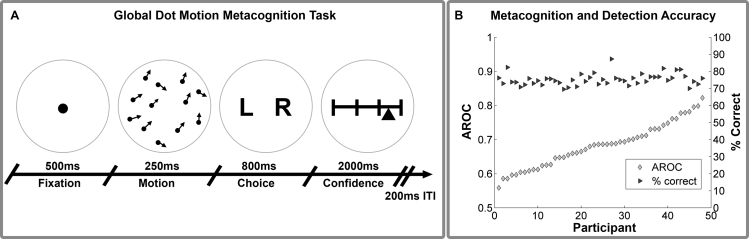
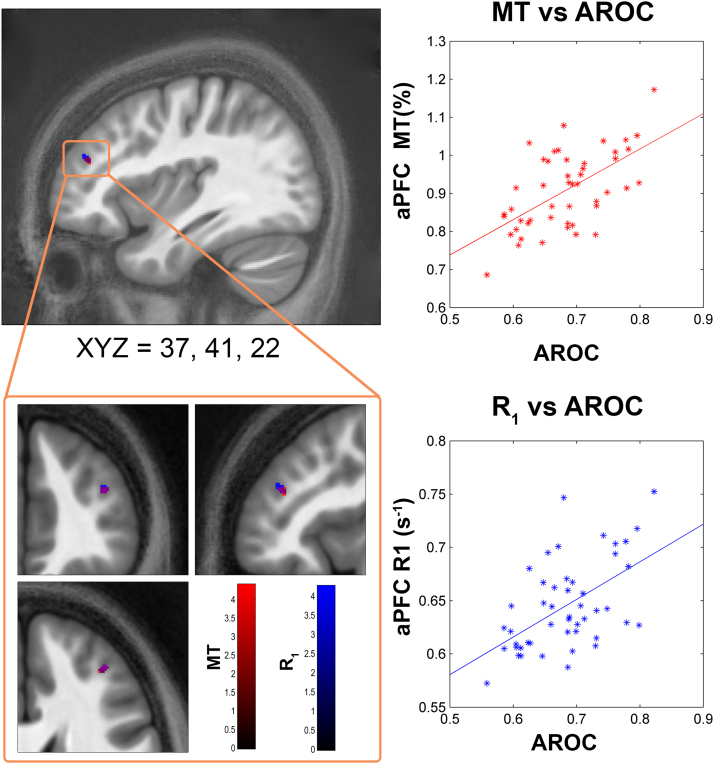
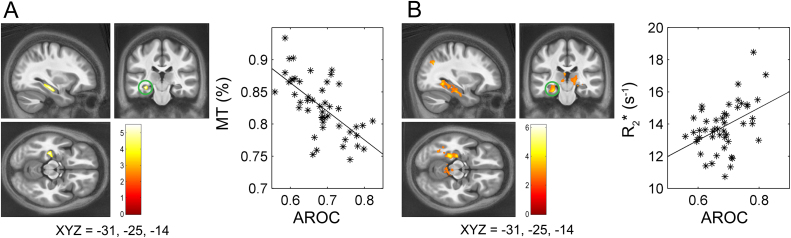
The ability to introspectively evaluate our experiences to form accurate metacognitive beliefs, or insight, is an essential component of decision-making. Previous research suggests individuals vary substantially in their level of insight, and that this variation is related to brain volume and function, particularly in the anterior prefrontal cortex (aPFC). However, the neurobiological mechanisms underlying these effects are unclear, as qualitative, macroscopic measures such as brain volume can be related to a variety of microstructural features. Here we leverage a high-resolution (800µm isotropic) multi-parameter mapping technique in 48 healthy individuals to delineate quantitative markers of in vivo histological features underlying metacognitive ability. Specifically, we examined how neuroimaging markers of local grey matter myelination and iron content relate to insight as measured by a signal-theoretic model of subjective confidence. Our results revealed a pattern of microstructural correlates of perceptual metacognition in the aPFC, precuneus, hippocampus, and visual cortices. In particular, we extend previous volumetric findings to show that right aPFC myeloarchitecture positively relates to metacognitive insight. In contrast, decreased myelination in the left hippocampus correlated with better metacognitive insight. These results highlight the ability of quantitative neuroimaging to reveal novel brain-behaviour correlates and may motivate future research on their environmental and developmental underpinnings.
Keywords: Hippocampus; Iron; Metacognition; Microstructure; Myelination; Quantitative MRI.
Copyright © 2017 The Authors. Published by Elsevier Inc. All rights reserved.
Figures
References
-
- Allen M., Frank D., Schwarzkopf D.S., Fardo F., Winston J.S., Hauser T.U., Rees G. Unexpected arousal modulates the influence of sensory noise on confidence. eLife. 2016;5:e18103. https://doi.org/10.7554/eLife.18103 - DOI - PMC - PubMed
-
- Ashburner J. Computational anatomy with the SPM software. Magn. Reson. Imaging. 2009;27:1163–1174. - PubMed
-
- Ashburner J. A fast diffeomorphic image registration algorithm. NeuroImage. 2007;38:95–113. - PubMed
-
- Ashburner J., Friston K.J. Unified segmentation. NeuroImage. 2005;26:839–851. - PubMed
Publication types
MeSH terms
Grants and funding
LinkOut - more resources
Full Text Sources
Other Literature Sources
Molecular Biology Databases
