. 2017 Mar 31;120(7):1072-1074.
doi: 10.1161/CIRCRESAHA.117.310710. Epub 2017 Feb 8.

Repeated Cell Therapy: A Paradigm Shift Whose Time Has Come

Affiliations

Repeated Cell Therapy: A Paradigm Shift Whose Time Has Come

Roberto Bolli. Circ Res. .

Abstract

Although treatment with stem/progenitor cells is a promising approach to heart disease, enthusiasm for cell therapy has been dampened by the inconsistent, modest, borderline, or undetectable benefits reported in clinical trials (all of which have used one dose of cells),,,. As a result, clinical translation has not occurred (no cell-based therapy is close to being approved for heart disease), and a rising tide of skepticism has bedeviled the field,, leading some critics even to question whether clinical studies should continue. Here I propose that a major reason for the modest, borderline, or disappointing results is the administration of only one dose of cells, which causes the benefits of cell therapy to be underestimated. Iargue that just as most pharmacologic agents are ineffective when given once but can be highly effective when given repeatedly, so a cell product may be ineffective, or modestly effective, when given as a single treatment, but may turn out to be quite efficacious if given repeatedly. This concept constitutes a major paradigm shift, with potentially vast implications for the entire field of reparative medicine.

Keywords: adoptive transfer; cardiac repair; cell therapy; myocardium; regeneration; stem cells.


Figures
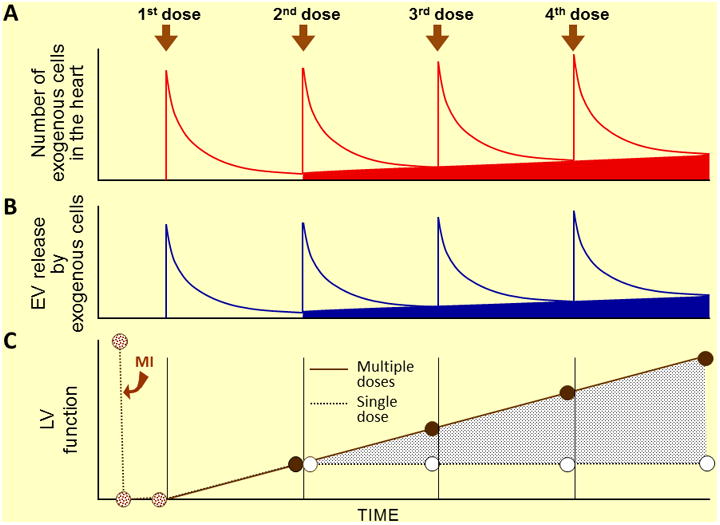
Figure 1
Figure 1. Conceptual paradigm of repeated cell therapy
A. Following cell administration, the number of transplanted cells in the myocardium falls rapidly but a small number persist for many weeks (at least 1 year). Repeated cell doses produce a cumulative increase in the number of transplanted cells that persist long-term in the myocardium (red area)., Each cell dose produces a burst of EV release (B), which is responsible for the cumulative therapeutic effects (C). The cumulative increase in long-lasting exogenous cells (red area) may be associated with a cumulative increase in sustained EV release by these cells (blue area). Panels A and C are based on experimental data,; panel B is speculative.

References

    1. Sanganalmath SK, Bolli R. Cell therapy for heart failure: A comprehensive overview of experimental and clinical studies, current challenges, and future directions. Circ Res. 2013;113:810–834. - PMC - PubMed
    1. Keith MC, Bolli R. “String theory” of c-kit (pos) cardiac cells: A new paradigm regarding the nature of these cells that may reconcile apparently discrepant results. Circ Res. 2015;116:1216–1230. - PMC - PubMed
    1. Fisher SA, Doree C, Mathur A, Martin-Rendon E. Meta-analysis of cell therapy trials for patients with heart failure. Circ Res. 2015;116:1361–77. doi: 10.1161/CIRCRESAHA.116.304386. - DOI - PubMed
    1. Gyöngyösi M, Wojakowski W, Lemarchand P, Lunde K, Tendera M, Bartunek J, et al. Meta-Analysis of Cell-based CaRdiacstUdiEs (ACCRUE) in patients with acute myocardial infarction based on individual patient data. Circ Res. 2015;116:1346–60. doi: 10.1161/CIRCRESAHA.116.304346. - DOI - PMC - PubMed
    1. Sahara M, Santoro F, Chien KR. Programming and reprogramming a human heart cell. EMBO J. 2015;34:710–738. - PMC - PubMed

Publication types