


Key Lessons Learned from Moffitt's Molecular Tumor Board: The Clinical Genomics Action Committee Experience
- PMID: 28179575
- PMCID: PMC5330702
- DOI: 10.1634/theoncologist.2016-0195
Key Lessons Learned from Moffitt's Molecular Tumor Board: The Clinical Genomics Action Committee Experience
Abstract
Background: The increasing practicality of genomic sequencing technology has led to its incorporation into routine clinical practice. Successful identification and targeting of driver genomic alterations that provide proliferative and survival advantages to tumor cells have led to approval and ongoing development of several targeted cancer therapies. Within many major cancer centers, molecular tumor boards are constituted to shepherd precision medicine into clinical practice.
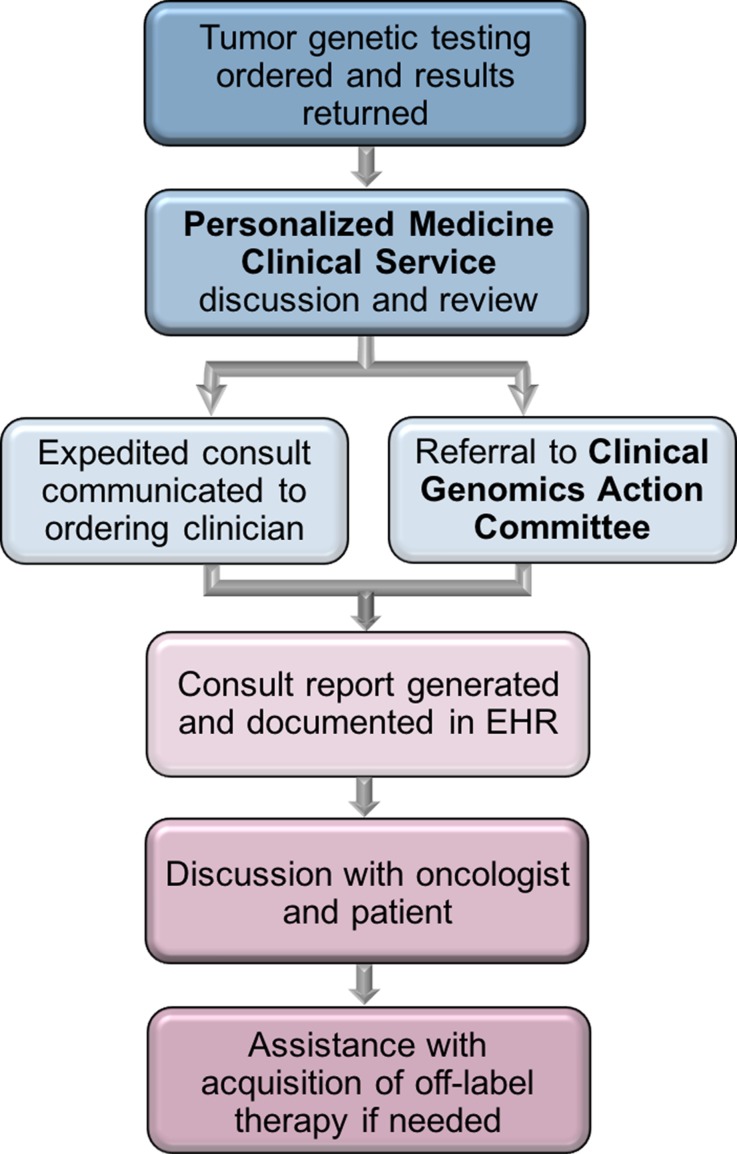
Materials and methods: In July 2014, the Clinical Genomics Action Committee (CGAC) was established as the molecular tumor board companion to the Personalized Medicine Clinical Service (PMCS) at Moffitt Cancer Center in Tampa, Florida. The processes and outcomes of the program were assessed in order to help others move into the practice of precision medicine.
Results: Through the establishment and initial 1,400 patients of the PMCS and its associated molecular tumor board at a major cancer center, five practical lessons of broad applicability have been learned: transdisciplinary engagement, the use of the molecular report as an aid to clinical management, clinical actionability, getting therapeutic options to patients, and financial considerations. Value to patients includes access to cutting-edge practice merged with individualized preferences in treatment and care.
Conclusions: Genomic-driven cancer medicine is increasingly becoming a part of routine clinical practice. For successful implementation of precision cancer medicine, strategically organized molecular tumor boards are critical to provide objective evidence-based translation of observed molecular alterations into patient-centered clinical action. Molecular tumor board implementation models along with clinical and economic outcomes will define future treatment standards. The Oncologist 2017;22:144-151Implications for Practice: It is clear that the increasing practicality of genetic tumor sequencing technology has led to its incorporation as part of routine clinical practice. Subsequently, many cancer centers are seeking to develop a personalized medicine services and/or molecular tumor board to shepherd precision medicine into clinical practice. This article discusses the key lessons learned through the establishment and development of a molecular tumor board and personalized medicine clinical service. This article highlights practical issues and can serve as an important guide to other centers as they conceive and develop their own personalized medicine services and molecular tumor boards.
Keywords: Cancer; Lessons learned; Molecular tumor board; Personalized medicine; Precision medicine.
© AlphaMed Press 2017.
Conflict of interest statement
Figures
References
-
- Dancey JE, Bedard PL, Onetto N et al. The genetic basis for cancer treatment decisions. Cell 2012;148:409–420. - PubMed
-
- Hanahan D, Weinberg RA. Hallmarks of cancer: the next generation. Cell 2011;144:646–674. - PubMed
-
- Wong KM, Hudson TJ, McPherson JD. Unraveling the genetics of cancer: Genome sequencing and beyond. Annu Rev Genomics Hum Genet 2011;12:407–430. - PubMed
-
- Druker BJ, Talpaz M, Resta DJ et al. Efficacy and safety of a specific inhibitor of the BCR‐ABL tyrosine kinase in chronic myeloid leukemia. N Engl J Med 2001;344:1031–1037. - PubMed
Publication types
MeSH terms
Grants and funding
LinkOut - more resources
Full Text Sources
Other Literature Sources
