


Temporally and Genetically Discrete Periods of Wheat Sensitivity to High Temperature
- PMID: 28179910
- PMCID: PMC5263156
- DOI: 10.3389/fpls.2017.00051
Temporally and Genetically Discrete Periods of Wheat Sensitivity to High Temperature
Abstract
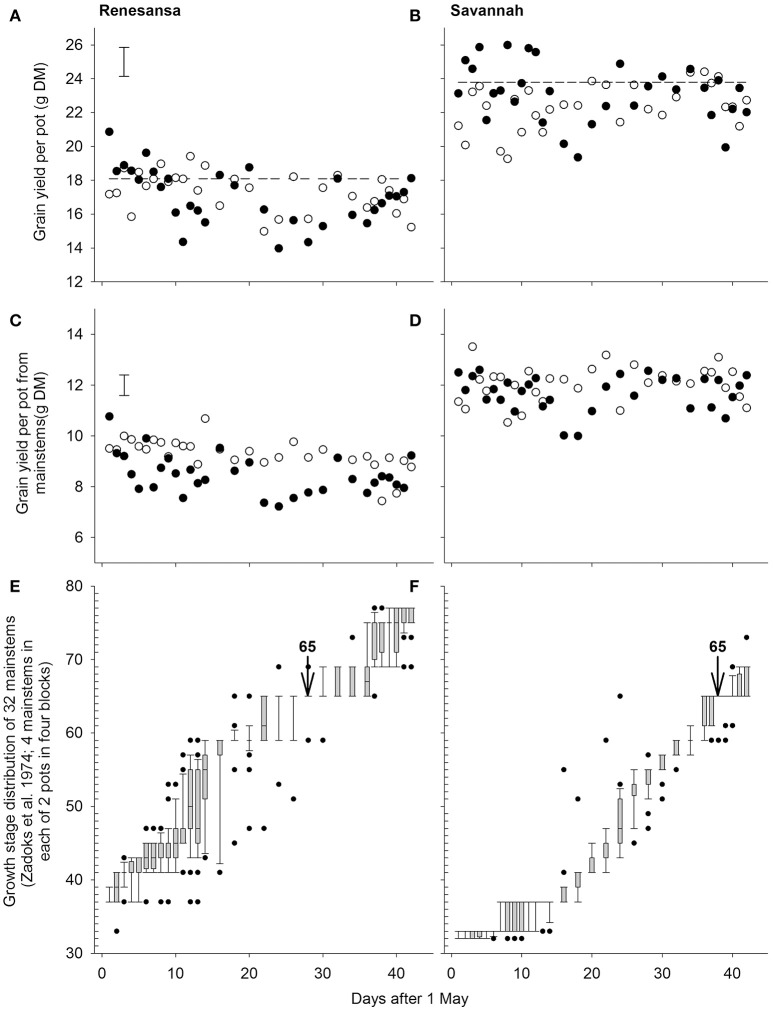
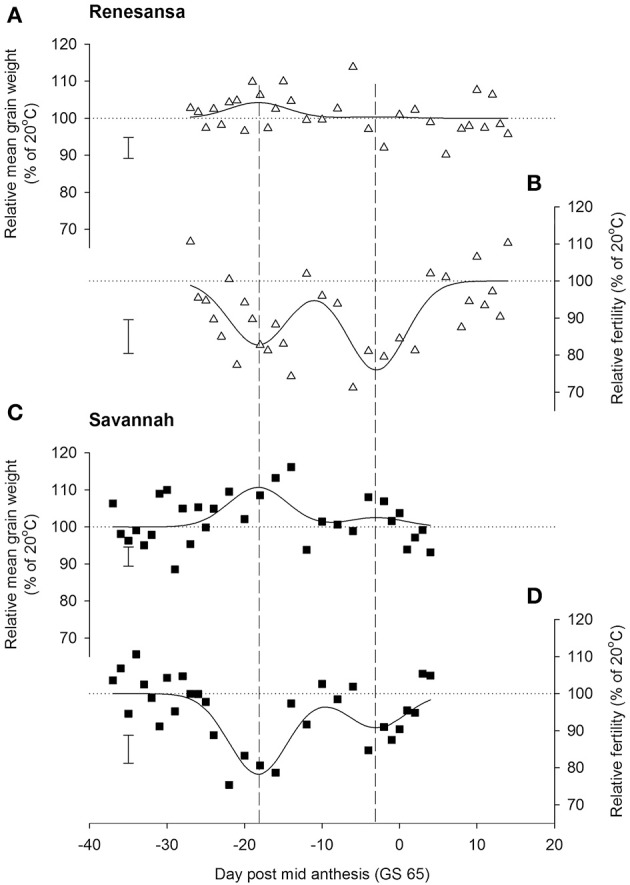
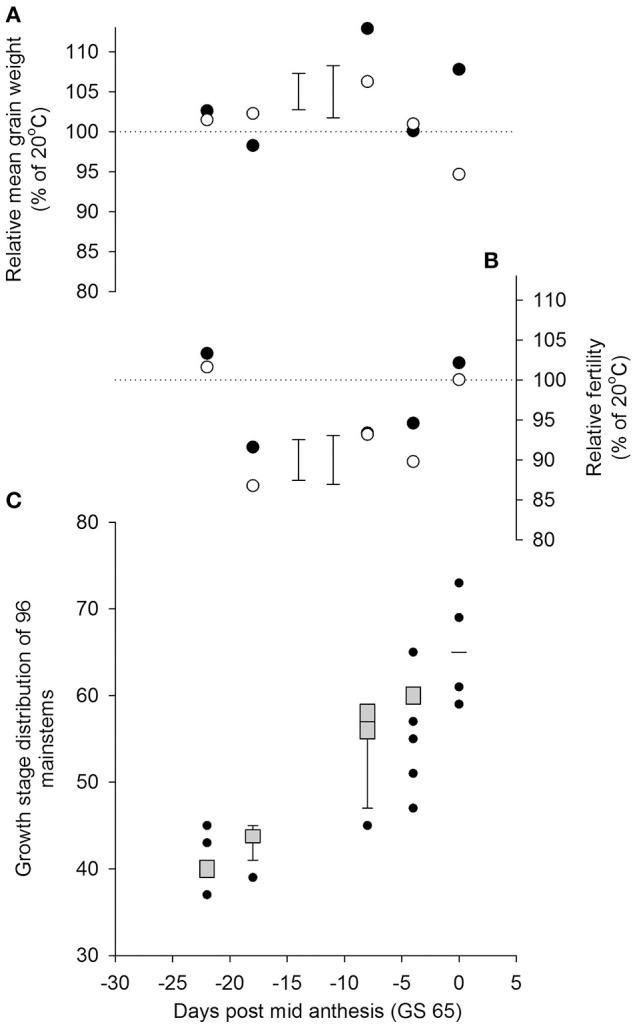
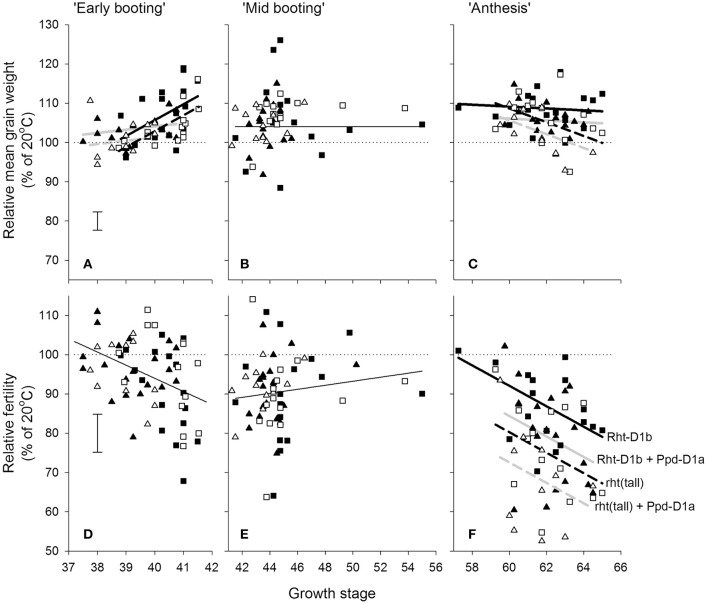
Successive single day transfers of pot-grown wheat to high temperature (35/30°C day/night) replicated controlled environments, from the second node detectable to the milky-ripe growth stages, provides the strongest available evidence that the fertility of wheat can be highly vulnerable to heat stress during two discrete peak periods of susceptibility: early booting [decimal growth stage (GS) 41-45] and early anthesis (GS 61-65). A double Gaussian fitted simultaneously to grain number and weight data from two contrasting elite lines (Renesansa, listed in Serbia, Ppd-D1a, Rht8; Savannah, listed in UK, Ppd-D1b, Rht-D1b) identified peak periods of main stem susceptibility centered on 3 (s.e. = 0.82) and 18 (s.e. = 0.55) days (mean daily temperature = 14.3°C) pre-GS 65 for both cultivars. Severity of effect depended on genotype, growth stage and their interaction: grain set relative to that achieved at 20/15°C dropped below 80% for Savannah at booting and Renesansa at anthesis. Savannah was relatively tolerant to heat stress at anthesis. A further experiment including 62 lines of the mapping, doubled-haploid progeny of Renesansa × Savannah found tolerance at anthesis to be associated with Ppd-D1b, Rht-D1b, and a QTL from Renesansa on chromosome 2A. None of the relevant markers were associated with tolerance during booting. Rht8 was never associated with heat stress tolerance, a lack of effect confirmed in a further experiment where Rht8 was included in a comparison of near isogenic lines in a cv. Paragon background. Some compensatory increases in mean grain weight were observed, but only when stress was applied during booting and only where Ppd-D1a was absent.
Keywords: Ppd-D1; Rht; anthesis; heat stress; meiosis; wheat.
Figures
References
-
- Addisu M., Snape J. W., Simmonds J. R., Gooding M. J. (2010). Effects of reduced height (Rht) and photoperiod insensitivity (Ppd) alleles on yield of wheat in contrasting production systems. Euphytica 172, 169–181. 10.1007/s10681-009-0025-2 - DOI
-
- Alghabari F., Lukac M., Jones H. E., Gooding M. J. (2014). Effect of Rht alleles on the tolerance of wheat grain set to high temperature and drought stress during booting and anthesis. J. Agron. Crop Sci. 200, 36–45. 10.1111/jac.12038 - DOI
-
- Barber H. M., Carney J., Alghabari F., Gooding M. J. (2015). Decimal growth stages for precision wheat production in changing environments? Ann. Appl. Biol. 166, 355–371. 10.1111/aab.12207 - DOI
-
- Craufurd P. Q., Vadez V., Jagadish S. V. K., Prasad P. V. V., Zaman-Allah M. (2013). Crop science experiments designed to inform crop modeling. Agric. For. Meteorol. 170, 8–18. 10.1016/j.agrformet.2011.09.003 - DOI
LinkOut - more resources
Full Text Sources
Other Literature Sources
