Comparative Study
. 2017 Apr;69(4):255-269.
doi: 10.1007/s00251-017-0973-y. Epub 2017 Feb 9.

The evolution of the natural killer complex; a comparison between mammals using new high-quality genome assemblies and targeted annotation

Affiliations
Comparative Study

The evolution of the natural killer complex; a comparison between mammals using new high-quality genome assemblies and targeted annotation

John C Schwartz et al. Immunogenetics. 2017 Apr.

Abstract

Natural killer (NK) cells are a diverse population of lymphocytes with a range of biological roles including essential immune functions. NK cell diversity is in part created by the differential expression of cell surface receptors which modulate activation and function, including multiple subfamilies of C-type lectin receptors encoded within the NK complex (NKC). Little is known about the gene content of the NKC beyond rodent and primate lineages, other than it appears to be extremely variable between mammalian groups. We compared the NKC structure between mammalian species using new high-quality draft genome assemblies for cattle and goat; re-annotated sheep, pig, and horse genome assemblies; and the published human, rat, and mouse lemur NKC. The major NKC genes are largely in the equivalent positions in all eight species, with significant independent expansions and deletions between species, allowing us to propose a model for NKC evolution during mammalian radiation. The ruminant species, cattle and goats, have independently evolved a second KLRC locus flanked by KLRA and KLRJ, and a novel KLRH-like gene has acquired an activating tail. This novel gene has duplicated several times within cattle, while other activating receptor genes have been selectively disrupted. Targeted genome enrichment in cattle identified varying levels of allelic polymorphism between the NKC genes concentrated in the predicted extracellular ligand-binding domains. This novel recombination and allelic polymorphism is consistent with NKC evolution under balancing selection, suggesting that this diversity influences individual immune responses and may impact on differential outcomes of pathogen infection and vaccination.

Keywords: C-type lectin; KLRA; KLRC; Leukocyte receptor complex; Natural killer cells; Natural killer complex.


Figures
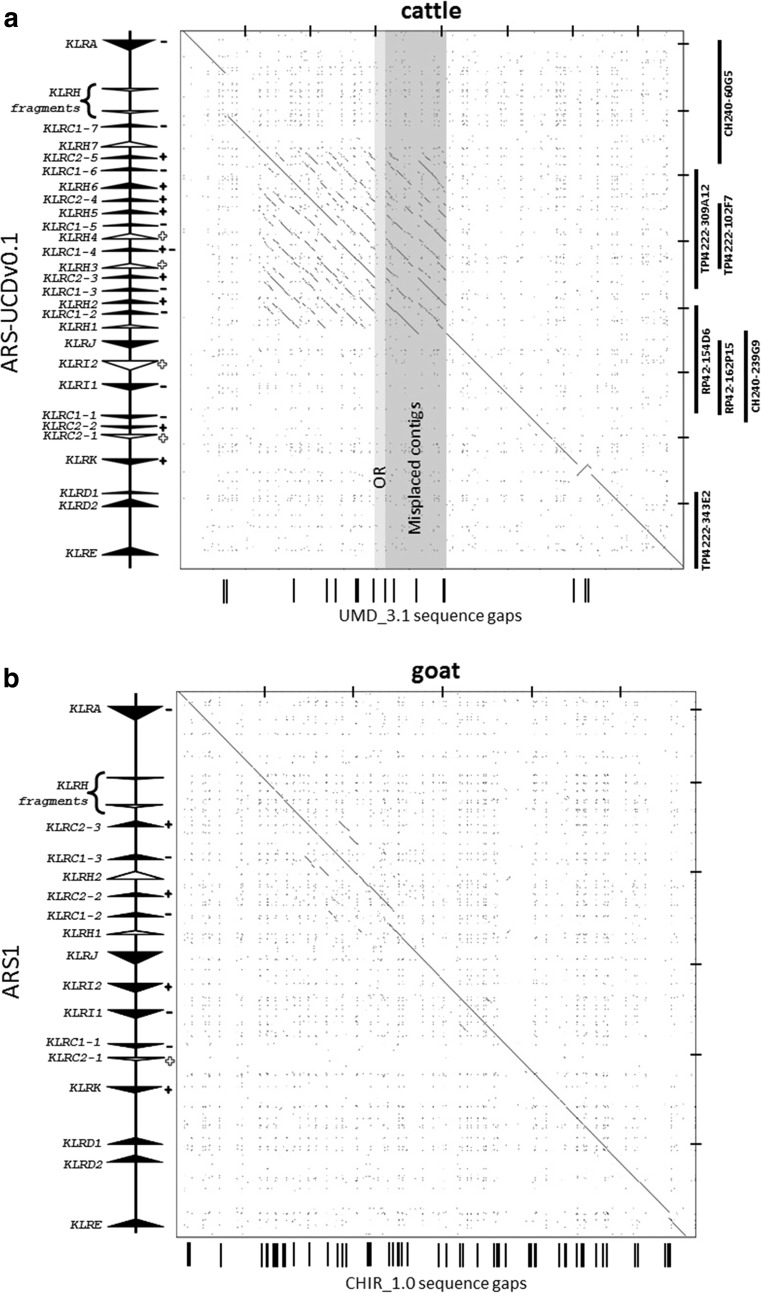
Fig. 1
Fig. 1
Comparison of NKC genome assemblies. a Recurrence plots of cattle and b goat NKC regions comparing the sequence identities of the reference genome assemblies (x axes) with the current respective long-read assemblies (y axes). Gene annotation is shown at the left. Genes which are either putatively functional (closed arrows) or non-functional (open arrows) are indicated and point in the direction of transcription. Genes which encode receptors that possess inhibitory (negative) and/or activating components (positive) are indicated, and open symbols denote non-functional genes. Gaps within the reference assemblies are represented by black bars below the x axes. No sequence gaps were present within either long-read assembly. Tick marks at the top and right are separated by 100 kb. Misplaced and olfactory receptor (OR)-containing contigs are indicated for the cattle genome as gray boxes. BAC clones used in the current analyses are represented at the right
Fig. 2
Fig. 2
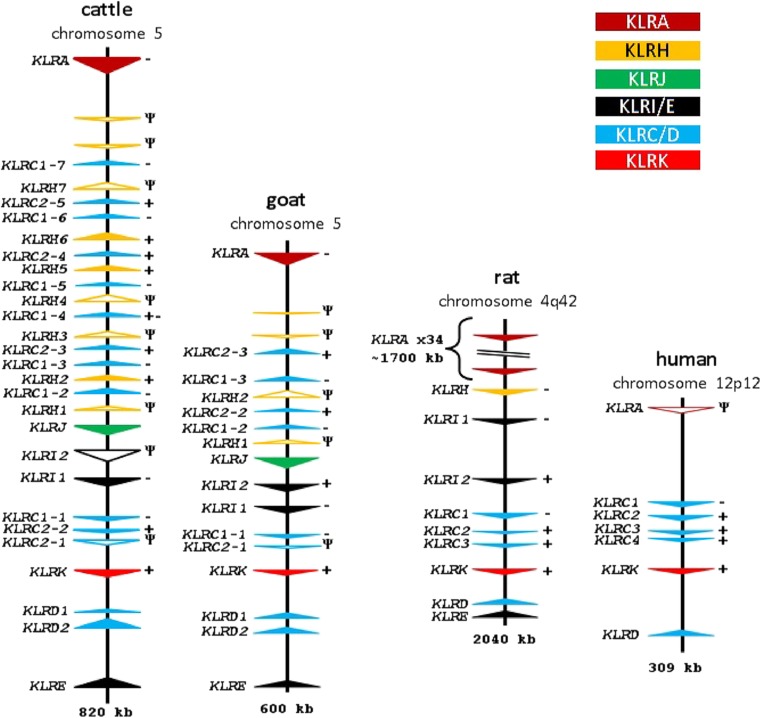
Comparative organization of the NKC in selected species. Genomic regions are approximately to scale, visualized as in Fig. 1 with Ψ indicating pseudogenes and anchored on KLRK
Fig. 3
Fig. 3
Phylogenetic relationships of nucleotide coding region sequence for KLRC and KLRH in cattle, goats, humans, and rats. a Cytoplasmic and TM regions encoded by exons 1 to 3. b C-type lectin domain encoded by exons 4 to 6. The first three exons of rat KLRH were excluded as the sequence was too divergent to be aligned. Bootstrap values (out of 100) are indicated at branch points. Dashed boxes indicate the ruminant genes found within the expanded region flanked by KLRA and KLRJ. To ease visualization, KLRH genes are shown in bold
Fig. 4
Fig. 4
Genetic variation within the cattle NKC coding regions. Genomic orientation is preserved with gene orientation shown at the left with arrows pointing in the direction of transcription. Black-shaded regions of genes indicate the lectin-coding domains, and gray-shaded regions indicate cytoplasmic, TM, and stalk regions. Shaded bars at the left indicate whether the SNP at that position is synonymous (gray) or non-synonymous (black) when compared to the reference genome (UMD_3.1). Red-colored bars indicate the homozygous SNPs (approximately 100% of reads), yellow-colored bars indicate the heterozygous SNPs (approximately 50% of reads), and gray-colored bars indicate the identity to the reference. Nerewater Tiptop, Blackisle Garve, 159, 766, 252, 183, 405, 652, 982, 4222, 598, 818, 805, 204, 882, 206, and 375 represent the Friesian cattle. Samples from Kuchinoshima and Chillingham cattle were obtained from genetically isolated herds in Japan and the UK, respectively. B. indicus is represented by three individuals from either the Sahiwal or Nelore breed
Fig. 5
Fig. 5
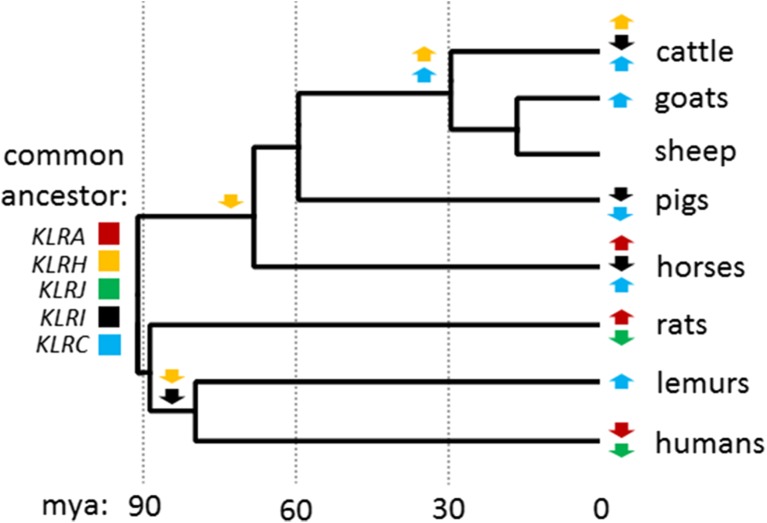
NKC evolution between selected mammalian lineages using mtDNA sequence. All five KLR gene subgroups indicated were carried by the last common ancestor of the species presented at the right. Gene subgroup expansion (up arrows) or contraction (down arrows) for individual species or clades is indicated at nodes. Divergence time estimates are shown below and with dashed lines at 30-Myr intervals

References

    1. Abi-Rached L, Parham P. Natural selection drives recurrent formation of activating killer cell immunoglobulin-like receptor and Ly49 from inhibitory homologues. J Exp Med. 2005;201:1319–1332. doi: 10.1084/jem.20042558. - DOI - PMC - PubMed
    1. Altschul SF, Gish W, Miller W, Myers EW, Lipman DJ. Basic Local Alignment Search Tool. J Mol Biol. 1990;215:403–410. doi: 10.1016/S0022-2836(05)80360-2. - DOI - PubMed
    1. Anderson SK, Ortaldo JR, McVicar DW. The ever-expanding Ly49 gene family: repertoire and signaling. Immunol Rev. 2001;181:79–89. doi: 10.1034/j.1600-065X.2001.1810106.x. - DOI - PubMed
    1. Averdam A, Petersen B, Rosner C, Neff J, Roos C, Eberle M, Aujard F, Münch C, Schempp W, Carrington M, Shiina T, Inoko H, Knaust F, Coggill P, Sehra H, Beck S, Abi-Rached L, Reinhardt R, Walter L. A novel system of polymorphic and diverse NK cell receptors in primates. PLoS Genet. 2009;5:e1000688. doi: 10.1371/journal.pgen.1000688. - DOI - PMC - PubMed
    1. Berlin K, Koren S, Chin CS, Drake JP, Landolin JM, Phillippy AM. Assembling large genomes with single-molecule sequencing and locality-sensitive hashing. Nat Biotechnol. 2015;33:623–630. doi: 10.1038/nbt.3238. - DOI - PubMed

Publication types

Substances