doi: 10.2807/1560-7917.ES.2017.22.4.30447.
Steep rise in norovirus cases and emergence of a new recombinant strain GII.P16-GII.2, Germany, winter 2016
Affiliations
- PMID: 28181902
- PMCID: PMC5388089
- DOI: 10.2807/1560-7917.ES.2017.22.4.30447
Item in Clipboard
Steep rise in norovirus cases and emergence of a new recombinant strain GII.P16-GII.2, Germany, winter 2016
Euro Surveill.
.
Abstract
Since early November 2016, the number of laboratory-confirmed norovirus infections reported in Germany has been increasing steeply. Here, we report the detection and genetic characterisation of an emerging norovirus recombinant, GII.P16-GII.2. This strain was frequently identified as the cause of sporadic cases as well as outbreaks in nine federal states of Germany. Our findings suggest that the emergence of GII.P16-GII.2 contributed to rising case numbers of norovirus gastroenteritis in Germany.
Keywords: GII.P16-GII.2; Germany; emergence; norovirus; recombinant.
This article is copyright of The Authors, 2017.
Conflict of interest statement
Figures
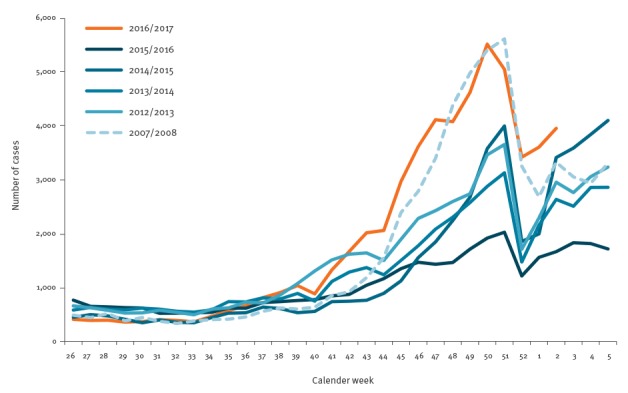
Laboratory-confirmed norovirus infections by calendar week and year of notification, compared previous seasons, Germany, week 26 2016–week 2 2017 (n = 56,384)
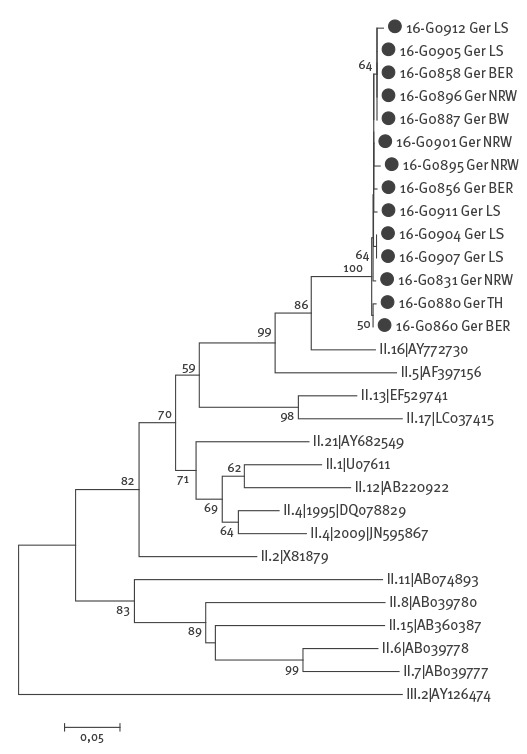
Phylogenetic analysis based on the nucleotide sequence of a 357 bp region (ORF1) of genogroup II norovirus, Germany, 2016/17 (n = 14 representative samples)
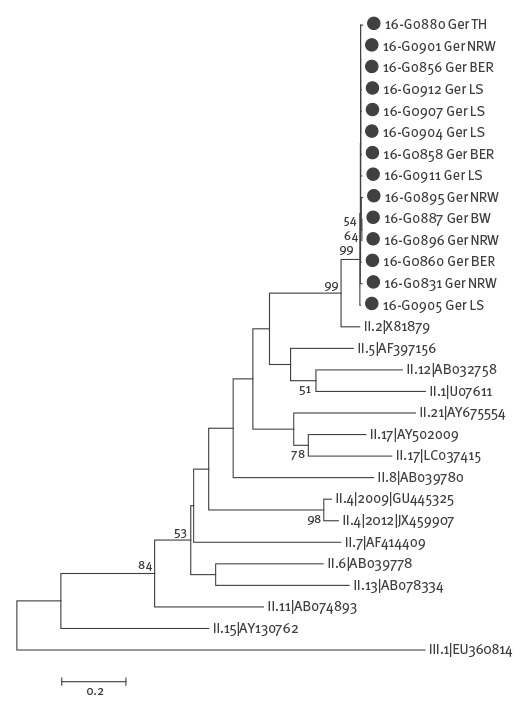
Phylogenetic analysis based on the nucleotide sequence of a 628 bp region of the P2 domain (ORF2) of genogroup II noroviruses, Germany, 2016/17 (n = 14 representative samples)
References
MeSH terms
Substances
LinkOut - more resources
Full Text Sources
Other Literature Sources
Medical