. 2017 Feb 9:7:42187.
doi: 10.1038/srep42187.

Genomic insights into the population structure and history of the Irish Travellers

Affiliations

Genomic insights into the population structure and history of the Irish Travellers

Edmund Gilbert et al. Sci Rep. .

Abstract

The Irish Travellers are a population with a history of nomadism; consanguineous unions are common and they are socially isolated from the surrounding, 'settled' Irish people. Low-resolution genetic analysis suggests a common Irish origin between the settled and the Traveller populations. What is not known, however, is the extent of population structure within the Irish Travellers, the time of divergence from the general Irish population, or the extent of autozygosity. Using a sample of 50 Irish Travellers, 143 European Roma, 2232 settled Irish, 2039 British and 6255 European or world-wide individuals, we demonstrate evidence for population substructure within the Irish Traveller population, and estimate a time of divergence before the Great Famine of 1845-1852. We quantify the high levels of autozygosity, which are comparable to levels previously described in Orcadian 1st/2nd cousin offspring, and finally show the Irish Traveller population has no particular genetic links to the European Roma. The levels of autozygosity and distinct Irish origins have implications for disease mapping within Ireland, while the population structure and divergence inform on social history.


Conflict of interest statement

The authors declare no competing financial interests.

Figures
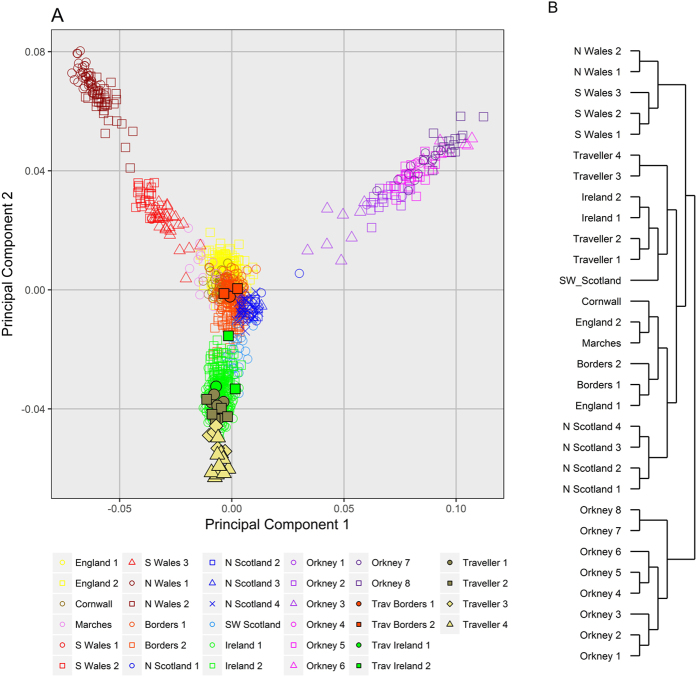
Figure 1
Figure 1. Clustering of 34 Irish Travellers, 300 Settled Irish, and 828 British by fineStructure.
(A) The first and second components of principal component analysis of the haplotype-based co-ancestry matrix produced by fineStructure analysis. Individual clusters are indicated by colour and shape. Individual Irish Travellers are indicated with black bordered shapes, with cluster shown in Legend. (B) The full fineStructure tree with the highest posterior probability, with cluster size and name, and broad branches shown.
Figure 2
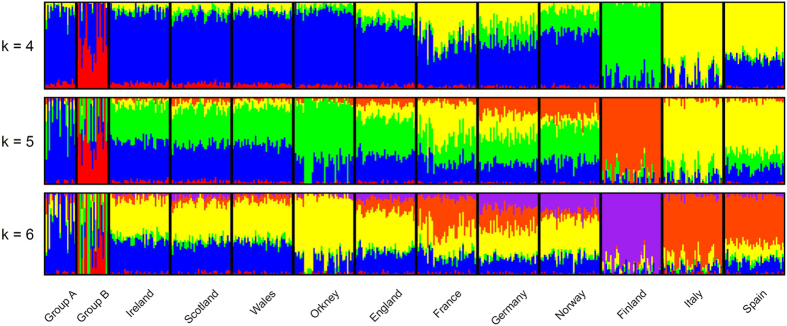
Figure 2. Ancestry profiles of the Irish Travellers, and neighbouring European populations by ADMIXTURE.
Shown are the ancestry components per individual for the two groups of Irish Travellers (Group A and Group B), settled Irish, British, and European populations; modelling for 4 to 6 ancestral populations.
Figure 3
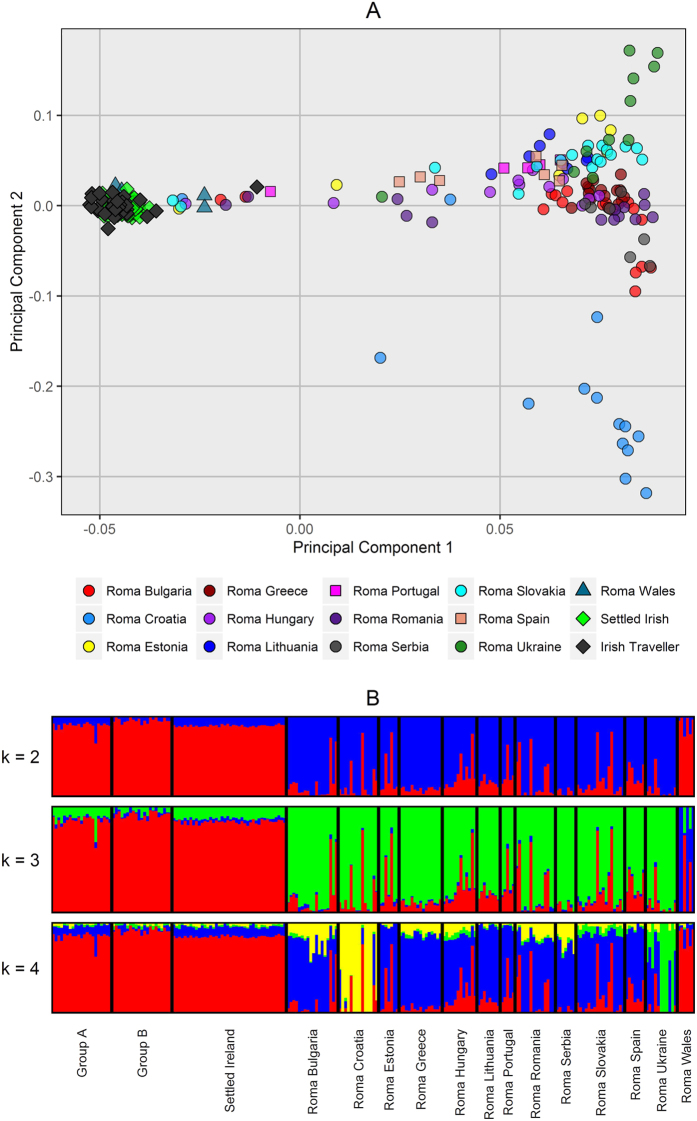
Figure 3. Comparison between the Irish Travellers, the settled Irish, and the European Roma.
(A) The first and second components from principal component analysis using gcta64. (B) The ancestry profiles using ADMIXTURE, assuming 2 to 4 ancestral populations.
Figure 4
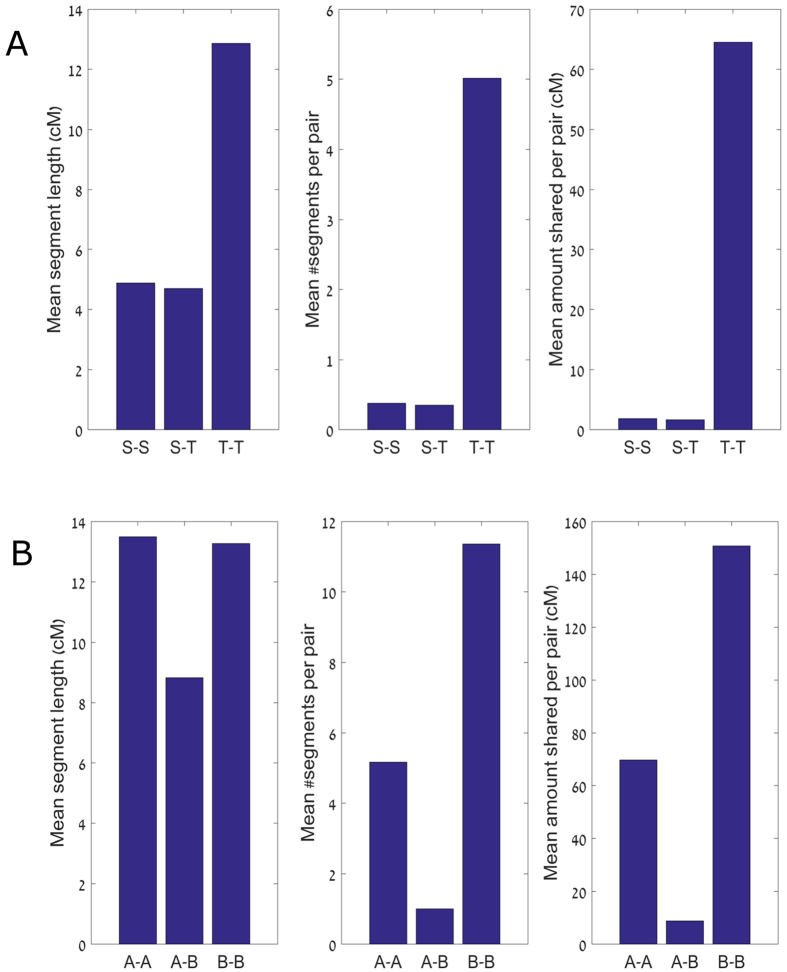
Figure 4. Extent of haplotype sharing between the settled Irish and the Irish Travellers, and between the two groups of Irish Travellers.
(A) The number and lengths of shared segments within Settled Irish, within Traveller Irish, and between the groups. Left panel: The mean segment length; middle panel: the mean number of shared segments; right panel: the mean total sequence length (in cM) shared between each pair of individuals. (B) The number and lengths of shared segments within Traveller Group A, Traveller Group B, and between the groups. The format of the figure is as in (A).
Figure 5
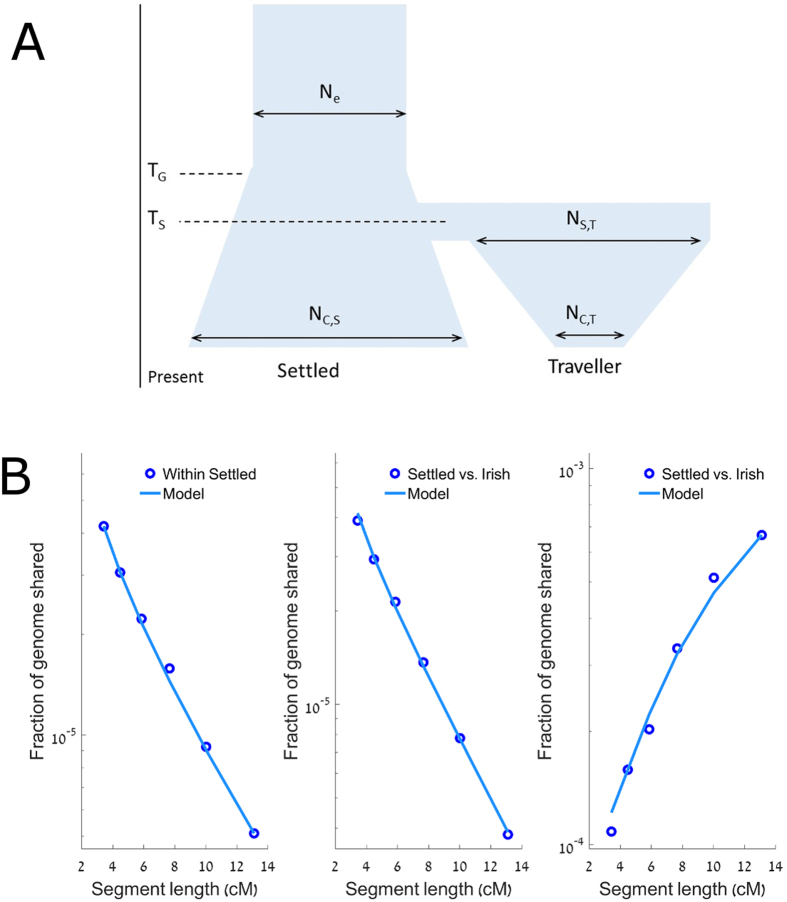
Figure 5
(A) The model used for demographic inference. The two populations were one ancestral population, with size Ne, TG generations ago. At this point the ancestral population started to grow exponentially until TS generations ago, where the ancestral Traveller and settled populations split from each other, with NS,T being the initial starting population size of the Traveller population. The settled population experienced continued exponential growth until the present, with a population size of NC,S. The Traveller population experienced a period of exponential contraction until the present, with a population of NC,T. (B) The proportion of the genome in IBD segments vs the IBD segments length. The total genome size and the sum of segment lengths were computed in cM. Left: sharing between pairs of settled Irish; middle: sharing between pairs of one settled and one Traveller individuals; right: sharing between pairs of Traveller Irish. Each data point is located at the harmonic mean of the boundaries of the length interval it represents.
Figure 6
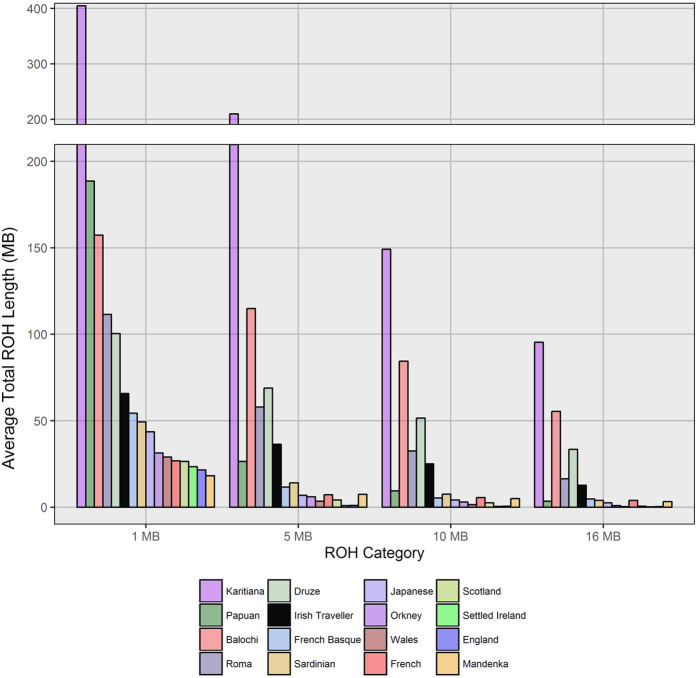
Figure 6. Extent of autozygosity in the Irish Travellers, settled Irish, select world-wide populations, and the European Roma.
Shown, across four minimum lengths of runs of homozygosity (ROH), are the average lengths of ROH in each population. The average ROH burdens for the European Roma are the mean of means across the 13 Roma populations studied. These values are from a separate analysis, and collated with the wider European ROH values for reasons of SNP coverage between the different datasets.

References

    1. Abdalla S. et al.. Summary of the findings of the All Ireland Traveller Health Study. School of Public Health and Population Science, University College Dublin (2010).
    1. Relethford J. & Crawford M. Genetic drift and the population history of the Irish travellers. American Journal of Physical Anthropology, 150(2), 184–189 (2013). - PubMed
    1. Commission of Itinerancy 1963, Report of the Commission of Itinerancy 1963. Stationery Office, Government Publication: Dublin (1963).
    1. North K. E., Martin L. J. & Crawford M. H. The origins of the Irish travellers and the genetic structure of Ireland. Annals of Human Biology, 27(5), 453–66 (2000). - PubMed
    1. McCann M., Síocháin S. Ó. & Ruane J. Irish Travellers: Culture and ethnicity. Institute of Irish Studies, Queens University of Belfast: Belfast (1994).

Publication types

LinkOut - more resources