


Proton beam therapy for bone sarcomas of the skull base and spine: A retrospective nationwide multicenter study in Japan
- PMID: 28182320
- PMCID: PMC5448607
- DOI: 10.1111/cas.13192
Proton beam therapy for bone sarcomas of the skull base and spine: A retrospective nationwide multicenter study in Japan
Abstract
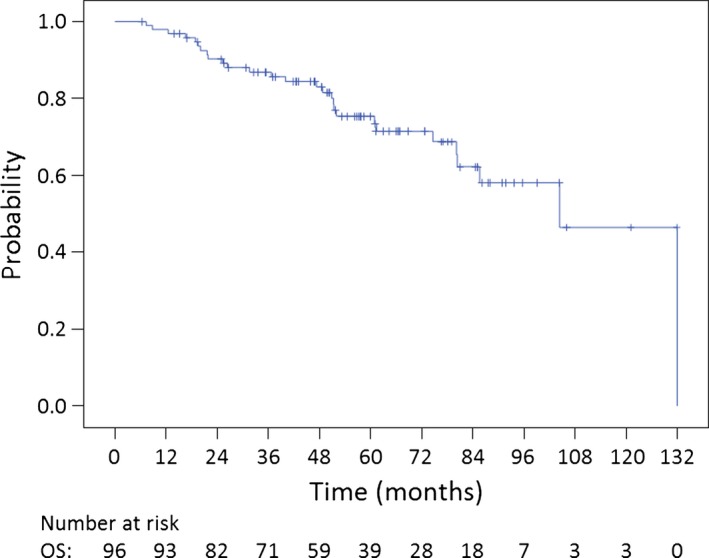
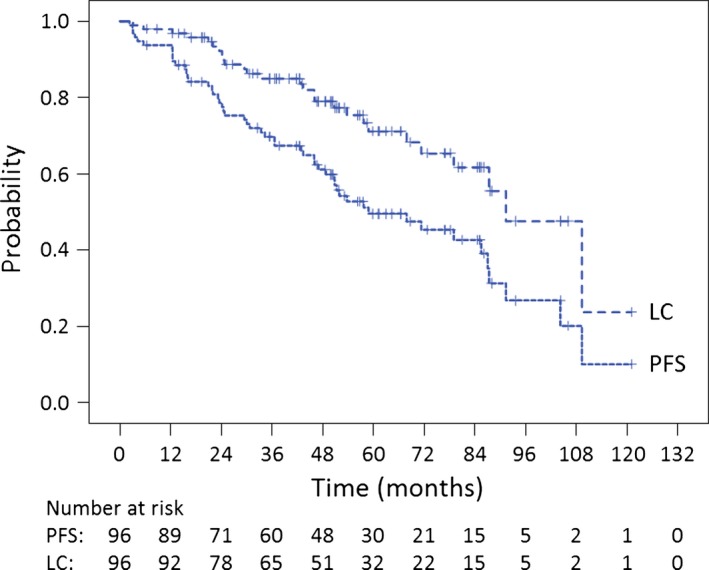
We conducted a retrospective, nationwide multicenter study to evaluate the clinical outcomes of proton beam therapy for bone sarcomas of the skull base and spine in Japan. Eligibility criteria included: (i) histologically proven bone sarcomas of the skull base or spine; (ii) no metastases; (iii) ≥20 years of age; and (iv) no prior treatment with radiotherapy. Of the 103 patients treated between January 2004 and January 2012, we retrospectively analyzed data from 96 patients who were followed-up for >6 months or had died within 6 months. Seventy-two patients (75.0%) had chordoma, 20 patients (20.8%) had chondrosarcoma, and four patients (7.2%) had osteosarcoma. The most frequent tumor locations included the skull base in 68 patients (70.8%) and the sacral spine in 13 patients (13.5%). Patients received a median total dose of 70.0 Gy (relative biological effectiveness). The median follow-up was 52.6 (range, 6.3-131.9) months. The 5-year overall survival, progression-free survival, and local control rates were 75.3%, 49.6%, and 71.1%, respectively. Performance status was a significant factor for overall survival and progression-free survival, whilst sex was a significant factor for local control. Acute Grade 3 and late toxicities of ≥Grade 3 were observed in nine patients (9.4%) each (late Grade 4 toxicities [n = 3 patients; 3.1%]). No treatment-related deaths occurred. Proton beam therapy is safe and effective for the treatment of bone sarcomas of the skull base and spine in Japan. However, larger prospective studies with a longer follow-up are warranted.
Keywords: Multicenter study; proton beam therapy; sarcoma; skull base; spine.
© 2017 The Authors. Cancer Science published by John Wiley & Sons Australia, Ltd on behalf of Japanese Cancer Association.
Figures
References
-
- Siegel RL, Miller KD, Jemal A. Cancer statistics, 2016. CA Cancer J Clin 2016; 66: 7–30. - PubMed
-
- Catton C, O'Sullivan B, Bell R et al Chordoma: long‐term follow‐up after radical photon irradiation. Radiother Oncol 1996; 41: 67–72. - PubMed
-
- DeLaney TF, Trofimov AV, Engelsman M, Suit HD. Advanced‐technology radiation therapy in the management of bone and soft tissue sarcomas. Cancer Control 2005; 12: 27–35. - PubMed
-
- Suit HD, Goitein M, Munzenrider J et al Definitive radiation therapy for chordoma and chondrosarcoma of base of skull and cervical spine. J Neurosurg 1982; 56: 377–85. - PubMed
-
- Austin‐Seymour M, Munzenrider J, Goitein M et al Fractionated proton radiation therapy of chordoma and low‐grade chondrosarcoma of the base of the skull. J Neurosurg 1989; 70: 13–17. - PubMed
Publication types
MeSH terms
LinkOut - more resources
Full Text Sources
Other Literature Sources
Medical
