


Assessment of Impact and Recovery Needs in Communities Affected by the Elk River Chemical Spill, West Virginia, April 2014
- PMID: 28182514
- PMCID: PMC5349483
- DOI: 10.1177/0033354916689606
Assessment of Impact and Recovery Needs in Communities Affected by the Elk River Chemical Spill, West Virginia, April 2014
Abstract
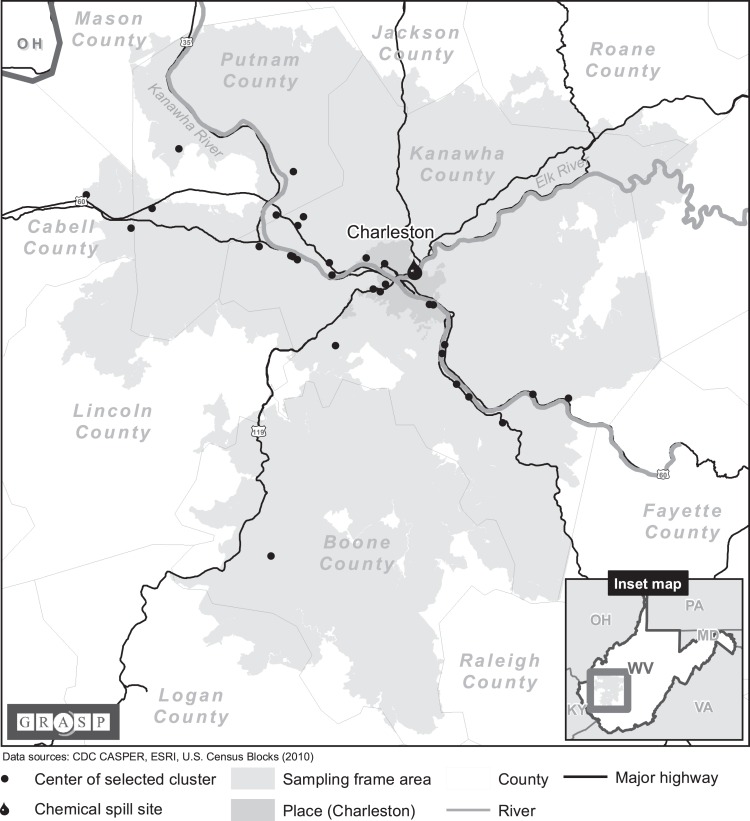
Objectives: In January 2014, 4-methylcyclohexanemethanol spilled into the Elk River near Charleston, West Virginia, contaminating the water supply for about 120 000 households. The West Virginia American Water Company (WVAWC) issued a "do not use" water order for 9 counties. After the order was lifted (10 days after the spill), the communities' use of public water systems, information sources, alternative sources of water, and perceived impact of the spill on households were unclear to public health officials. To assist in recovery efforts, the West Virginia Bureau for Public Health and the Centers for Disease Control and Prevention conducted a Community Assessment for Public Health Emergency Response (CASPER).
Methods: We used the CASPER 2-stage cluster sampling design to select a representative sample of households to interview, and we conducted interviews in 171 households in April 2014. We used a weighted cluster analysis to generate population estimates in the sampling frame.
Results: Before the spill, 74.4% of households did not have a 3-day alternative water supply for each household member and pet. Although 83.6% of households obtained an alternative water source within 1 day of the "do not use" order, 37.4% of households reportedly used WVAWC water for any purpose. Nearly 3 months after the spill, 36.1% of households believed that their WVAWC water was safe, and 33.5% reported using their household water for drinking.
Conclusions: CASPER results identified the need to focus on basic public health messaging and household preparedness efforts. Recommendations included (1) encouraging households to maintain a 3-day emergency water supply, (2) identifying additional alternative sources of water for future emergencies, and (3) increasing community education to address ongoing concerns about water.
Keywords: disaster; environmental health; water.
Conflict of interest statement
Figures
References
-
- US Census Bureau. West Virginia QuickFacts. http://quickfacts.census.gov/qfd/maps/west_virginia_map.html. Accessed October 16, 2015.
-
- Office of the Governor. Governor Tomblin declares state of emergency in 9 counties. http://www.governor.wv.gov/Pages/State-of-Emergency.aspx. Published January 9, 2014. Accessed October 16, 2015.
-
- Gallagher DL, Phetxumphou K, Smiley E, Dietrich AM. Tale of two isomers: complexities of human odor perception for cis- and trans-4-methylcyclohexane methanol from the chemical spill in West Virginia. Environ Sci Technol. 2015;49(3):1319–1327. - PubMed
-
- Federal Emergency Management Agency. West Virginia chemical spill (EM-3366). https://www.fema.gov/disaster/3366. Published January 10, 2014. Accessed October 16, 2015.
-
- Christie RD, Fortin RJ, Gross AE. Process for Coal Flotation Using 4-Methyl Cyclohexane Methanol Frothers. Washington, DC: US Patent and Trademark Office; 1990.
MeSH terms
Substances
LinkOut - more resources
Full Text Sources
Other Literature Sources
Medical
Miscellaneous
