


Spectrum-Malaria: a user-friendly projection tool for health impact assessment and strategic planning by malaria control programmes in sub-Saharan Africa
- PMID: 28183343
- PMCID: PMC5301449
- DOI: 10.1186/s12936-017-1705-3
Spectrum-Malaria: a user-friendly projection tool for health impact assessment and strategic planning by malaria control programmes in sub-Saharan Africa
Abstract
Background: Scale-up of malaria prevention and treatment needs to continue but national strategies and budget allocations are not always evidence-based. This article presents a new modelling tool projecting malaria infection, cases and deaths to support impact evaluation, target setting and strategic planning.
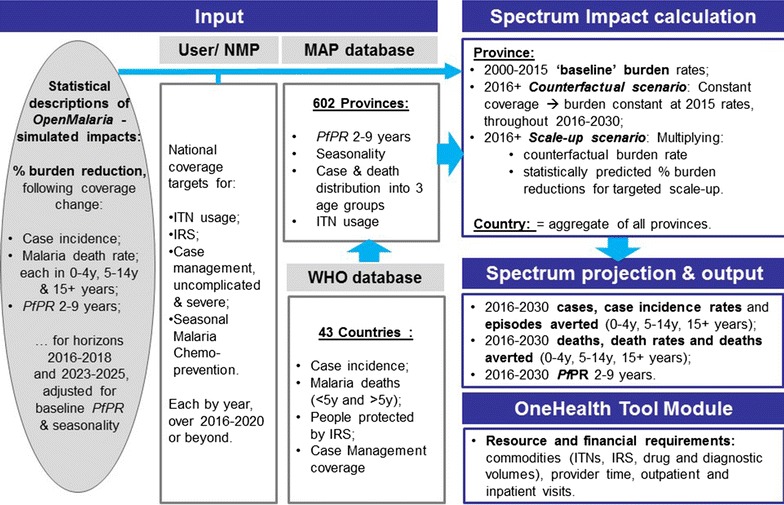
Methods: Nested in the Spectrum suite of programme planning tools, the model includes historic estimates of case incidence and deaths in groups aged up to 4, 5-14, and 15+ years, and prevalence of Plasmodium falciparum infection (PfPR) among children 2-9 years, for 43 sub-Saharan African countries and their 602 provinces, from the WHO and malaria atlas project. Impacts over 2016-2030 are projected for insecticide-treated nets (ITNs), indoor residual spraying (IRS), seasonal malaria chemoprevention (SMC), and effective management of uncomplicated cases (CMU) and severe cases (CMS), using statistical functions fitted to proportional burden reductions simulated in the P. falciparum dynamic transmission model OpenMalaria.
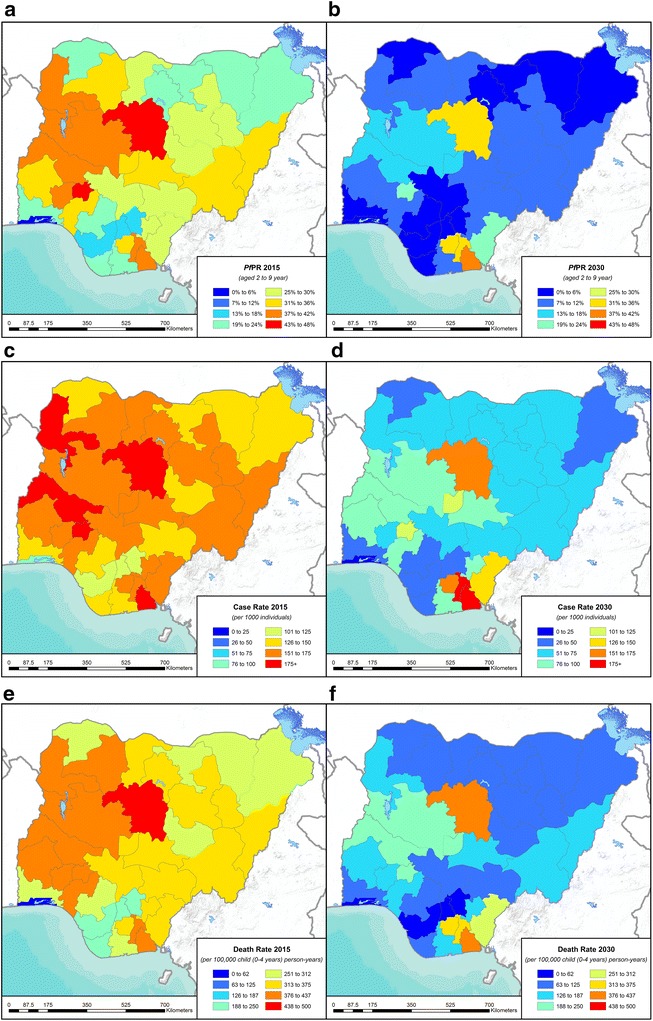
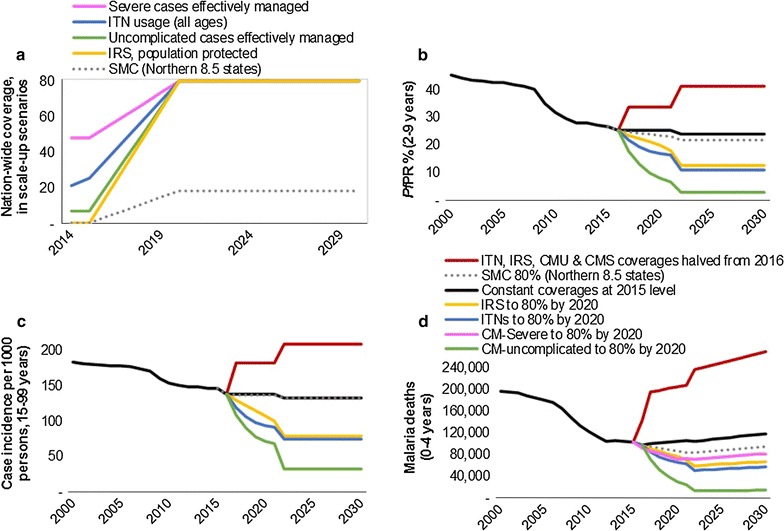
Results: In projections for Nigeria, ITNs, IRS, CMU, and CMS scale-up reduced health burdens in all age groups, with largest proportional and especially absolute reductions in children up to 4 years old. Impacts increased from 8 to 10 years following scale-up, reflecting dynamic effects. For scale-up of each intervention to 80% effective coverage, CMU had the largest impacts across all health outcomes, followed by ITNs and IRS; CMS and SMC conferred additional small but rapid mortality impacts.
Discussion: Spectrum-Malaria's user-friendly interface and intuitive display of baseline data and scenario projections holds promise to facilitate capacity building and policy dialogue in malaria programme prioritization. The module's linking to the OneHealth Tool for costing will support use of the software for strategic budget allocation. In settings with moderately low coverage levels, such as Nigeria, improving case management and achieving universal coverage with ITNs could achieve considerable burden reductions. Projections remain to be refined and validated with local expert input data and actual policy scenarios.
Keywords: Health impact; Malaria; Morbidity; Mortality; Policy evaluation; Prevention; Programmes; Strategic planning; Treatment.
Figures
References
-
- WHO . World Malaria Report 2015. Geneva: World Health Organization; 2015.
-
- WHO . Global technical strategy for malaria 2016–2030. Geneva: World Health Organization; 2015.
Publication types
MeSH terms
Grants and funding
LinkOut - more resources
Full Text Sources
Other Literature Sources
