Review
. 2017 Jan 30:6:90.
doi: 10.12688/f1000research.10152.1. eCollection 2017.

Mechanisms of pathogenesis of emerging adenoviruses

Affiliations
Review

Mechanisms of pathogenesis of emerging adenoviruses

James Cook et al. F1000Res. .

Abstract

Periodic outbreaks of human adenovirus infections can cause severe illness in people with no known predisposing conditions. The reasons for this increased viral pathogenicity are uncertain. Adenoviruses are constantly undergoing mutation during circulation in the human population, but related phenotypic changes of the viruses are rarely detected because of the infrequency of such outbreaks and the limited biological studies of the emergent strains. Mutations and genetic recombinations have been identified in these new strains. However, the linkage between these genetic changes and increased pathogenicity is poorly understood. It has been observed recently that differences in virus-induced immunopathogenesis can be associated with altered expression of non-mutant viral genes associated with changes in viral modulation of the host innate immune response. Initial small animal studies indicate that these changes in viral gene expression can be associated with enhanced immunopathogenesis in vivo. Available evidence suggests the hypothesis that there is a critical threshold of expression of certain viral genes that determines both the sustainability of viral transmission in the human population and the enhancement of immunopathogenesis. Studies of this possibility will require extension of the analysis of outbreak viral strains from a sequencing-based focus to biological studies of relationships between viral gene expression and pathogenic responses. Advances in this area will require increased coordination among public health organizations, diagnostic microbiology laboratories, and research laboratories to identify, catalog, and systematically study differences between prototype and emergent viral strains that explain the increased pathogenicity that can occur during clinical outbreaks.

Keywords: adenovirus; immunopathogenesis; innate immune response; outbreak.


Conflict of interest statement

The authors declare that they have no competing personal or financial interests. No competing interests were disclosed. No competing interests were disclosed.

Figures
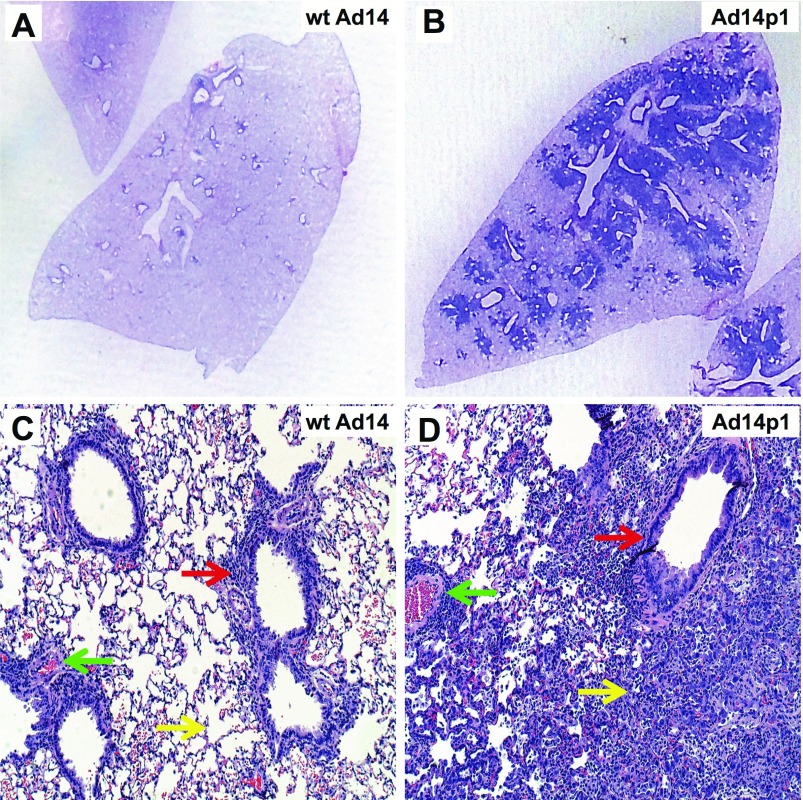
Figure 1.
Figure 1.. Comparative lung pathology induced by infection with prototype strain Ad14 (wild type, wt) vs. the outbreak strain, Ad14p1.
Lungs were harvested from infected hamsters at 7 days after intratracheal viral inoculation (5 × 10 9 plaque-forming units per animal). A& B, hematoxylin and eosin ( H& E)-stained lung section macroscopic comparison, showing minimal peribronchial changes in wt Ad14-infected lung ( A) vs. marked peribronchial infiltrates in Ad14p1-infected lung ( B). C& D, H& E comparisons at 10X magnification. Green, yellow, and red arrows indicate perivascular, alveolar, and peribronchial inflammation, respectively, in wt Ad14-infected lung ( C) vs. Ad14p1-infected lung ( D). Adapted with permission from American Society of Microbiology. Copyright © American Society for Microbiology, [Journal of Virology, volume 90(1), 2016, pages 497-505 and doi: 10.1128/JVI.01790-15].
Figure 2.
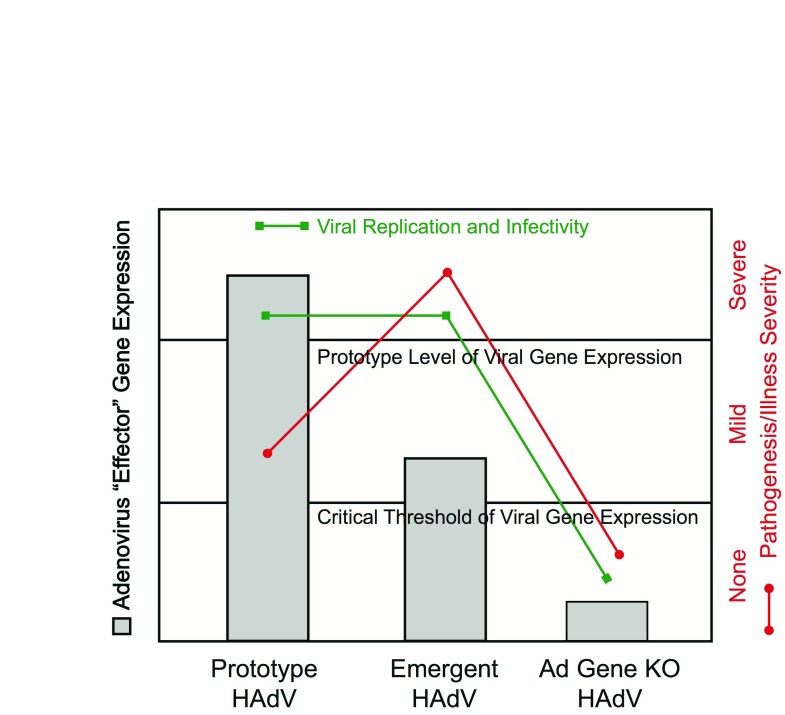
Figure 2.. “Critical threshold” viral gene expression model of emergent adenoviral immunopathogenesis.
When expression of the adenoviral “effector” gene is normal (left gray bar, Prototype human adenovirus [HAdV]), viral replication and infectivity (green line) are at the rates associated with prototype virus infection, and pathogenesis and illness severity (red line) are mild. Conversely, when viral effector gene expression falls below the critical threshold needed for normal viral replication and infectivity, as would be observed with a gene knockout (KO) virus (right gray bar, Ad Gene KO), there would be inadequate virus generated for infection transmission and little (or no) pathogenesis and no clinical illness. With more virulent, emergent adenoviral strains, expression of the adenoviral effector gene would fall below the normal expression level observed with the prototype strain but would stay above the critical threshold expression level needed for viral replication, infectivity, and infection transmission. Because of the loss-of-function phenotype of the emergent virus that would result from reduced expression of the effector gene, there would be reduced infection-related immunomodulation and, consequently, increased virus-induced immunopathogenesis and more severe clinical illness.

References

    1. Ghebremedhin B: Human adenovirus: Viral pathogen with increasing importance. Eur J Microbiol Immunol (Bp). 2014;4(1):26–33. 10.1556/EuJMI.4.2014.1.2 - DOI - PMC - PubMed
    2. F1000 Recommendation

    1. Lukashev AN, Ivanova OE, Eremeeva TP, et al. : Evidence of frequent recombination among human adenoviruses. J Gen Virol. 2008;89(Pt 2):380–8. 10.1099/vir.0.83057-0 - DOI - PubMed
    1. Rebelo-de-Andrade H, Pereira C, Gíria M, et al. : Outbreak of acute respiratory infection among infants in Lisbon, Portugal, caused by human adenovirus serotype 3 and a new 7/3 recombinant strain. J Clin Microbiol. 2010;48(4):1391–6. 10.1128/JCM.02019-09 - DOI - PMC - PubMed
    1. Zhao S, Wan C, Ke C, et al. : Re-emergent human adenovirus genome type 7d caused an acute respiratory disease outbreak in Southern China after a twenty-one year absence. Sci Rep. 2014;4(4): 7365. 10.1038/srep07365 - DOI - PMC - PubMed
    2. F1000 Recommendation

    1. Yamamoto D, Okamoto M, Lupisan S, et al. : Impact of human adenovirus serotype 7 in hospitalized children with severe fatal pneumonia in the Philippines. Jpn J Infect Dis. 2014;67(2):105–10. 10.7883/yoken.67.105 - DOI - PubMed
    2. F1000 Recommendation

LinkOut - more resources