


Effect of an evidence-based website on healthcare usage: an interrupted time-series study
- PMID: 28186945
- PMCID: PMC5128895
- DOI: 10.1136/bmjopen-2016-013166
Effect of an evidence-based website on healthcare usage: an interrupted time-series study
Erratum in
-
Correction.BMJ Open. 2017 May 4;7(4):e013166corr1. doi: 10.1136/bmjopen-2016-013166corr1. BMJ Open. 2017. PMID: 28473525 Free PMC article. No abstract available.
Abstract
Objectives: Healthcare costs and usage are rising. Evidence-based online health information may reduce healthcare usage, but the evidence is scarce. The objective of this study was to determine whether the release of a nationwide evidence-based health website was associated with a reduction in healthcare usage.
Design: Interrupted time series analysis of observational primary care data of healthcare use in the Netherlands from 2009 to 2014.
Setting: General community primary care.
Population: 912 000 patients who visited their general practitioners 18.1 million times during the study period.
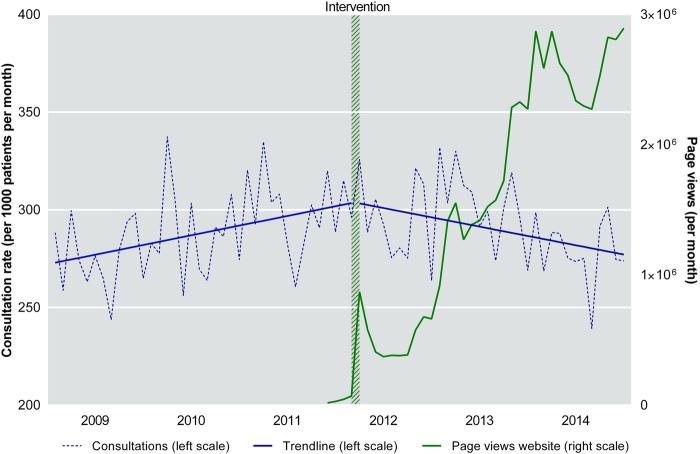
Intervention: In March 2012, an evidence-based health information website was launched by the Dutch College of General Practitioners. It was easily accessible and understandable using plain language. At the end of the study period, the website had 2.9 million unique page views per month.
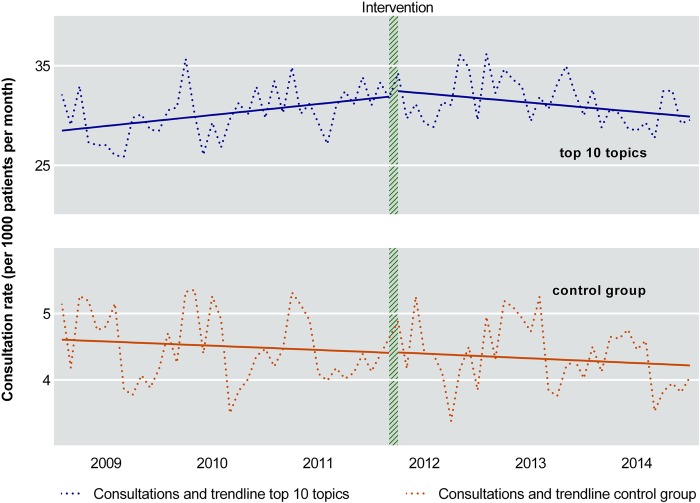
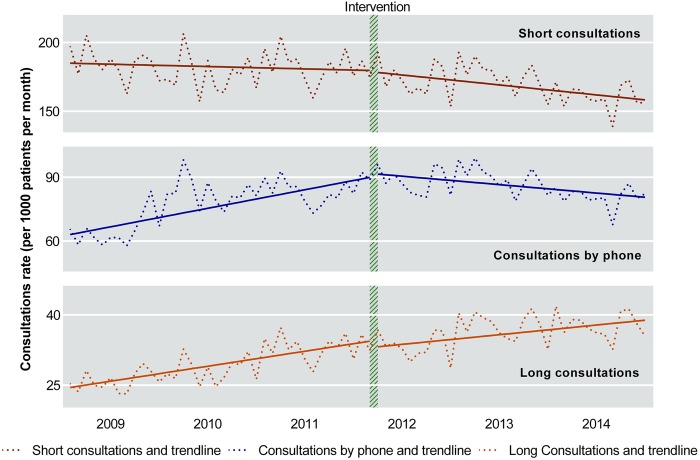
Main outcomes measures: Primary outcome was the change in consultation rate (consultations/1000 patients/month) before and after the release of the website. Additionally, a reference group was created by including consultations about topics not being viewed at the website. Subgroup analyses were performed for type of consultations, sex, age and socioeconomic status.
Results: After launch of the website, the trend in consultation rate decreased with 1.620 consultations/1000 patients/month (p<0.001). This corresponds to a 12% decline in consultations 2 years after launch of the website. The trend in consultation rate of the reference group showed no change. The subgroup analyses showed a specific decline for consultations by phone and were significant for all other subgroups, except for the youngest age group.
Conclusions: Healthcare usage decreased by 12% after providing high-quality evidence-based online health information. These findings show that e-Health can be effective to improve self-management and reduce healthcare usage in times of increasing healthcare costs.
Keywords: PRIMARY CARE; PUBLIC HEALTH; eHealth; health care utilization; health communication; interrupted time series.
Published by the BMJ Publishing Group Limited. For permission to use (where not already granted under a licence) please go to http://www.bmj.com/company/products-services/rights-and-licensing/.
Conflict of interest statement
TD and IJMS are employed by the Dutch College of General Practitioners, which financially supports the website thuisarts.nl.
Figures
References
-
- Centers for Medicare & Medicaid Services B. National Health Expenditure Data 2014. https://www.cms.gov/Research-Statistics-Data-and-Systems/Statistics-Tren... (accessed 3 Nov 2015).
-
- Burwell SM, Frieden TR, Rothwell CJ. Health, United States, 2014: with special feature on adults aged 55–64. National Center for Health Statistics, 2015. http://www.cdc.gov/nchs/data/hus/hus14.pdf (accessed 3 Nov 2015). - PubMed
-
- Europian Union statistical office. Eurostat Health care expenditure 2015. http://ec.europa.eu/eurostat/web/health/health-care (accessed 3 Nov 2015).
Publication types
MeSH terms
LinkOut - more resources
Full Text Sources
Other Literature Sources
