


Genital-Systemic Chemokine Gradients and the Risk of HIV Acquisition in Women
- PMID: 28187085
- PMCID: PMC5305292
- DOI: 10.1097/QAI.0000000000001218
Genital-Systemic Chemokine Gradients and the Risk of HIV Acquisition in Women
Abstract
Background: Mucosal and systemic immune mediators have been independently associated with HIV acquisition risk, but the relationship between compartments remains unclear.
Methods: To address this, the concentrations of 12 cytokines were compared in matched plasma and cervicovaginal lavages (CVLs) from 57 HIV-positive women before their acquisition of HIV (cases) and 50 women who remained uninfected (controls) during the CAPRISA 004 trial.
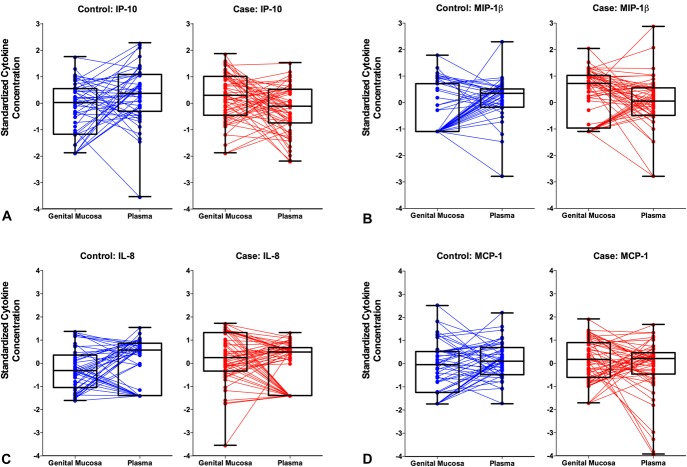
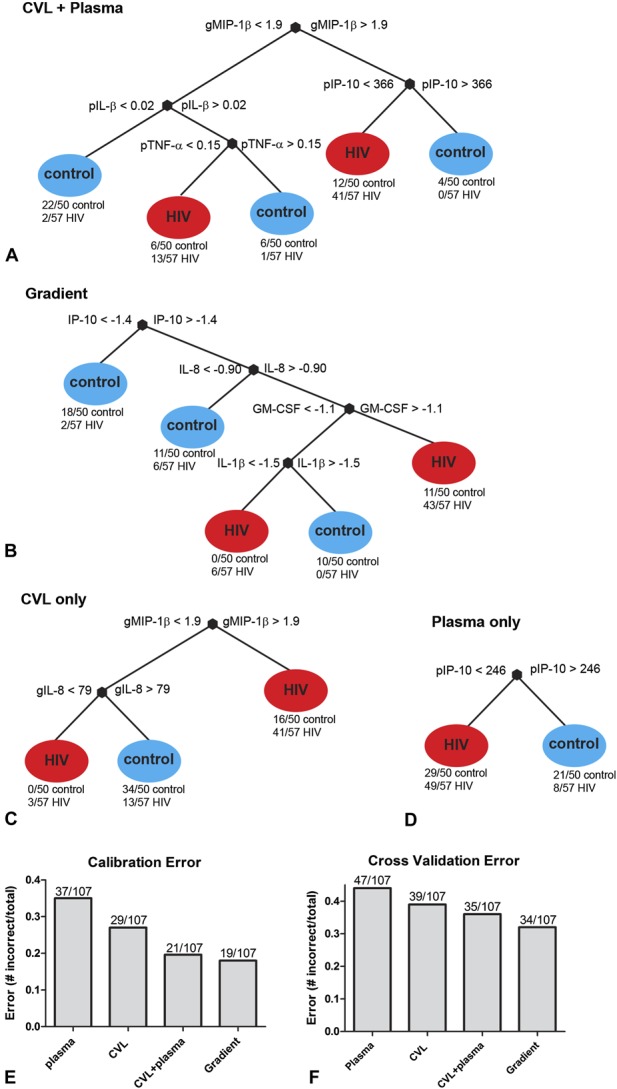
Results: Although genital IP-10 concentrations were significantly higher in cases, plasma IP-10 concentrations were inversely associated with HIV risk. Comparing differences in mucosal and systemic cytokine concentrations between cases and controls, mucosa-biased gradients indicating higher cervicovaginal lavage relative to plasma concentrations were observed for all 5 chemokines in the panel. Four were significantly associated with HIV acquisition, including IP-10 (odds ratio [OR] 1.73, 95% confidence interval [CI]: 1.27 to 2.36), macrophage inflammatory protein-1β (OR 1.72, 95% CI: 1.23 to 2.40), interleukin (IL)-8 (OR 1.50, 95% CI: 1.09 to 2.05), and monocyte chemotactic protein-1 (OR 1.36, 95% CI: 1.01 to 1.83). None of the other 7 cytokines tested predicted HIV risk. Decision tree analyses confirmed this association, with gradients of IP-10, IL-8, and granulocyte-macrophage colony-stimulating factor concentrations correctly classifying 77% of HIV outcomes.
Conclusions: Our findings suggest that mucosa-biased gradients of IP-10, macrophage inflammatory protein-1β, IL-8, and monocyte chemotactic protein-1 are associated with an increased risk of HIV infection.
Conflict of interest statement
The authors have no conflicts of interest to disclose.
Figures
References
-
- Auvert B, Ballard R, Campbell C, et al. HIV infection among youth in a South African mining town is associated with herpes simplex virus-2 seropositivity and sexual behaviour. AIDS. 2001;15:885–898. - PubMed
-
- Pettifor AE, Hudgens MG, Levandowski BA, et al. Highly efficient HIV transmission to young women in South Africa. AIDS. 2007;21:861–865. - PubMed
MeSH terms
Substances
LinkOut - more resources
Full Text Sources
Other Literature Sources
Medical
Research Materials
