


Review
doi: 10.1016/j.cell.2016.11.037.
Emerging Biological Principles of Metastasis
Affiliations
- PMID: 28187288
- PMCID: PMC5308465
- DOI: 10.1016/j.cell.2016.11.037
Item in Clipboard
Review
Emerging Biological Principles of Metastasis
Cell.
.
Abstract
Metastases account for the great majority of cancer-associated deaths, yet this complex process remains the least understood aspect of cancer biology. As the body of research concerning metastasis continues to grow at a rapid rate, the biological programs that underlie the dissemination and metastatic outgrowth of cancer cells are beginning to come into view. In this review we summarize the cellular and molecular mechanisms involved in metastasis, with a focus on carcinomas where the most is known, and we highlight the general principles of metastasis that have begun to emerge.
Copyright © 2017 Elsevier Inc. All rights reserved.
Figures
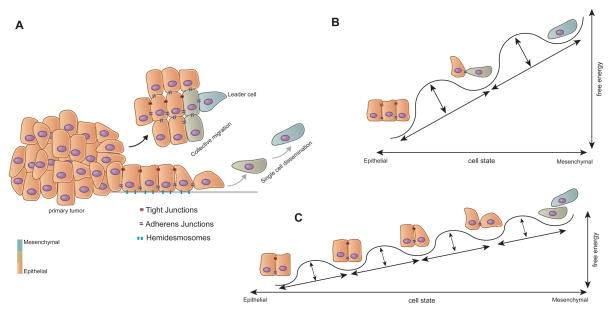
(A) Carcinoma cell dissemination occurs via two mechanisms - single cell dissemination through an EMT (grey arrow) or the collective dissemination of tumor clusters (black arrow). Recent evidence suggests that the leader cells of tumor clusters also undergo certain phenotypic changes associated with the EMT. (B) The epithelial state can be portrayed as the default state of residence; as cells undergo an EMT they enter into a succession of multiple epigenetic states, depicted here as free energy wells, with each state moving toward a more mesenchymal state representing a higher energy state. (C) However, the barriers between states, depicted here again as free energy wells, may be relatively low, resulting in substantial spontaneous interconversion between them, this being manifested as phenotypic plasticity.
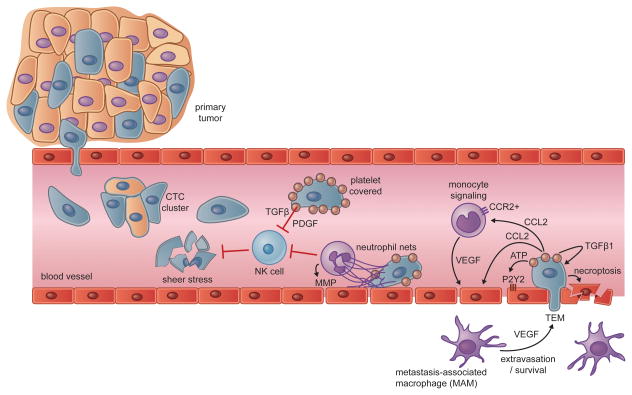
Carcinoma cells escaping from primary tumors can intravasate into the circulation, either as single circulating tumor cells (CTCs) or as multicellular CTC clusters. The bloodstream represents a hostile environment for CTCs, exposing them to rapid clearance by natural killer (NK) cells or fragmentation due to the physical stresses encountered in transit through the circulation. Carcinoma cells gain physical and immune protection through the actions of platelets, which coat CTCs shortly after their intravasation. Neutrophils can provide protection from NK cell attacks as well, while also contributing to the physical entrapment and extravasation of CTCs. Once lodged in a capillary, activated platelets and carcinoma cells secrete a number of bioactive factors that can act on monocytes, endothelial cells, and the carcinoma cells themselves. The collective effects of these interactions promote the transendothelial migration (TEM) of carcinoma cells, which can be aided by metastasis-associated macrophages (MAMs) in the target parenchyma. In lieu of TEM, arrested carcinoma cells may also proliferate intraluminally (not shown) or induce necroptosis in endothelial cells.
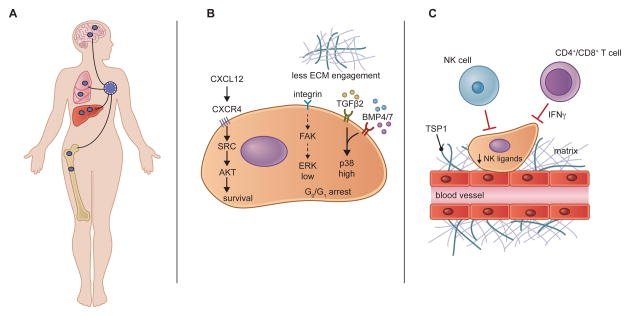
(A) Carcinoma cells that have disseminated prior to the surgical removal of the primary tumor may persist in distant tissue environments as dormant disseminated tumor cells (DTCs). Patients harboring such reservoirs of occult carcinoma cells are considered to have minimal residual disease and are at increased risk of eventual metastatic recurrence. Although DTCs are most frequently examined in the bone, the delayed outgrowth of metastases in other organs suggests that they, too, can harbor dormant DTCs. (B) Dormant DTCs rely on unique biochemical signaling pathways that sustain their survival and impose programs of quiescence. Signals from the microenvironment, such as CXCL12, can activate SRC and AKT to promote DTC survival. Reduced integrin-mediated mitogenic signaling, coupled with the actions of certain dormancy-inducing cytokines, enacts a quiescent program in DTCs that is associated with an ERKlow/p38high signaling state. (C) DTCs may reside in dormant niches such as the hematopoietic stem cell niche (not shown) or the perivascular niche illustrated here. Thrombospondin-1 (TSP1), present in the basement membrane surrounding mature blood vessels promotes dormancy. Dormant cells can evade detection by NK cells through the repression of NK-activating ligands and are likely subject to surveillance by the adaptive immune system, which may keep cancer cells in a dormant state through the actions of IFN γ.
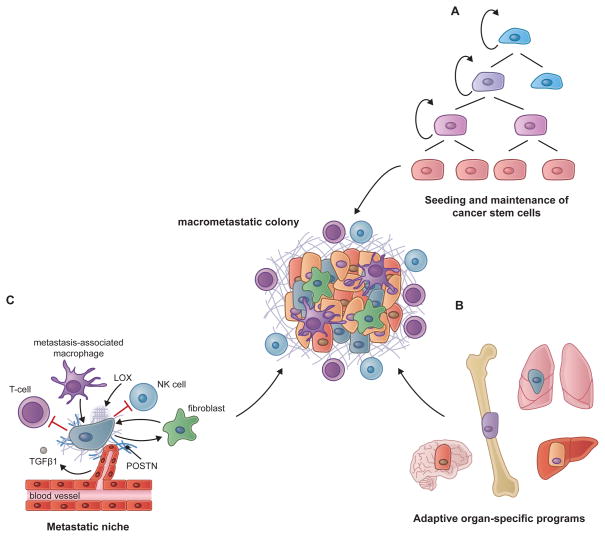
The ability of carcinoma cells to outgrow as lethal metastases appears to be dependent on three essential conditions. (A) The capacity to seed and maintain a population of cancer stem cells, which are competent to re-initiate tumor growth, appears to be an initial prerequisite for metastatic growth. Dormant DTCs also exhibit key cancer stem cell attributes that likely contribute to their prolonged persistence in a quiescent state and their ability to eventually spawn a metastatic colony. (B) Although cancer stem cells are endowed with the potential to re-initiate tumor growth, the proliferative expansion to an overt metastatic colony is dependent on the ability to contrive organ-specific colonization programs that allow these cells to thrive in a foreign tissue microenvironment. An array of organ-specific metastatic programs has been described in the literature but there is also evidence for the existence of colonization programs that confer multi-organ metastatic potential. (C) During many stages of metastatic growth, cancer cells depend on interactions with their microenvironmental niche and cross talk with various stromal cells, including endothelial cells, fibroblasts and cells of the innate and adaptive immune system. The ECM is also an important component of the niche and can be modified in ways that support metastatic colonization. In some cases the formation of a metastatic niche may actually precede the arrival of cancer cells, in what is referred to as a pre-metastatic niche. Selected niche interactions discussed in the text are depicted here.
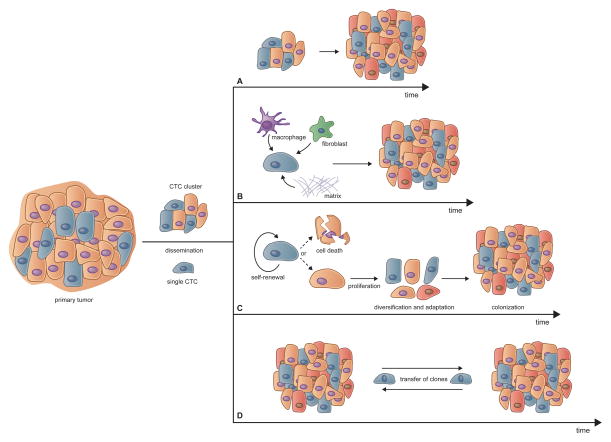
The progression and evolution of metastatic disease is highly variable, manifesting in ways that must affect the kinetics of metastatic colonization. Four hypothetical alternative outcomes are presented here: (A) The dissemination of CTC clusters to distant sites may generate overt metastases with a relatively short latency, since such clusters are highly efficient at spawning metastatic growths. Their efficiency in forming metastases may derive from advantages during transit in the circulation or because they benefit from homotypic cell-cell interactions in a foreign tissue environment. (B) Solitary disseminated carcinoma cells that are adept at recruiting and establishing a supportive metastatic niche, or that are able to generate a microenvironmental niche themselves, may be able to better survive and initiate programs of proliferation. (C) While the dissemination of tumor-initiating cancer stem cells may be a prerequisite for metastasis, the generation and evolution of progeny that are well adapted to the local microenvironment could take many months or years. (D) At later stages of metastatic progression, other dynamics come into play, such as the exchange of metastatic cells clones between different metastatic lesions in the same patient. The biological and clinical impact of such transfer, however, remains to be firmly established.
References
-
- Aceto N, Bardia A, Miyamoto DT, Donaldson MC, Wittner BS, Spencer JA, Yu M, Pely A, Engstrom A, Zhu H, Brannigan BW, Kapur R, Stott SL, Shioda T, Ramaswamy S, Ting DT, Lin CP, Toner M, Haber DA, Maheswaran S. Circulating tumor cell clusters are oligoclonal precursors of breast cancer metastasis. Cell. 2014;158:1110–1122. - PMC - PubMed
-
- Aceto N, Toner M, Maheswaran S, Haber DA. En Route to Metastasis: Circulating Tumor Cell Clusters and Epithelial-to-Mesenchymal Transition. Trends in cancer. 2015;1:44–52. - PubMed
Publication types
MeSH terms
Grants and funding
LinkOut - more resources
Full Text Sources
Other Literature Sources
Medical
